
c. 1065 – 1150·Feast 27 August
St. Guarinus of Sitten
Monk of Molesme and bishop of the Alps
Overview
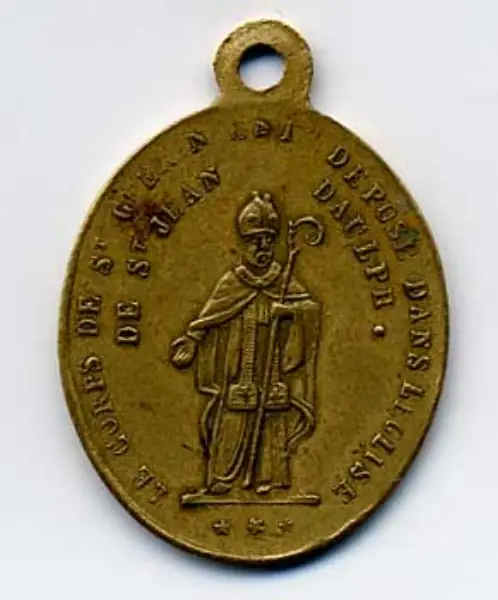
Guarinus of Sitten — Warin in German, Guérin in French — was a Lotharingian noble who became a Benedictine monk, a founding father of an abbey, and finally a bishop. Born at Pont-à-Mousson around 1065, he entered the monastery of Molesme about 1085, in the generation when that house was becoming a fountainhead of monastic renewal. In 1094 he went out with a group of brothers from Molesme to found Aulps Abbey in Savoy, a daughter house whose very name, from the Latin alpibus, 'mountain pastures', announces its setting; Guarinus served as its second abbot. In 1138, in his seventies, he was appointed bishop of Sion in the Valais, and held the office until his death at Aulps on 27 August 1150. Venerated soon after his death, he is invoked especially for cattle and for protection against the diseases of animals — a patronage that reflects the mountain world in which he prayed, founded, and governed. Pilgrims to his shrine received medallions bearing his image, and his feast is kept on 27 August, the day he died in the abbey he had founded more than half a century before.
The Complete Life
A Noble of Lotharingia
Guarinus was born at Pont-à-Mousson around 1065, in Lotharingia — the middle kingdom of the old Carolingian world, whose name survives in the French Lorraine. He came of noble stock, and his name traveled with him across languages: Warin to the Germans, Guérin to the French, Guarinus to the Latin of the Church. He grew up in the generation when the great monastic revival was remaking the religious landscape of the region, when reformed houses were persuading the sons of the aristocracy that their swords and their lands alike could be given over to God. That a young noble of Pont-à-Mousson should have heard of Molesme Abbey, far to the west in Burgundy, and wanted a place in it, shows how far the reforming spirit reached across the lands of the old empire. Around 1085, in his twentieth year, he left his family and his prospects behind and became a monk of the Benedictine monastery of Molesme — the decision that turned a frontier nobleman into the future founder of an abbey in the Alps and, at the very end of his life, a bishop of the high mountain country.
§ Introduction
The School of Molesme
Molesme in the 1080s stood at the head of an expanding monastic family, and its practice was growth by daughter foundations: small bands of monks, sent out under strong leaders, to plant new houses on land given by pious lords. Guarinus was formed in this colonizing, missionary style of Benedictine life, and he proved to be one of its men. In 1094, roughly a decade after his profession, he left Molesme together with a group of brothers to establish Aulps Abbey in Savoy, a daughter house planted in the mountains south of Lake Geneva. The monastery's very name proclaimed its home: it derives from the Latin word alpibus, meaning 'mountain pastures'. For a monk reared in the gentle country of the Moselle valley, the high Alpine valleys demanded a harder and more self-sufficient kind of monasticism — land to clear, herds to tend, a cloister to build from what the mountains supplied. Guarinus gave the young house leadership as well as labor: in time he became its second abbot, governing the community he had helped to plant and fixing its character for the generations that followed him.
§ Introduction
Abbot of Aulps, Bishop of Sion
Guarinus led Aulps as its second abbot until middle age had passed into old age. In 1138, when he was about seventy-three, his career changed register: he was appointed bishop of Sion, in the Valais — an Alpine diocese whose bishop ranked among the most consequential churchmen of the region. He had been a monk for more than half a century, a founder and an abbot; now, at an age when most men had long laid down their work, he took up the government of a see. Nothing is recorded of his conduct as bishop beyond the reverence it earned him, but the sources are clear that he held the office until the end of his life, and that his episcopate never uprooted him from his monastery: he died at Aulps Abbey itself, the house of his profession and his founding, on 27 August 1150. The monk of Molesme, the abbot of the mountain pastures, and the bishop of Sion thus closed his life where the three identities met, in the abbey he had helped to raise from nothing more than sixty years earlier.
§ Introduction
Patron of the Herds
Guarinus came to be revered as a saint not long after his death, and his cult settled in the Alpine country where he had lived and worked. His patronage is distinctive: he is a patron saint of cattle, invoked for protection against the diseases of animals — the natural patron for the mountains of Savoy and the Valais, where a family's herd could be its whole livelihood, and where a bishop who had been an abbot of mountain pastures was the natural intercessor for the beasts that grazed them. Pilgrims to his shrine received medallions bearing his image, small tokens of a devotion that traveled the passes with herdsmen and traders. His feast is kept on 27 August, the anniversary of his death at Aulps, and the Roman Catholic Church venerates him without the formalities of a modern canonization: his sanctity rests on the verdict of the communities that kept his memory — the monks of Aulps, the faithful of Sion, and the herdsmen of the Alps, who needed a saint of their own kind and found one in the noble of Pont-à-Mousson who had spent a lifetime among them.
§ Introduction
Timeline
- 1065
Born at Pont-à-Mousson in Lotharingia, into a noble family
§ Introduction
- 1085
Entered Molesme Abbey as a monk of its Benedictine community
§ Introduction
- 1094
Left Molesme with a band of brothers to found Aulps Abbey in Savoy, later becoming its second abbot
§ Introduction
- 1138
Appointed bishop of Sion
§ Introduction
- 27 Aug 1150
Died at Aulps Abbey
§ Introduction
The Record
- Major works
- Aulps Abbey in Savoy (co-founder)
- Patron of
- cattle·protection from animal diseases
- Canonization
- Pre-congregation; revered as a saint after his death by the Church of the Alpine region
Prayer
Bibliography
Show 1 sources
- Sauser, Ekkart (2000). "Guarin (Warin): hl. Bischof von Sitten". In Bautz, Traugott (ed.). Biographisch-Bibliographisches Kirchenlexikon (BBKL). Vol. 17. Herzberg: Bautz. col. 546. ISBN 3-88309-080-8.
Profile text adapted from the Wikipedia article, licensed CC BY-SA 4.0.
Pray with this saint every day
Save St. Guarinus of Sitten to your favorites, read the full profile, and get feast-day reminders in the Saints app.
Get the Saints AppFree on the App Store for iPhone and iPad