
c. 646 – 712·Feast 8 January
St. Gudula of Brabant
Lantern-bearing virgin and patroness of Brussels
Overview
Gudula of Brabant, called Goedele in Dutch and Gudule in French, is one of the beloved saints of the Low Countries, honored by Catholics and Orthodox alike. Born near the year 646 somewhere in the Brabant pagus — territory of today's Belgium — she belonged to a family that reads almost like a calendar of saints: her father was the Lotharingian duke Witger, her mother was Saint Amalberga, and her sisters and brother — Pharaildis, Reineldis, Ermelinde, and Emebertus — were all venerated as saints. Educated at Nivelles Abbey under her godmother Gertrude of Nivelles, she returned after Gertrude's death to her home at Moorsel and spent her life there in prayer, generous almsgiving, and famously early visits to the village church two miles from her parents' house. She died between 680 and 714, most often said to be in 712, and was buried at Hamme. Her relics moved over the centuries to the chapel of Saint Gaugericus in Brussels and then to the church of Saint Michael, which grew into the Cathedral of St. Michael and St. Gudula. With Saint Michael she is patroness of Brussels; her emblem is a lantern that the devil tries in vain to blow out.
The Complete Life
A Family of Saints
Gudula was born around 646 somewhere in the pagus of Brabant, the early medieval territory that lies within modern Belgium. She came into a family whose holiness was almost dynastic. Her father, Witger, was a duke of Lotharingia; her mother, Amalberga, is herself honored as a saint and embraced the religious life at Maubeuge Abbey. The children followed their mother's pattern: Gudula's sisters Pharaildis, Reineldis, and Ermelinde were all venerated as saints, as was her brother Emebertus. What survives of Gudula's childhood comes from an eleventh-century life, the Vita Gudilae, put together by a monk of Hautmont, Onulfus of Hautmont, in the years 1048 to 1051 — roughly four centuries after her death, but drawing on a tradition the region never let go cold. From the same source comes the one ceremony the record preserves: Gudula received the veil from the hands of Saint Aubert, bishop of Cambrai, who died around 668. In an age when noble daughters were frequently pledged to Christ by their families, the gesture set the course of a life that would be lived not in a monastery but at home, in the midst of her own country.
§ Life
Formed at Nivelles, Sent Home
Her formation was entrusted to Nivelles Abbey and to her godmother, Gertrude of Nivelles, one of the great figures of the Merovingian church. From Gertrude the girl learned the discipline of prayer and the rhythm of the liturgical day. When Gertrude died, Gudula left the abbey and returned to her family house at Moorsel, choosing a life that carried no office and bore no title. There she settled into what her biographer presents as a career of quiet good works: profuse in alms for the poor, constant in devotion, and faithful to one particular habit that became her signature — the walk to the church of Moorsel, which stood roughly two miles from her parents' house, and which she visited again and again, at hours when the road was still dark. Nothing dramatic marked these years, and the sources admit as much: nothing particular is recorded of her beyond the singular holiness of her life. Sanctity, in her case, meant distance covered on foot before dawn, and bread given away; the tradition judged that enough, and four centuries later it was still being written down with reverence.
§ Life
The Holiness of the Ordinary
The sanctity the tradition assigns to Gudula is of the domestic kind, and the more persuasive for it. She was no founder, no writer, no martyr; her recorded acts are gifts and journeys — alms for the poor given lavishly, and the repeated walk from her home at Moorsel to the village church, undertaken with such constancy that it passed into legend and gave her the lantern by which art has known her ever since. The one biographer her cult produced, writing four centuries after her death, could find no miracles and no adventures to relate — only a duke's daughter who gave her goods away, prayed in the dark hours before the village was awake, and was never forgotten by her neighbors for it. That honesty is itself a kind of witness. The compilers of her story did not need to invent marvels; they understood that her sanctity lay in fidelity repeated at an hour when fidelity costs something, in wealth surrendered without drama, and in a life of prayer so steady that the whole of Brabant came to call it holy long before anyone thought to write the word down.
§ Life
Death at Hamme
Gudula died between 680 and 714; the date most often given, and the one her biographers favor, is 712. She was buried at Hamme, in East Flanders, but her body did not remain there. It was removed first to the church of St. Salvator near Moorsel and interred behind the altar, close to the ground she had never left in life. From there, during the reign of Charles, Duke of Lower Lorraine, which ran from 977 to 992, her relics were translated to the chapel of Saint Gaugericus in Brussels — the beginning of the saint's long association with the town that would make her its patroness. The movements of her bones sketch the history of her fame: a village grave, a parish altar, a ducal capital. She had lived quietly in one place, and death turned her into a traveler whose remains were carried with honor from shrine to shrine, each translation announcing to a new generation and a new city that the woman who had walked two miles in the dark to pray was worth the journey, and worth keeping close.
§ Life
A Saint Before the Process
Gudula belongs to the age before formal canonization: no pope ever processed her cause, and her cult rests on the ancient and uninterrupted veneration of the churches of Brabant, a devotion that Catholic and Eastern Orthodox tradition share to this day. Her feast is generally kept on 8 January, the day of her death according to her hagiography, though the diocese of Ghent — within whose bounds Moorsel lies — celebrates it on 19 January; the Orthodox calendar likewise keeps her memory in January. Such plural dates are typical of a saint whose cult grew up locally, long before any central registry of the blessed existed. Royal recognition came early: Charlemagne himself sent gifts to the convent at Moorsel in her memory, a mark of how far her reputation had traveled within a few generations of her death. No process proved her sanctity, because none was needed. Her case was made by the plain evidence of a life given to prayer and almsgiving, and by the devotion of a region that kept her name alive from the seventh century down to the present without ever letting it fade.
§ Veneration
The Lantern of Brussels
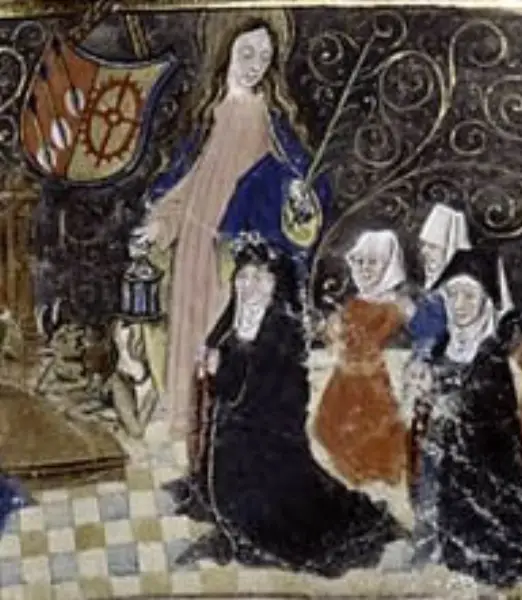
With Saint Michael, Gudula is patron saint of Brussels, and her name is fastened to the city's greatest church. In 1047 Lambert II, Count of Leuven, founded a chapter in her honour, and the relics were carried by Bishop Gerardus I of Cambrai to Saint Michael's church in Brussels — the building that grew into the Cathedral of St. Michael and St. Gudula, where her statue stands today. That church was wrecked on 6 June 1579, when Protestant Geuzen pillaged the collegiate building and scattered her disinterred relics; her skull had earlier been preserved and is now conserved in the Catholic Church of St. Hildegard at Eibingen, Germany. Her emblem in art — a woman holding a lantern or taper that a demon tries in vain to blow out — appears on a seal of the church of St. Gudula of 1446, candle in the right hand and lamp in the left, and it recalls the legend of her pre-dawn walk to church: the demon put out her candle to lead her astray, and God relit it at her prayer. The image probably arose from confusion with the tradition of Saint Genevieve of Paris, but it clung permanently to Gudula. Even the fields kept her name: a January-fruiting fungus, tremella deliquescens, is known in the region as Sinte Goedele's lampken — St. Gudula's lantern.
§ Veneration
Timeline
- 646
Born somewhere in the Brabant pagus, within modern Belgium
§ Life
- 712
Died — the date most often given, though sources range from 680 to 714 — and buried at Hamme in East Flanders
§ Life
- 977
Her relics were moved to Brussels' chapel of Saint Gaugericus, in the days of Duke Charles of Lower Lorraine, whose rule ran from 977 to 992
§ Life
- 1047
Lambert II, Count of Leuven, founded a chapter in her honour; her relics were carried to Saint Michael's church in Brussels under Bishop Gerardus I of Cambrai
§ Life
- 1446
Shown on a seal of the church of St. Gudula, holding a candle in her right hand and a lamp in her left
§ Iconography
- 6 Jun 1579
The collegiate church in Brussels was pillaged and wrecked by Protestant Geuzen, and her relics were disinterred and scattered
§ Life
The Record
- Patron of
- Brussels·single women·laywomen
- Symbols
- a lantern which the devil tries to blow out
- Canonization
- Pre-congregation; venerated from antiquity in the Catholic and Eastern Orthodox churches
Prayer
Bibliography
Show 7 sources
- Van der Essen, Léon. "St. Gudula." The Catholic Encyclopedia, Vol. 7. New York: Robert Appleton Company, 1910.
- Butler, Alban. "St. Gudula, Virgin, Patroness of Brussels", The Lives of the Saints, Volume I: January, 1866.
- Jameson, Anna. Sacred and Legendary Art, Volume 2, Longmans, Green, 1891, p. 779.
- Lanzi, Fernando and Gioia. "Gudula of Brussels, Virgin", Saints and Their Symbols, Liturgical Press, 2004, ISBN 9780814629703, p. 127.
- Van Droogenbroeck, F. J., "Onulfus van Hautmont (ca. 1048), auteur van de Vita S. Gudilae anonymo", Eigen Schoon en De Brabander 95 (2012) 595–643.
- Bollandus J., Henschenius G., De S. Gudila Virgine Bruxellis in Belgio, Acta Sanctorum Januarii I (1643) 524–530.
- Bonenfant, P., "La charte de foundation du chapitre de Sainte-Gudule à Bruxelles", Bulletin de la Commission Royale d'Histoire 115 (1950) 17–58.
Profile text adapted from the Wikipedia article, licensed CC BY-SA 4.0.
Pray with this saint every day
Save St. Gudula of Brabant to your favorites, read the full profile, and get feast-day reminders in the Saints app.
Get the Saints AppFree on the App Store for iPhone and iPad