
c. 1004 – 1070·Feast 2 June
St. Guido of Acqui
Reforming bishop and builder of Acqui Cathedral
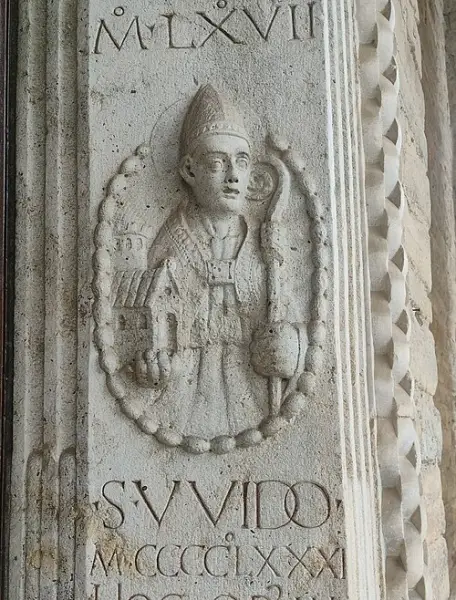
Overview
Guido of Acqui, also called Wido, governed the northern Italian see of Acqui from 1034 until his death in 1070, and is remembered above all as the builder of its cathedral. Born around 1004 into the noble family of the Counts of Acquesana at Melazzo, where the family's wealth was concentrated, he lost his parents young and completed his education in Bologna. Elected bishop in March 1034, he gave his episcopate to reform — of the liturgy, of spirituality, and of morality among clergy and people — and backed it with his own resources, giving his money and possessions to the diocese both to relieve the economic pressures that had bred widespread corruption and to fund new works outright. Those works included his push to educate young women and his founding of the nunnery of Santa Maria De Campis. Crowning everything stood Acqui Cathedral, raised in honour of the Madonna Assunta and given its solemn consecration on 13 November 1067, just three years before his death. Guido's own death came on 2 June 1070, and his remains rest today in the cathedral he raised, and his feast of 2 June stands in the Martyrologium Romanum, though Acqui itself celebrates him on the second Sunday of July.
The Complete Life
An Orphan of the Counts
Guido — Wido, in the Latin forms of his name — was born around 1004 into the counts of Acquesana, the noble family whose power and property were concentrated at Melazzo, in the hill country of north-west Italy near Acqui. His early life was marked by loss: by the time his schooling was finished, both his parents were dead, and the orphan completed his education in Bologna, one of the rising intellectual centers of eleventh-century Italy. The combination would define his episcopate: a bishop with a noble's instinct for the landed wealth of his own diocese, a scholar's formation gathered from outside it, and no surviving family claims left to serve. He might have expected an ecclesiastical career among kin who could advance him, a comfortable place in the church of his own region. Instead, when the see of Acqui fell vacant, it was Guido himself who was chosen: in March 1034 he was elected bishop of the city at whose heart his family's fortune lay, a man of about thirty asked to govern the church that had formed him.
§ Introduction
Elected to a Troubled See
Election to the bishopric of Acqui in March 1034 made Guido shepherd of the diocese for the remaining thirty-six years of his life. The church he inherited showed the deformations common to an old landed diocese in that age: economic pressure on the clergy had bred widespread corruption, and the spiritual tone of the diocese had suffered with it. Guido's answer was characteristic of the reforming movement then working through the eleventh-century church, and unusual in its financing. He surrendered his own money and possessions for the diocese's use, partly to lift the pressures that made corruption profitable and partly to support new projects outright. A bishop who disendowed himself could demand sacrifice of his clergy with a clear voice and a clean hand. His program reached everything the reformers of the century cared about — the liturgy, the life of prayer, and the morals of both clergy and people — but it was matched always by building and by teaching: works of stone and schools of souls, carried out with the resources of a family that had kept its wealth in the diocese's own hills and was now giving it back.
§ Introduction
Cathedral, Nunnery, and Schools
The works of Guido's episcopate still mark Acqui. Its cathedral — the church at the center of the city's life — was erected under his government and dedicated to the Madonna Assunta, and on 13 November 1067 it was solemnly consecrated, three years before his death. The building embodied the whole of his reforming program: a diocese gathered around a worthy church, its worship restored to splendor, its bishop's wealth poured into the common sanctuary rather than kept for his kin. Guido's care extended to those whom the structures of the age served worst. He promoted the education of young women, an unusual object of episcopal spending in the eleventh century, and founded the nunnery of Santa Maria De Campis to house and sustain the religious life of women within his diocese. Taken together, the cathedral, the nunnery, and the schools describe a bishop who understood reform not as prohibition but as provision: the cure for corruption was not only discipline but endowment, buildings, and learning, given by a pastor who held back nothing of his own. Thirty-six years of such government gave the see of Acqui its enduring shape.
§ Introduction
The Grave Beneath His Own Church
Guido died on 2 June 1070, after thirty-six years as bishop of Acqui, and his remains were laid to rest in the cathedral he had founded — the church he had raised and consecrated standing over the grave of its builder. The Martyrologium Romanum records his feast on 2 June, the day he died and the date the universal calendar keeps; the city of Acqui, however, celebrates him on the second Sunday of July, when the summer light falls on the church he gave it. The arrangement is a small lesson in how local cults live: the formal entry of the calendar and the town's own festival, both centered on the same stone church. He was never canonized by formal process; the diocese that elected him in 1034 simply never stopped honoring him, and the Martyrologium's entry records a verdict the local church had reached long before the machinery of papal canonization existed. The cathedral's campanile and loggia were added in later centuries, but its heart remains Guido's: the eleventh-century church of a reforming bishop who spent his inheritance, and himself, upon it.
§ Introduction
Timeline
- 1004
Born at Melazzo into the noble family of the Counts of Acquesana
§ Introduction
- Mar 1034
Elected bishop of Acqui, at around thirty years of age
§ Introduction
- 13 Nov 1067
Acqui Cathedral, dedicated to the Madonna Assunta, was consecrated
§ Introduction
- 2 Jun 1070
Died after thirty-six years as bishop; buried in the cathedral he founded
§ Introduction
The Record
- Major works
- Acqui Cathedral, dedicated to the Madonna Assunta·Nunnery of Santa Maria De Campis
- Canonization
- Pre-congregation; his feast of 2 June is recorded in the Martyrologium Romanum
Prayer
Bibliography
Show 1 sources
- Arduino, Fabio. "San Guido (Wido) d'Acqui", Sante e Beati.
Profile text adapted from the Wikipedia article, licensed CC BY-SA 4.0.
Pray with this saint every day
Save St. Guido of Acqui to your favorites, read the full profile, and get feast-day reminders in the Saints app.
Get the Saints AppFree on the App Store for iPhone and iPad