
c. 1589 – 1637·Feast 28 September
St. Guillaume Courtet
Dominican missionary and martyr of Nagasaki
Overview
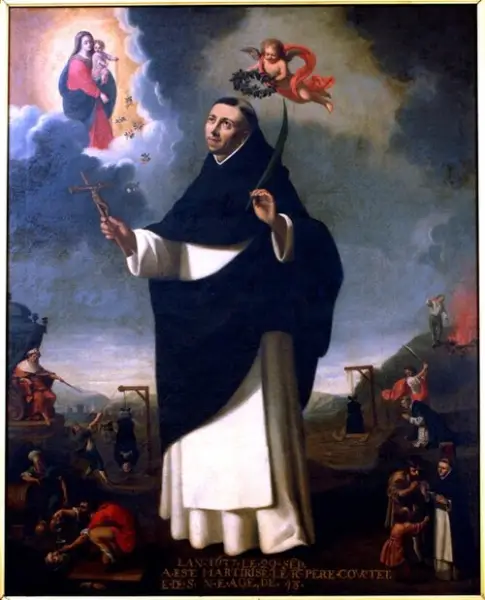
Guillaume Courtet was a French Dominican friar, priest, and missionary who became one of the first Frenchmen known to have set foot in Japan, and died there as a martyr. Born at Sérignan in Languedoc in 1589 or 1590, he entered the Order of Preachers at Albi in 1607, took his vows at seventeen, and rose quickly as a teacher of theology, earning his licentiate at Toulouse at twenty-two. He served as prior of the great Dominican house at Avignon, carried his order's reform across northern Europe as commissioner from 1626, and won the commendation of Cardinal Richelieu for diplomatic service during the Thirty Years' War. Transferring to the Spanish province to reach the missions, he took the religious name Thomas de Santo Domingo, served the French ambassador and the Queen of Spain as confessor, and sailed for Manila at the end of 1634. After nearly two years of obstacles he landed secretly at Okinawa in July 1636, ministered for about a month, and was arrested. A year of imprisonment at Kagoshima ended on Nishizaka Hill at Nagasaki, where he endured three days of water torture, awls, and the hanging torture of tsurushi before being beheaded on Michaelmas Day, 29 September 1637. John Paul II beatified him in Manila in 1981 and canonized him in Rome in 1987 among the sixteen Martyrs of Japan.
The Complete Life
A Burgher's Son of Sérignan
Guillaume Courtet was born in 1589 or 1590 at Sérignan, a small town just inland from the Gulf of Lion coast in Languedoc, within the ecclesiastical jurisdiction of the Diocese of Béziers. The exact date is uncertain because the parish baptism register for those years does not survive, but local tradition names a spot on the Rue des Salanquiers as the house of his birth. Jehan Courtet and Barbe Malaure, a prosperous and prominent burgher couple, had at least four children, and Guillaume was among them — his father's name appears in civic documents holding the office of 'second consul' in local government. He grew up amid the turmoil of the last years of the French Wars of Religion, eight years before the Edict of Nantes, and his childhood was broken by loss: his mother died when he was twelve. His gifts, however, were unmistakable. At thirteen he was recorded as godparent to a child of seigneurial rank, a mark of unusual responsibility. His first schooling came from the college of canons at the church of Our Lady of Grace in Sérignan; around the time of his mother's death he moved to the Jesuit school at Béziers — the present Lycée Henri-IV — where he received a first-rate humanist education.
§ Early life
From Toulouse to the Order of Preachers
At fifteen he left Béziers for the University of Toulouse, where he read scripture, scholastic philosophy, and theology as preparation for life in the Church. It was there, while still at university, that he chose to seek admittance to the Order of Preachers — the order Saint Dominic had founded in Languedoc some four centuries earlier — and in 1607 the priory at Albi entered his name among its new novices. His simple vows followed at seventeen, taken on the Assumption feast, 15 August. His formation continued at the studium of the Toulouse Dominican priory, the chief shrine of Saint Thomas Aquinas, whose writings gave his priestly formation its bedrock; he drew inspiration too from the austere monastic ideals of Sébastien Michaëlis, once prior of Toulouse and the great reformer of the French Dominicans in the wake of the Council of Trent. After ordination he received the Licentiate of Sacred Theology at Toulouse at the remarkably early age of twenty-two, beginning the teaching and lecturing career that would accompany him everywhere he went, all his life. Through it all, the boyhood dream of the Far East never left him.
§ Dominican career
The Long Road to Japan
Courtet's path to the missions ran through a decade of responsibility. In 1624 he was elected prior of the famous Dominican house at Avignon, the popes' first residence in the city, and during his two years there ten postulants entered the order. In 1626 he was named commissioner of the Order of Preachers in Northern Europe, with the demanding task of carrying Michaëlis's reform — poverty in cell and priory, fasting and abstinence, the Liturgy of the Hours rigorously kept, silent meditation — into priories far from home. During those same years he was drawn into the diplomacy of the Thirty Years' War and earned the commendation of Cardinal Richelieu. Yet his mind was on Japan: inspired by the Great Genna Martyrdom and by the deaths of his fellow friars Alfonso Navarrete, Thomas of Zumárraga, and Pedro Vásquez, he wrote in 1628 asking to be sent where the Church was persecuted. Only the Spanish and Portuguese empires could arrange passage to the Far East, so he transferred to the Spanish province, arrived at the priory of Our Lady of Atocha in Madrid in 1628, took the religious name Thomas de Santo Domingo in honor of Aquinas and Dominic, and served five years there as confessor to the French ambassador and spiritual director to Queen Isabelle Bourbon. At the end of 1634 he was authorized to sail for the Philippines, landing at Manila on 24 June 1635, where he lectured at the University of Santo Tomas while battling the Governor-General's ban on missionary passage to Japan — his first covertly built boat destroyed by the authorities — until he procured a junk in the early summer of 1636.
§ Dominican career
The Mind of a Martyr
Courtet's interior life was formed by two great inheritances of the French Dominicans. The first was intellectual: the doctrine of Saint Thomas Aquinas, whose shrine at the Toulouse priory stood at the center of his studies and whose thought he carried as professor through Avignon, Madrid, and Manila. The second was ascetical: the reform of Sébastien Michaëlis, with its poverty of the cell, its fasting and abstinence, its rigorous choral liturgy and silent meditation, which Courtet himself later enforced as commissioner in the priories of northern Europe. Over both lay the pull of martyrdom. The stories of Paul Miki's companions, martyred in 1597, had reached him through his Jesuit schoolmasters; the examples of Navarrete, Zumárraga, and Vásquez, friars killed in the mission field of his own order, confirmed the desire in manhood. His letter of 1628 speaks plainly: he wanted to serve where the Church bled, looking forward to the torments he wished to undergo for Christ, a desire, he said, that had never left him. It is the spirituality of a man who studied Thomas Aquinas on courage and prudence and then asked to sit the examination in person, at the far edge of the known world.
§ Dominican career
Okinawa, Kagoshima, Nishizaka
On 10 June 1636 Courtet sailed in company with fellow priests Miguel de Ozaraza, Antonio González, and Vincent Shiwozuka, a Japanese Dominican, along with two laymen, Lorenzo Ruiz and Lazarus of Kyoto, disembarking at Okinawa a month later. Very little is known of his brief mission: probably answering calls for priests from the 200,000-strong hidden Christian community, he worked in deep secrecy for just over a month, presumably celebrating the Eucharist and hearing confessions, before an informant betrayed him. He was arrested near where he had landed and brought to Kagoshima, imprisoned for a year, then taken to Nagasaki for harsher measures. On 27 September 1637 he and his companions were brought to Nishizaka Hill — the very place where the twenty-six martyrs whose stories had fired his boyhood had died — for trial by torture intended to break them into apostasy: the water torture, needles driven under the fingernails, and the slow hanging of tsurushi. He stayed true through all three days. On the evening of Michaelmas Day, 29 September 1637, he was pulled from the tsurushi pit and beheaded with the others who had not already bled to death. His last words, spoken through translators, declared that the missionaries had come not to die but to preach the Gospel. Their bodies were burned at once and the ashes scattered at sea, to deny the faithful any relics.
§ Martyrdom
From Manila's Park to St Peter's
The cause of beatification was prepared by the respected historian Father Fidel Villarroel, archivist of the University of Santo Tomas, who authored the Positio Super Introductione Causae. On 18 February 1981, during Pope John Paul II's visit to the Philippines, Courtet was beatified at Rizal Park in Manila — the first beatification ceremony in history to be held outside the Vatican. Six years later, on 18 October 1987, the same pope canonized him in St Peter's Square, together with fifteen other martyrs of Japan. His liturgical commemoration is fixed on 28 September in the Roman Martyrology, among the sixteen Martyrs of Japan, while the Dominican order remembers him on 6 November as one of the Thomasian Martyrs — the band of martyrs given by the University of Santo Tomas and its missionaries. Nearly three and a half centuries separate his beheading at Nagasaki from his enrollment in the canon of saints, but the delay changed nothing essential: the Church ratified what the crowds at Manila and Rome celebrated, that the burgher's son from Sérignan had poured out his life for the Gospel at the far end of the earth and had been found worthy of the crown he had asked for since his youth.
§ Beatification and canonisation
Shrines Across Three Countries
Courtet's memory lives on three continents. His principal shrine is the Collegiate Church of Our Lady of Grace at Sérignan, the town church where he was most likely baptized and where the canons gave him his first schooling; it houses the Shrine of Saint Guillaume Courtet and All Japanese Martyrs, and a statue of the saint was raised in the town in 1894 near his traditional birthplace. In the Philippines he is commemorated at Binondo Church, the Shrine of the sixteen Martyrs, and at the Santísimo Rosario Church that honors the Thomasian Martyrs, the two Manila churches of his teaching years. In Japan his memory is centered at the place of his death: the Twenty-Six Martyrs Museum and Monument at Nagasaki stands on the site where he and his companions gave their lives. History remembers him, too, for what he barely had time to do: Philippe Pons, writing in Le Monde, called Guillaume Courtet the first Frenchman to set foot on Japanese soil. He arrived an outlaw, ministered for a month in hiding, and died on the hill of the martyrs — yet the connection between France and Japan that his journey began is one his feast still quietly marks each autumn.
§ Shrines
Timeline
- 1589
Born at Sérignan in Languedoc; the parish register of the year has been lost
§ Early life
- 1597
News of the martyrdom of Paul Miki and his companions, spreading through Jesuit schools, first stirred his longing for the missions
§ Early life
- 1607
Entered the Dominican novitiate, his name recorded in the register of the priory at Albi
§ Dominican career
- 1611
His father, Jehan Courtet, died
§ Dominican career
- 1624
Elected superior, or prior, of the Dominican priory at Avignon, where ten postulants joined during his two years in office
§ Dominican career
- 1626
Appointed commissioner of the Order of Preachers in Northern Europe, charged with spreading Michaëlis's reform of monastic life
§ Dominican career
- 1628
Transferred to the Spanish province at the priory of Our Lady of Atocha in Madrid; in a letter he asked to be sent where the Church endured persecution
§ Dominican career
- 1634
Given leave, together with some twenty religious, to sail for the Philippines through New Spain
§ Dominican career
- 24 Jun 1635
Arrived in Manila; he later lectured as a professor at the University of Santo Tomas
§ Dominican career
- 10 Jun 1636
Embarked secretly for Japan with three priests and two lay companions aboard a procured junk
§ Journey
- 10 Jul 1636
Disembarked at Okinawa after a month at sea
§ Journey
- 1637
Brought from a year of imprisonment at Kagoshima to Nagasaki for harsher treatment
§ Mission and imprisonment
- 27 Sep 1637
Taken to Nishizaka Hill in Nagasaki for three days of torture meant to force apostasy
§ Martyrdom
- 29 Sep 1637
Beheaded on Michaelmas Day after three days of torment, having remained constant in the faith
§ Martyrdom
- 1894
A statue of Courtet was erected in his hometown of Sérignan, near the traditional site of his birth
§ Memorials
- 18 Feb 1981
Beatified by Pope John Paul II at Rizal Park, Manila — the first beatification ceremony ever held outside the Vatican
§ Beatification and canonisation
- 18 Oct 1987
Canonized by Pope John Paul II in St Peter's Square together with fifteen other martyrs of Japan
§ Beatification and canonisation
In Their Own Words
Father William, having heard, asked the translators to say on his part to the judges that it was not because they were enemies of life and had desire to die that they came to Japan; rather, the purpose of their journey was not to die there but to preach the Gospel of Jesus Christ the true God.
Enduring the torments to which I want to expose myself
I would always boast... of being mocked, even crucified... in truth, according to the example of Jesus Christ. Pray to God that he likes to make me worthy of this great good.
The Record
- Canonization
- Canonized by Pope John Paul II in St Peter's Square on 18 October 1987, one of the sixteen Martyrs of Japan
Prayer
Bibliography
Show 7 sources
- Polak, Christian (2001). Soie et lumières: L'âge d'or des échanges franco-japonais (des origines aux années 1950). Tokyo: Chambre de Commerce et d'Industrie Française du Japon, Hachette Fujin Gahōsha.
- Polak, Christian (2002). 絹と光: 知られざる日仏交流100年の歴史 (Kinu to hikari: shirarezaru Nichi-Futsu kōryū 100-nen no rekishi). Tokyo: Ashetto Fujin Gahōsha. ISBN 978-4-573-06210-8; OCLC 50875162.
- "Saint Guillaume Courtet - Life and martyrdom". www.saintguillaumecourtet.org. Friends of St Guillaume Courtet. Retrieved 14 December 2024.
- Butler's Lives of the Saints, by Alban Butler, Paul Burns, p. 259.
- Gonzalez, D. (1638), "Relacion...", Manila; translated in 1641 in Toulouse: "Relation newly sent from the Indies of the glorious death of the R.P. Guillaume Courtet", quoted in Montagnes 1984, "The missionary vocation of Guillaume Courtet".
- Pons, Philippe, Le Monde des Livres, July 26, 2002, p. 7.
- "The Thomasian Saints and Martyrs", The Varsitarian, March 4, 2011.
Profile text adapted from the Wikipedia article, licensed CC BY-SA 4.0.
Pray with this saint every day
Save St. Guillaume Courtet to your favorites, read the full profile, and get feast-day reminders in the Saints app.
Get the Saints AppFree on the App Store for iPhone and iPad