
1070 – 1123·Feast 5 November
St. Guiraud
Bishop of Béziers of the Languedoc
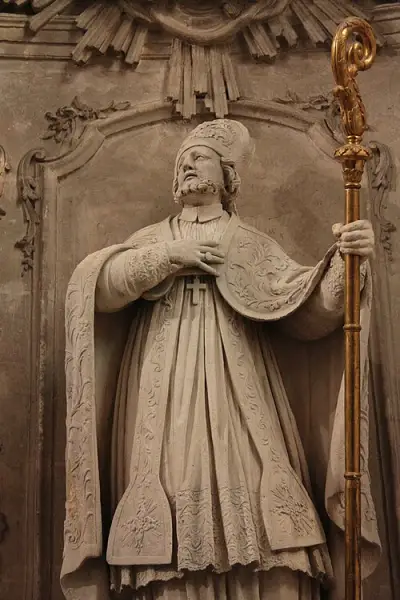
Overview
Guiraud was a bishop of Béziers in the early twelfth century, honored as a Catholic saint and remembered in the local legends of his native Languedoc. Puissalicon saw his birth in 1070; tradition makes him the second prior of the canons regular community at Cassan Abbey before his elevation to the episcopate. He served as bishop of Béziers from 1121 until his death on 5 November 1123, a tenure of barely two years. Whatever the later legends that preferred to imagine him lowly, charters signed 'Guiraud of Puissalicon' point to noble birth; one tale even held that the baptismal water began to boil when he was baptized as an infant. His episcopate, though short, was honored: he died in office in the autumn of 1123 and found burial beside Aphrodisius, the city's legendary first bishop, a resting place that bound his memory to the apostolic beginnings of the see of Béziers. His feast is kept on 5 November, the anniversary of his death, and he remains a saint of the local church that never forgot him.
The Complete Life
A Boy of Puissalicon
Guiraud was born at Puissalicon in 1070, a village in the Languedoc lying not far from Béziers, the city whose church he would one day govern. Two traditions about his origins disagree, and both were preserved. The legends that gathered around him in his home country preferred a saint of humble condition, and one of them dramatized the point at the very start of his life: at his baptism as an infant the water in the font began to boil — a sign, so the story runs, of the fervor that would burn in him all his days. The documents tell another story. Several acts and charters of the period carry the signature 'Guiraud of Puissalicon', and a man who signed with a place name in that fashion was declaring noble birth; clerics of no standing did not sign as lords of villages. Perhaps the legends kept a memory of a modest childhood within a noble line, or perhaps they simply wished their saint more ordinary than he was. What stands certain is the birthplace, the year, and the signature: a nobleman of Puissalicon, destined for the service of the Church.
§ Introduction
Second Prior of Cassan
Before he reached the episcopate, Guiraud's life was formed among the canons regular of Cassan Abbey, the religious house in his home country whose community lived under a rule in common. He is said to have been its second prior — the second man to govern the community — a detail that places him at the head of a young foundation while still comparatively early in his religious life. The canons regular occupied a distinctive station in the twelfth-century church: clergy who lived as religious, holding goods in common, praying the office together, and serving the churches of the surrounding country. To be prior of such a house was to be exercised in both halves of the pastoral vocation, the contemplative and the administrative at once. The abbey of Cassan endured as a landmark of the Languedoc, and Guiraud's remembered connection with it — second prior, son of the neighboring village, later a saint whose name the abbey kept alive — anchored his reputation in the religious soil of his own region long before the city of Béziers called him to a higher and heavier office.
§ Introduction
Two Years on the Throne of Béziers
In 1121 Guiraud was raised to the bishopric of Béziers, one of the ancient sees of the south of France. His tenure was brief: he served as bishop from 1121 until 5 November 1123, dying within two years of taking up the office. The record of what he accomplished as bishop is slight, but the outline is clear — a prior of Cassan, past his fiftieth year, accepting the government of a great southern diocese at the end of a long life in the Church. Béziers in the early twelfth century was a flourishing city whose bishop stood among the notable men of the province; to govern it, even for a moment, was to hold a station far above the village abbey where his religious life had begun. Whatever designs he may have formed for the see were cut short by death in the autumn of 1123. His episcopate is remembered less for its acts than for its ending: the bishop died at his post, already honored as holy, and the city laid him among its own bishops with the veneration it would never afterward withdraw.
§ Introduction
Buried Beside the First Bishop
Guiraud found his grave in the church of Béziers, beside Aphrodisius, the city's first bishop of legend — a resting place that set the twelfth-century bishop in the company of the diocese's founding saint and fastened his cult to the cathedral's own memory. He is honored as a Catholic saint, his feast kept on 5 November, the day of his death. The legends that made him famous locally grew up around his name after his passing: the boiling water of his baptism, the humble origins set beside the noble charters, the village boy who became bishop of the nearby city. They are the ordinary folklore of a popular saint — anecdote and emblem rather than record — but they testify to a devotion that persisted in the Languedoc long after the events they embroider. For historians, Guiraud remains a figure fixed by documents: the signatures of Puissalicon, the episcopal dates of 1121 and 1123, the calendar entry for 5 November. For the faithful of Béziers he was something simpler: their bishop, resting beside the first of the line, remembered each November as the fathers of the diocese deserve.
§ Introduction
Timeline
- 1070
Born at Puissalicon in the Languedoc
§ Introduction
- 1121
Became bishop of Béziers
§ Introduction
- 5 Nov 1123
Died in office at Béziers; buried near Aphrodisius, the city's legendary first bishop
§ Introduction
The Record
- Canonization
- Pre-congregation; honored as a Catholic saint with a feast on 5 November
Prayer
Bibliography
Show 3 sources
- Sabatier, Étienne, Histoire de la ville et des évêques de Beziers (1854), p. 192.
- "Château-Abbaye de Cassan", Monument historique, Histoire et patrimoine du Languedoc Roussillon.
- "The Legend of Saint Guiraud".
Profile text adapted from the Wikipedia article, licensed CC BY-SA 4.0.
Pray with this saint every day
Save St. Guiraud to your favorites, read the full profile, and get feast-day reminders in the Saints app.
Get the Saints AppFree on the App Store for iPhone and iPad