
717 – 774·Feast October 11
St. Gummarus
Hermit of Lier and courtier turned peacemaker
Overview
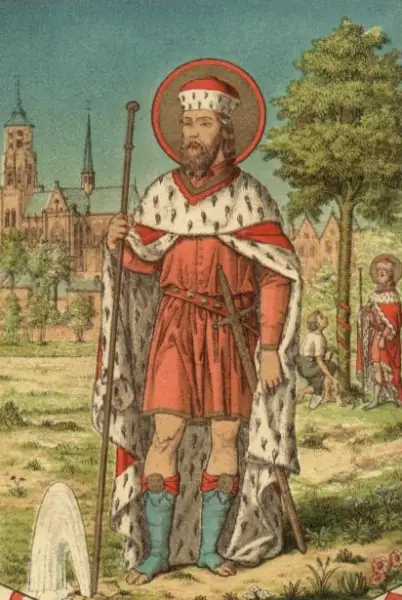
Gummarus, also called Gommaire, Gommer, or Gummery, was a Belgian saint born around 717 at Emblehem, an area that took in Lier and the town of Emblem in Brabant. A relative of Pippin the Younger, he was summoned to the royal court and charged with important offices, later accompanying the king on military campaigns across Cardekho, Saxony, and Aquitaine over eight years of service. His marriage to the wealthy and haughty noblewoman Guinmarie was unhappy and childless, and her harsh treatment of their household servants outlived even his efforts at reconciliation. When he came home from the wars he worked to undo the injustices she had inflicted, and built a chapel called Nivesdunc as a place of quiet and private prayer. The couple eventually parted, and Gummarus withdrew to Nivesdunc for the eremitical life. Around his retreat the town of Lier took shape, and there his earthly course ended in 774, although some sources argue for a much earlier death around 714. Miracles were attributed to his intercession, and he became the patron saint of Lier, honored by Catholics and Orthodox alike on October 11.
The Complete Life
A Noble of Brabant
Gummarus was born around 717 at Emblehem, a name that in his day covered an area including the later town of Lier and not merely the settlement of Emblem, in the province of Brabant, then part of Austrasia within the Kingdom of the Franks. He was the son of the Lord of Emblem, and so grew up among the lesser nobility of the Carolingian world. Through his family he was related to Pippin the Younger, the powerful mayor of the palace who dominated Frankish politics, and it was this kinship that drew the young man out of his home district and into the orbit of the court. The sources describe him as an official in the service of his royal relative, entrusted with important offices, though the details of his early administration have not survived. What is remembered instead is the pattern of his life: a man of rank and connection who would one day abandon privilege for the hidden life of prayer. Even his birthplace became holy ground to later generations, for the region around Lier cherished his memory as its own.
§ Life
Courtier and Soldier
Called to court by Pippin, Gummarus served as an official and was drawn into the military affairs of the Frankish kingdom. The king also arranged his marriage to Guinmarie, a wealthy noblewoman described by the sources as extravagant and haughty, and by some accounts shrewish and abusive toward the household servants whenever her husband was away. The union produced no children, and the domestic unhappiness that shadowed it became one of the defining trials of his life. Meanwhile his military duties took him far from home: he accompanied Pippin on a number of campaigns and spent eight years in the field, serving in Cardekho, in Saxony, and in the Aquitaine. Those years of hardship on campaign seem to have deepened him. When he finally returned from military service, he did not simply resume his old position. He sought first to be reconciled with his wife, and then to make amends for the wrongs she had done to those who served in their household, giving back what had been taken and mending what his absence had allowed to sour. It was the instinct of a man beginning to measure his life by other standards than rank.
§ Life
The Chapel of Nivesdunc
Back from the wars, Gummarus built a chapel called Nivesdunc, intending it as a place of quiet and retirement where he could attend to his private devotions away from the demands of court and household. The reconciliation with Guinmarie did not hold; husband and wife eventually separated, and the marriage that had produced neither children nor peace ended in a formal parting of their ways. Freed from the entanglements of his former station, Gummarus withdrew to Nivesdunc and took up the life of a hermit. The move proved consequential far beyond his own soul. Settlers gathered around the holy man's retreat, and the town of Lier grew up on the very site of his hermitage, taking shape around the presence of one who had sought to be alone with God. What began as a solitary's shelter became the seed of a community, and the chapel he raised for his own prayers became, in time, the spiritual heart of a town. It is a striking irony of his story that the man who fled society became the reason it assembled.
§ Life
Death at the Hermitage
Gummarus ended his days at the hermitage of Nivesdunc, where the growing town of Lier stood around him, and there he died. The traditional date of his death is 774, though the sources are divided: some place his death as early as 714. Those who argue for the earlier year point to his reported meeting with St. Rumbold of Mechelen, a missionary of the Brabant region whose death has been determined on other evidence to have fallen between 580 and 655. If Gummarus truly knew Rumbold, he cannot have died in the 770s, and the earlier chronology would follow. The 2004 relic study lent weight to that view, pointing to a Rumbold who died more than fifty years before Gummarus was even born, which would make the supposed meeting impossible and restore the later dating. The question remains open among scholars, but it has never troubled the devotion of Lier, which remembers its founder regardless of the exact year of his passing. Where his body first rested is not recorded, though his memory at Lier became the anchor of the city's religious identity.
§ Life
Recognition of Sanctity
Gummarus belongs to the age of pre-congregation saints, honored by the Church's recognition long before the modern canonical process existed. The sources record that he was recognized as a saint in 754, which would mean his canonization came during his own lifetime or immediately after his death, though the same chronology is complicated by the uncertainty over his death year; an alternative tradition dates the recognition to 815. Either way, his cult took root early and firmly in the region of his birth. The Church confirmed what the people of Brabant already knew: miracles were attributed to his intercession in growing numbers, and he was numbered among the saints of both the Roman Catholic Church and the Eastern Orthodox Church, which commemorate him, including its Western Rite communities, on October 11. No formal papal canonization was ever needed or recorded. His sanctity was established by the witness of the community that grew around his hermitage, by the miracles reported at his tomb, and by the steady devotion of the city of Lier, which took him as its patron and has kept his feast for well over a thousand years.
§ Veneration
Lier and Its Patron
The legacy of Gummarus is inseparable from the city of Lier, of which he is the patron saint. His hermitage ground is occupied today by St. Peter's Chapel, and in 1378 the city raised the collegiate Church of St. Gummarus in the Brabantine Gothic style, a building that still dominates the town. On the first Sunday following October 10, Lier stages the Sint-Gummarus Fair year by year, at the heart of which a great procession bears the saint's relics along the city streets, an act of public gratitude that has continued across the centuries. In art he is often shown alongside St. Rumbold of Mechelen, since tradition held the two to have been close companions who together founded an abbey at Lier, though the relic evidence of 2004 suggests they were not contemporaries and the pairing reflects legend more than history. His patronages trace the outline of his life: separated spouses and difficult marriages remember his own sorrow; courtiers his service; woodcutters and cowherds the rural world of his hermitage. Even the brewery of Limburg that bears his name, producing an award-winning Sint Gummarus Tripel, keeps his memory present in the daily life of Flanders.
§ Veneration
Timeline
- 717
Born at Emblehem in Brabant, in the Frankish kingdom of Austrasia.
§ Introduction
- 754
Recognized as a saint, according to one dating; another source places the recognition in 815.
§ Life
- 774
Died at the hermitage of Nivesdunc, around which the town of Lier had grown.
§ Life
- 1378
The collegiate Church of St. Gummarus was built at Lier in the Brabantine Gothic style.
§ Veneration
- 2004
A relic examination suggested Rumbold of Mechelen died decades before Gummarus was born.
§ Iconography
The Record
- Major works
- Chapel of Nivesdunc, on whose site the town of Lier arose
- Patron of
- patron of Lier·childless people·courtiers·cowherds·difficult marriages·glovers·hernia sufferers·separated spouses·woodcutters
- Canonization
- Pre-congregation; recognized as a saint in 754, though some sources date the recognition to 815.
Prayer
Bibliography
Show 8 sources
- Hallett, Dr Nicky (2013-04-28). Lives of Spirit: English Carmelite Self-Writing of the Early Modern Period. ISBN 9781409489641.
- Jones, Paul Anthony (2019). The Cabinet of Linguistic Curiosities: A Yearbook of Forgotten Words. University of Chicago Press. p. 285. ISBN 978-0-226-64670-1.
- Horemans, Karine (1990). De legende van Gummarus Patroon van Lier (1 ed.). Lier-Kermiscomité.
- Butler, Alban. "Saint Gummar, or Gomer, Confessor". Lives of the Fathers, Martyrs, and Principal Saints, 1866. CatholicSaints.Info. 7 May 2016.
- Monks of Ramsgate. "Gummarus". Book of Saints, 1921. CatholicSaints.Info. 7 May 2016.
- Mulder-Bakker, Anneke; Carasso-Kok, Marijke (1997). Gouden legenden : heiligenlevens en heiligenverering in de Nederlanden. Verloren. p. 145. ISBN 9065502912.
- van Eck, Xander (2015). "The high altar of the archiepiscopal cathedral of Mechelen: St Rumbold's grand reliquary and tomb". Simiolus: Netherlands Quarterly for the History of Art. 38 (4): 213–227. ISSN 0037-5411.
- Mark van Strydonck; Anton Ervynck; Marit Vandenbruaene; Mathieu Boudin (2006). Relieken, echt of vals? (in Dutch). Davidsfonds, Leuven. ISBN 978-90-5826-420-6.
Profile text adapted from the Wikipedia article, licensed CC BY-SA 4.0.
Pray with this saint every day
Save St. Gummarus to your favorites, read the full profile, and get feast-day reminders in the Saints app.
Get the Saints AppFree on the App Store for iPhone and iPad