
c. 955 – 1045·Feast October 9
St. Gunther of Bohemia
Duke turned hermit and peacemaker of Bohemia
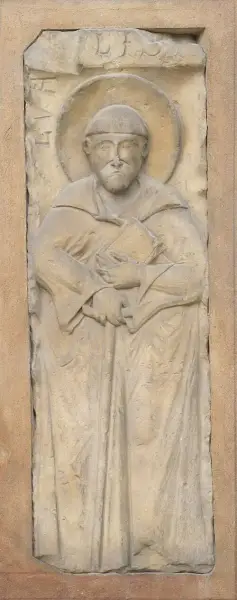
Overview
Gunther, known in Czech as Vintíř and in German as Günther, was a Bavarian nobleman who abandoned a life of rank and intrigue to become a hermit, and who came to exercise a quiet influence over the early history of both Hungary and Bohemia. Born around 955 into a family related to the Ottonian emperors and the Hungarian Arpads, he was Duke of Thuringia and an ancestor of the house of Schwarzburg. At the age of fifty, in 1005, he was converted by Gotthard of Hildesheim and resolved to do penance for his past. He gave his goods to the Abbey of Hersfeld, made a pilgrimage to Rome, and professed vows as a lay brother at Niederaltaich Abbey. A brief and unhappy attempt to govern his own monastery of Göllingen taught him humility, and in 1008 he withdrew to the Bavarian Forest as a hermit, settling at Rinchnach in 1011, where he raised cells and a church honoring St. John the Baptist and bent himself to clearing and cultivating the wilds. Endowed by Emperor Conrad II in 1029 and affiliated to Niederaltaich by Henry III in 1040, Rinchnach made Gunther a trusted figure to the rulers of Germany, Bohemia, Hungary, and Poland. He mediated in the 1040 conflict between Duke Bretislaus I of Bohemia and Henry III, and died on October 10, 1045, at his hermitage on Březník mountain, in the arms of Bretislaus and the Bishop of Prague.
The Complete Life
A Prince of This World
Gunther was born around 955 into one of the great noble houses of the German lands, a family related both to the imperial Ottonian dynasty and to the Arpads, the royal house of Hungary. He became Duke of Thuringia, and later generations would reckon him among the forebears of the princely house of Schwarzburg, a sign of how firmly his line was woven into the nobility of medieval Europe. His early life, as his biographers tell it, was passed at court amid pleasures of every kind and the scheming of ambitious men, the familiar air of a princely household and the usual peril to the soul. Nothing in his first fifty years suggested the direction his life would take. He was a man of power and expectation, with heirs to succeed him and estates to administer. Yet the sources record that the relationship with his relatives in high places would later serve a purpose no one could have foreseen: the same courtly connections that marked his worldly career would one day make him a trusted counselor to emperors and kings, and a mediator whom the rulers of four kingdoms were glad to hear.
§ Life
Conversion at Fifty
In 1005, at about the age of fifty, Gunther's life turned. He was converted by Gotthard of Hildesheim, then Abbot of Hersfeld and later Bishop of Hildesheim, one of the great reforming churchmen of the age, and he resolved to embrace the monastic life in penance for his past faults. The resolution was carried through with a nobleman's thoroughness: he won his heirs' consent and made over his entire estate to Hersfeld Abbey, though he insisted on retaining ownership of the monastery of Göllingen in order to endow and maintain it richly, despite all Gotthard's efforts to dissuade him. In 1006 the new novice went on pilgrimage to Rome, and a year later he professed his vows as a lay brother at Niederaltaich Abbey before Abbot Gotthard himself. His ambition, however, was not yet dead. Before long he was begging leave to take personal charge of Göllingen, and no protests from Gotthard could turn him from the design. Elevated to the abbacy, the former duke fell ill, quarreled with his monks, and brought the house near to ruin, until Gotthard's charitable counsel and severe reprimands dispelled his ambitions and he returned to the humble rank of lay brother at Niederaltaich, where he led an edifying life.
§ Life
Hermit of the Forest and Counselor of Kings
In 1008 Gunther retreated to a rugged, solitary height near Lalling in the Bavarian Forest and embraced the hermit's life; in 1011 he pressed deeper into the wilderness with several companions and settled at Rinchnach. There he raised cells and a church in honor of Saint John the Baptist, and set his hands to the work of civilization itself, clearing the forests and planting fields in a region that had known neither. He also became a bridge between worlds. A relative of the Hungarian king, he paid frequent visits to that court, obtained large sums for the poor, and urged the king to build churches and monasteries; the deed of donation that King Stephen I of Hungary made on June 6, 1009 was preserved by Mabillon. Recognition followed: Conrad II richly endowed Rinchnach in 1029, and Henry III affiliated it with Niederaltaich in 1040. In his old age Gunther was respected by the rulers of Germany, Bohemia, Hungary, and Poland, and when war broke out between Duke Bretislaus I of Bohemia and Henry III, it was Gunther who was likely present at the German defeat at Brůdek on August 22-23, 1040, and who then led the delegation that negotiated with Bretislaus at Chlumec.
§ Life
The Gift of Infused Knowledge
The tradition records that Gunther received what his biographers call the gift of infused knowledge: though deficient in ordinary ecclesiastical learning, and probably unable either to read or to write, he became a powerful preacher. Wolfher, his biographer, claimed to have known him intimately and often heard his sermons on his patron, St. John the Baptist, discourses so admirable that they drew tears from all who heard them. The paradox is the heart of his spirituality. A man formed at court rather than in a school, a lay brother rather than a cleric, a hermit who had failed as an abbot, he was given an authority that learning could not confer. His asceticism was joined to labor rather than withdrawal from the world entirely; he blessed the land he cleared, the fields he planted, and the church he raised to his patron the Baptist. His charity moved in grand channels, securing royal gifts for the poor and pressing kings to build houses of prayer. And his holiness gave him standing where diplomacy had none: at the very moment armies failed in the Bohemian war, it was the old hermit whom both sides trusted to open negotiations.
§ Life
Death on Březník Mountain
In his last years Gunther pushed the life of solitude still further, withdrawing to a hermitage on Březník mountain in what is today the municipality of Prášily, near Hartmanice in southwestern Bohemia. There, at about the age of ninety, he died on October 10, 1045. The manner of his death bears witness to the esteem he had won: he expired in the arms of Duke Bretislaus I of Bohemia, the very prince with whom he had negotiated peace five years earlier, and of Šebíř, Bishop of Prague. The hermit who had begun as a stranger in Bohemia ended his life cradled by its ruler and its church. His body was carried to Břevnov Monastery near Prague and buried there, a final sign of the bond between the Bavarian hermit and the Bohemian church. There his remains rested for nearly four centuries, until the storms of the fifteenth century overtook them: in 1420 the Hussite wars reached Břevnov and the saint's remains were destroyed. His tomb perished, but his cult did not, for the memory of Vintíř, as the Czechs call him, was kept alive in Bohemia, Bavaria, and Hungary alike.
§ Life
A Saint of Three Nations
Gunther's sanctity was never the subject of a formal papal canonization; like many hermits of the eleventh century, he was raised to the altars by the voice of the faithful. Czech, German, and Hungarian tradition alike venerate him as a saint, each nation claiming a share in him: the Germans as the Bavarian forest father, the Czechs as Vintíř who died on their soil in the arms of their duke, the Hungarians as the kinsman and counselor of their first Christian king. The Church ratified this triple devotion by entering his feast, October 9, in the Roman Martyrology of 2004, the authoritative register of the Church's saints and blesseds. The lack of a formal canonization process has never hindered his cult, which rests on the witness of his contemporaries: the biographer Wolfher who heard his preaching, the rulers who trusted his mediation, and the monasteries of Niederaltaich and Rinchnach that guarded his memory. In an age when holiness was recognized by reputation and miracle rather than by decree, the old duke-turned-hermit was counted among the saints by those who knew him best, and the Church has never seen reason to doubt their judgment.
§ Gunther of Bohemia
The Way of St. Gunther
Gunther's memory is written into the landscape he once cleared. St. Gunther's Way, the Gunthersteig in German and Vintířova stezka in Czech, is a walking route that follows the old hermit's path from Niederalteich Abbey on the Danube, deep into the Bavarian Forest through Rinchnach and past the Guntherstein, and across the Czech border to the hamlet of Dobrá Voda, now part of the town of Hartmanice. There rises the sole church on earth that bears his dedication, that of Saint Gunther, erected between 1706 and 1734 and carefully renovated through 1995 for the 950th anniversary of his death. Its reconstruction gave the saint a singular monument: the Czech artist Vladimíra Tesařová created the entire interior, the altar, the sacrificial table, the lectern, the crèche, the Stations of the Cross, and Gunther's own statue — every one of them cast from glass, a fitting medium for a saint whose work made the forest shine. Hungary keeps his memory too: in the town of Mór, the Church of Holy Trinity bears a Baroque statue of Gunther, set in 1744 in a niche beside its portal. The wandering duke who became a hermit still draws pilgrims along his forest way a millennium after his death.
§ Legacy
Timeline
- 955
Born around this year to a noble family related to the Ottonian dynasty and the Hungarian Arpads.
§ Life
- 1005
Converted at about age fifty by Gotthard of Hildesheim and resolved to embrace the monastic life.
§ Life
- 1006
Made a pilgrimage to Rome as a novice.
§ Life
- 1007
Made his vows as a lay brother at Niederaltaich Abbey before Abbot Gotthard.
§ Life
- 1008
Took up the solitary eremitical life at a rugged retreat near Lalling, deep in the Bavarian Forest.
§ Life
- 1009
King Stephen I of Hungary issued a deed of donation at Gunther's urging, reproduced by Mabillon.
§ Life
- 1011
Settled farther north at Rinchnach, building cells and a church of Saint John the Baptist.
§ Life
- 1029
Emperor Conrad II richly endowed the monastery of Rinchnach.
§ Life
- 23 Aug 1040
Likely present at the German defeat at the Battle at Brůdek; later led the delegation negotiating with Bretislaus at Chlumec.
§ Life
- 1040
Emperor Henry III affiliated the monastery of Rinchnach with Niederaltaich Abbey.
§ Life
- 10 Oct 1045
Died at his hermitage on Březník mountain in the arms of Duke Bretislaus and Bishop Šebíř of Prague.
§ Life
- 1420
His remains, buried at Břevnov Monastery, were destroyed by the Hussites.
§ Life
The Record
- Major works
- Hermitage and church of Saint John the Baptist at Rinchnach·Monastery of Göllingen (endowed and briefly governed)
- Canonization
- Venerated as a saint by popular acclaim in Czech, German, and Hungarian tradition; feast listed in the Roman Martyrology (2004).
Prayer
Bibliography
Show 5 sources
- "Martyrologium Romanum (2004)".
- "'St. Gunther', Niederalteich – Bavaria's Gateway to the East" (PDF). Retrieved 18 April 2013.
- Besse, Jean. "Blessed Gunther." The Catholic Encyclopedia. Vol. 7. New York: Robert Appleton Company, 1910.
- "Saint Gunther", Hungarian Saints.
- M. Perlbach, Die Kriege Heinrichs III. gegen Böhmen. 1039-1041 (1870), 450–452.
Profile text adapted from the Wikipedia article, licensed CC BY-SA 4.0.
Pray with this saint every day
Save St. Gunther of Bohemia to your favorites, read the full profile, and get feast-day reminders in the Saints app.
Get the Saints AppFree on the App Store for iPhone and iPad