
674 – 714·Feast April 11
St. Guthlac of Crowland
Hermit of the Fens and tormentor of demons
Overview
Guthlac of Crowland was a Christian hermit and saint of Anglo-Saxon England, born in 674 in the kingdom of Mercia to the noble Penwalh and his wife Tette, whose daughter Pega is also venerated as a saint. While still young he took the field in the host of King Æthelred of Mercia, but at twenty-four he became a monk at Repton Abbey, and two years later, on St Bartholomew's Day, 699, he settled as a hermit on the island of Croyland, now Crowland, in the Lincolnshire Fens. There, hollowing a dwelling from a violated grave-mound, he set up an oratory with its cells, living a life of extreme austerity, clothed in skins and fed after sunset on barley bread and muddy water. His holiness drew visitors from across the land seeking spiritual guidance, and his battles with the demons of the Fens became famous through the Vita sancti Guthlaci written by Felix within living memory of his death. He gave sanctuary to the fugitive prince Æthelbald and foretold his kingship. Guthlac died on April 11, 714; his sister Pega buried him, and a year later found his body incorrupt. Æthelbald, now king, began Crowland Abbey in fulfillment of his promise, and Guthlac's cult endured there into the sixteenth century.
The Complete Life
A Noble of Mercia
Guthlac was born in 674 into the Mercian nobility, the son of Penwalh, or Penwald, one of the nobles of the Mercian kingdom, and of Tette his wife. The family's faith ran deep: his sister Pega would herself be venerated as a saint, and the household produced the most famous hermit of Anglo-Saxon England. As a young man Guthlac followed the first vocation of an aristocrat of his age, military service, and fought in the army of King Æthelred of Mercia, who reigned from about 675 to 704. The warrior years left their mark; the Old English poems about him portray a man formed by the heroic culture of the war band. But at the age of twenty-four Guthlac turned from the world's service to the Church's, becoming a monk at Repton Abbey in Derbyshire, then a double monastery, where he placed himself under the abbess. Two years of monastic discipline proved a preparation for something stricter. Felix, his early biographer, records that Guthlac's time in exile among the Celtic Britons had given him the strange ability to understand the barbarous speech of the spirits who would later haunt him, a detail that links his life to the older Christian world of the west.
§ Early life
From Warrior to Hermit
The turning of Guthlac's life came in stages: first the renunciation of arms for the cloister at Repton at the age of twenty-four, then, two years later, the still greater renunciation of the cloister for the desert. On St Bartholomew's Day in the year 699 he removed to the isle of Croyland — Crowland as it later came to be called — rising from the waters of the Lincolnshire Fens, and there he embraced the eremitical life. The island held an ancient barrow, a burial mound of clods of earth that treasure seekers had dug open, and in the side of this gutted tomb Guthlac made his home, building a hut over the hollow. His biographer Felix, writing within living memory of his subject, sets down the unalterable rule of the hermitage: Guthlac wore neither wool nor linen nor any soft material, but garments made of skins, and his sole nourishment, after nightfall, was a morsel of barley bread with a little cupful of muddy water, tasted only once the sun had run to its western bound. It was an asceticism of heroic severity, embraced freely by a man raised in nobility. The choice of the barrow itself was a kind of sermon: where greed had dug for treasure, the saint found the true riches.
§ Hermit
Light in the Fens
Word of the holy and austere ascetic spread until it was on every tongue, and though he had sought solitude, the solitude found him out. Crowds made their way to the holy man while he lived, asking direction for their souls, and the island of Crowland became an unlikely center of counsel for the anguished and the devout of Mercia. Among those who came to him was Æthelbald, a prince of the Mercian royal house fleeing from his cousin King Ceolred, and Guthlac gave him sanctuary, prophesying that Æthelbald would become king. The fugitive promised to build an abbey if the prophecy held true, and it did: Æthelbald took the throne in 716, two years after the hermit's death, and kept his word, beginning Crowland Abbey on St Bartholomew's Day of that year. Guthlac's spiritual combat gave his mission its fearsome fame. The Vita sancti Guthlaci describes the ferocious demons who entered his cell, terrible in shape, with throats vomiting flames and raucous cries that filled the space between earth and heaven, and the saint who scourged them with the whip that St Bartholomew brought him. He had chosen the wasteland, and made it a place of deliverance for all who sought him.
§ Veneration
Penance, Prophecy, and the Battle with Demons
The spirituality of Guthlac joined the severest bodily asceticism to an astonishing intimacy with the unseen world. His rule of life at Crowland admitted no comfort: skins for clothing, barley bread and muddy water for food, and that only after sunset. Against him ranged the demons of the Fens, whom Felix depicts in unforgettable detail, ferocious in appearance, with great heads, foul mouths, throats vomiting flames, and discordant bellowings that filled the whole space between earth and heaven. The tradition makes a point of how Guthlac could understand their sibilant, barbarous speech: only because he had spent time in exile among the Brittonic-speaking Celtic Britons, a prose detail that binds his combat to his biography. His reward was prophetic clarity. He foretold the kingship of Æthelbald, and Felix tells that his own passing was foreknown to him, and that he spoke with angels in his closing days. As he died a sweetness like nectar breathed from his lips, and his soul went forth in a shaft of light amid the singing of angels. The hermit's humility completed the picture: he had asked the abbess Ecgburh of Repton for a lead coffin and linen winding-sheet so that his sister Pega could perform his funeral rites, a final act of obedience and family devotion.
§ Veneration
Death and Incorruption
Guthlac died at Crowland on April 11, 714, at the age of forty or forty-one, having spent fifteen years on the island. He died as he had lived, attended by heaven: Felix tells that his own passing was foreknown to him, that he spoke with angels in his closing days, and that a sweetness like nectar and a shaft of light marked his soul's going amid angelic song. He had provided for his own burial, requesting from Ecgburh, Abbess of Repton, a lead coffin and a linen winding-sheet so that his sister Pega could carry out the funeral rites. Pega arrived the day after his death and found the whole island breathing an ambrosial fragrance; three days of prayer followed, and then she laid the body in the mound where the hermitage stood. A year later, called by a divine prompting, she translated the tomb and its relics to a chapel close at hand; the opened grave revealed a body untouched by decay, the shroud shining with light. The incorruption confirmed the sanctity that the region already credited. Later, Æthelbald was granted a vision of Guthlac, in which the saint renewed the prophecy of his royal future; the king who emerged, enthroned two years later, never forgot the debt.
§ Veneration
The Saint of the Fens
Guthlac's canonization was the work of the people and the Church of his own generation. He was venerated almost immediately after his death, and his feast was fixed on April 11, the day of his passing. The cult centered at Crowland, where a monastic community kept his memory and where Æthelbald built the abbey he had promised. He came to be venerated across the Church, and is honored today by the Anglican Communion, the Catholic Church, and the Eastern Orthodox Church, which have composed canons and akathists in his honor. The authority of his cult rests on the earliest and best hagiography in English history: the Latin Vita sancti Guthlaci by Felix, composed within a decade or two of the saint's death, most likely between 730 and 740 on Bertram Colgrave's judgment, at the command of King Ælfwald of East Anglia. Few Anglo-Saxon saints are attested so early and so fully. Crowland Abbey remained his shrine until the dissolution, the major shrine of his cult until 1539, and the stream of pilgrims who came seeking healing made the abbey wealthy and famous. The Church never needed a formal decree; the incorrupt body, the visions, and the unbroken devotion of fifteen centuries were evidence enough.
§ Veneration
Abbey, Poems, and the Guthlac Roll
Guthlac's legacy in English Christianity is immense for a man who lived alone in a swamp. His cult continued at Crowland, which became a Benedictine abbey in 971; though fires destroyed most early records, his relics underwent a further translation in 1136, and in 1196 the shrine took its place above the high altar. His literary afterlife was extraordinary. Felix's Latin Vita was translated and adapted into Old English prose and sermon, and inspired two poems, Guthlac A and Guthlac B, both found in the Exeter Book of the tenth century, the most ancient anthology of English verse to survive. The Guthlac Roll, a set of detailed early thirteenth-century illustrations now in the British Library, told his life pictorially, and its images, the saint tormented by demons, handed a scourge by St Bartholomew, still identify his iconography. The Yorkshire village of Golcar near Huddersfield is named for him, recorded in Domesday as Goullakarres, for Guthlac preached there. Churches bearing his dedication cluster in the Fens and East Midlands, and St Guthlac's Fellowship, formed in 1987, links his Anglican and Catholic churches across England. Some have even suggested that a lost Guthlac drama stood behind Shakespeare when he composed The Tempest, so deep did the hermit's story sink into English imagination.
§ Legacy
Timeline
- 674
Born in the kingdom of Mercia, son of the noble Penwalh and his wife Tette.
§ Early life
- 699
Became a hermit on the island of Croyland, in the Lincolnshire Fens, on St Bartholomew's Day.
§ Early life
- 11 Apr 714
Died at his hermitage on Crowland; buried on the mound by his sister Pega after three days of prayer.
§ Hermit
- 715
A year after his death, Pega moved his tomb to a nearby chapel and found the body incorrupt.
§ Veneration
- 716
King Æthelbald of Mercia began building Crowland Abbey on St Bartholomew's Day, keeping his promise to Guthlac.
§ Veneration
- 971
Crowland Abbey was established as a Benedictine house, and the cult of Guthlac continued there.
§ Legacy
- 1136
Guthlac's relics were translated yet again within Crowland Abbey.
§ Legacy
- 1196
Guthlac's shrine was placed above the main altar of Crowland Abbey.
§ Legacy
In Their Own Words
Now there was in the said island a mound built of clods of earth which greedy comers to the waste had dug open, in the hope of finding treasure there; in the side of this there seemed to be a sort of cistern, and in this Guthlac the man of blessed memory began to dwell, after building a hut over it.
The Record
- Major works
- Oratory and cells at Crowland, built into a plundered barrow
- Symbols
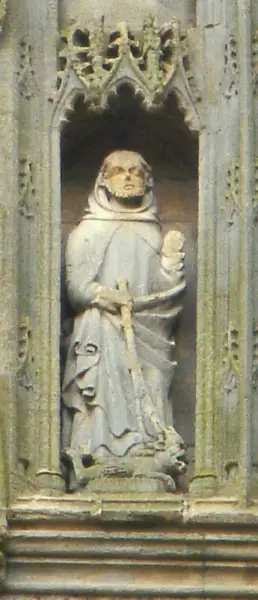
- the scourge of St Bartholomew·garments of skins·whip and flaying knives of St Bartholomew
- Canonization
- Pre-congregation; venerated as a saint from shortly after his death, with a cult centered at Crowland.
Prayer
Bibliography
Show 8 sources
- Felix. Vita Sancti Guthlaci [Life of St Guthlac] (in Latin). Translated by Bertram Colgrave. Cambridge: Cambridge University Press, 1985 [1956]. ISBN 0-521-31386-4.
- Goodwin, Charles Wycliffe, ed. (1848). The Anglo-Saxon Version of the Life of St. Guthlac. London: John Russell Smith.
- Loyn, H. R. (1970) [1962]. Anglo-Saxon England and the Norman Conquest. London: Longman. ISBN 978-0-582-48232-6.
- Cavill, Paul (January 2015). "The Naming of Guthlac". Nottingham Medieval Studies. 59: 25–47. doi:10.1484/J.NMS.5.107333.
- Cohen, Jeffrey J. (2003). "IV. The Solitude of Guthlac". Medieval Identity Machines. University of Minnesota Press. ISBN 0-8166-4002-5.
- Borlik, Todd Andrew (April 2013). "Caliban and the fen demons of Lincolnshire: The Englishness of Shakespeare's Tempest". Shakespeare. 9 (1): 21–51. doi:10.1080/17450918.2012.705882.
- Williams, Howard (2006). "6. Death and Landscape". Death and Memory in Early Medieval Britain. Cambridge University Press. pp. 179–214. doi:10.1017/CBO9780511489594.
- Noetzel, Justin T. (2014). "Monster, Demon, Warrior: St. Guthlac and the Cultural Landscape of the Anglo-Saxon Fens". Comitatus: A Journal of Medieval and Renaissance Studies. 45 (1): 105–131. doi:10.1353/cjm.2014.0000.
Profile text adapted from the Wikipedia article, licensed CC BY-SA 4.0.
Pray with this saint every day
Save St. Guthlac of Crowland to your favorites, read the full profile, and get feast-day reminders in the Saints app.
Get the Saints AppFree on the App Store for iPhone and iPad