
fl. 6th century·Feast July 1
St. Gwenafwy
Patroness of Gwennap in Cornwall
Overview
Gwenafwy, whose name survives in the corrupted form Wenappa, was a pre-congregational saint active, so far as the records allow us to say, in the sixth century. She belonged to the great saintly kindred of Caw of Strathclyde, being numbered among his daughters, with Peillan, Eigron, and Peithein counted among her brothers and sisters. Her life intersected with the westward movement of the Celtic church when she crossed into Cornwall in the company of her brother Eigron. There she took root in the devotional geography of the peninsula: she is honored as the patroness of Gwennap, the Cornish parish whose very name preserves a memory of hers. Her feast is kept on 1 July. Everything else about her, including the dates and circumstances of her birth and death, has been swallowed by the silence of the early sources, and what remains is the family tie, the journey to Cornwall, the patronage of a Cornish parish, and a summer feast day.
The Complete Life
A Daughter of Caw's Saintly Kindred
Gwenafwy's claim to remembrance begins with her family. The early Welsh genealogical tradition makes her a daughter of Caw of Strathclyde, the patriarch whose numerous children populated the calendars of Wales, Cornwall, and Brittany with saints. Among her brothers and sisters the sources name Peillan, Eigron, and Peithein, with the phrase 'among others' indicating that the full list of Caw's holy offspring was longer still. To be born into that household meant to be born into a network of monastic foundations and parish dedications that stretched across the Celtic world, and the careers of Gwenafwy's siblings show how widely that network ran. She herself flourished in the sixth century, the great age of Celtic expansion when holy men and women moved freely between Strathclyde, Wales, Cornwall, and Brittany, carrying the faith and their family's reputation for sanctity with them. Rice Rees printed the family's genealogy in his 1836 essay on the Welsh saints, and the Dictionary of Christian Biography entered the same connexion. Of her childhood, her education, and the place of her birth the records say nothing; her identity in the tradition is wholly that of a daughter and sister within this remarkable saintly family.
§ Introduction
Into Cornwall with Her Brother
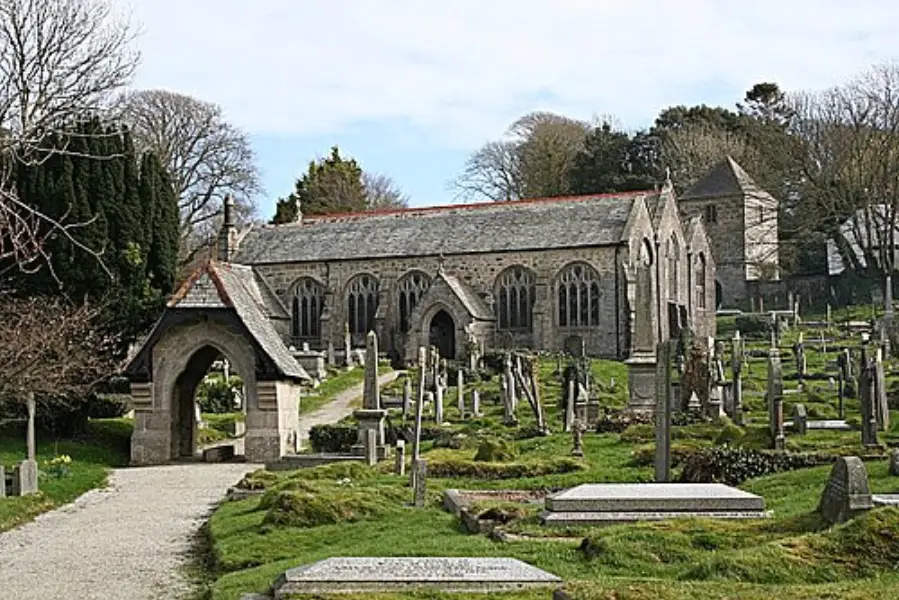
The single journey the sources record for Gwenafwy carried her out of the Welsh world and into Cornwall, which she entered in the company of her brother Eigron. Such sibling journeys are a familiar pattern in the hagiography of the period, where brothers and sisters of the great saintly families appear together at the head of new foundations. In Cornwall the mission of the two siblings left its trace in the map: Gwenafwy became the patroness of Gwennap, a parish in the west of the county whose name is understood as a garbled survival of her own. To be the patroness of a parish meant, in the economy of early Cornish Christianity, that the local community regarded her as its founder or first intercessor, the saint whose protection the church claimed and whose feast the parish kept. Whatever the historical core of the journey, the dedication stood for centuries as the lasting fruit of her crossing, The Cornish antiquaries numbered the dedication among the county's primitive foundations, and the Cambrian Archaeological Association's journal preserves the record of her patronage. It remains the one concrete work by which the medieval church remembered her.
§ Introduction
A Feast on the First of July
What survived of Gwenafwy's cult was gathered into the liturgical calendars of the Celtic church: her feast day is 1 July. The lives of the English and Cornish martyrs, edited with additions of Welsh saints, entered her among the commemorated, and the calendars of the later middle ages kept the date alive. For a saint about whom the written record is so meager, the feast is the principal continuing witness to her veneration, for calendars preserve the memory of saints whose stories have otherwise perished. Her standing as a pre-congregational saint of medieval South Wales, in the language of the modern reference works, means simply that her cult arose locally and antiquity, not papal process, made her a saint. The Cornish parish of Gwennap stands as her most tangible memorial, its very name a fossil of hers and its medieval church claiming her as patroness. Within the wider family of Caw of Strathclyde she holds her modest place beside Peillan, Eigron, and Peithein, one more branch of a kindred whose dedications still dot the map of western Britain. Her obscurity is itself instructive: entire regions of early British Christianity were shaped by men and women whose lives we can no longer reconstruct, only honor.
§ Introduction
The Record
- Patron of
- Gwennap, Cornwall
- Canonization
- Pre-congregation; a pre-congregational saint of medieval South Wales
Prayer
Bibliography
Show 5 sources
- Rees, Rev. Rice. Welsh Saints or Primitive Christians usually considered to be Founders of Churches in Wales (Longman Rees Orme Brown and Green, 1836), page 230.
- Smith, William; Wace, Henry (eds.). A Dictionary of Christian Biography (Little, Brown, 1880), p. 827.
- Jones, D. D. The early Cymry and their church (W. Spurrell & Son, 1910), page 88.
- Archaeologia Cambrensis: The Journal of the Cambrian Archaeological Association, 1903, p. 368.
- The lives of the saints. With introductions and additional lives of English martyrs, Cornish, Scottish, and Welsh saints, at p. 246.
Profile text adapted from the Wikipedia article, licensed CC BY-SA 4.0.
Pray with this saint every day
Save St. Gwenafwy to your favorites, read the full profile, and get feast-day reminders in the Saints app.
Get the Saints AppFree on the App Store for iPhone and iPad