
died c. 590·Feast November 3
St. Gwenhael
Second Abbot of Landévennec Abbey
Overview
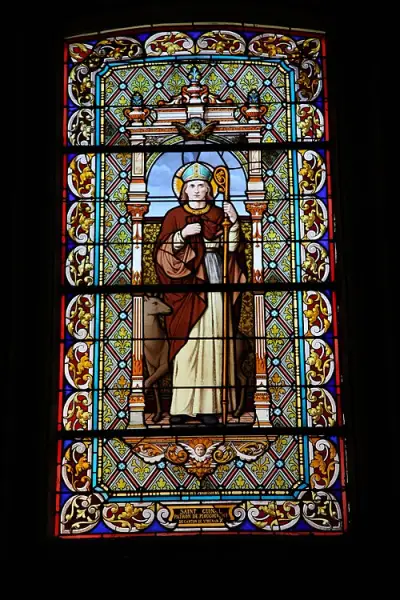
Gwenhael, in French Guénaël and in Breton Gwenael, was a sixth-century Breton abbot born at Ergué-Gabéric in Finistère, though neighboring Quimper also claims him. Precocious and intelligent, he was still a boy of about eleven when Winwaloe, the founder of Landévennec Abbey, met him in the streets of Quimper and won his parents' leave to educate him. Raised in the monastery, Gwenhael became a monk in 511 and was marked out by Winwaloe as his successor; when the founder died in 532, the community chose him as its second abbot. After seven years he resigned the office and set out with eleven companions for the Channel Islands, Brittany, and Ireland, studying and reviving monastic observance according to the rule of Columbanus. He founded two or three large monasteries, reformed around fifty smaller houses, and spent thirty-four years in Ireland before returning toward Armorica, founding three monasteries in Armorican Cornwall and settling finally on the right bank of the Blavet near Lanester. His holiness was such that even a hunted deer took refuge beneath his coat. He died around 590 and his feast is kept on 3 November.
The Complete Life
The Boy from Quimper's Streets
Gwenhael was born at the beginning of the sixth century, and the honor of his birthplace is disputed in the most local of ways: the tradition says he was born in Quimper, while the neighboring parish of Ergué-Gabéric in Finistère claims him as her own son. His parents observed early that the boy was intelligent and precocious, and they sent him to school while he was still very young. The turning point of his childhood came, as his biographers tell it, through a street encounter. Winwaloe, the holy founder of Landévennec, met the eleven-year-old Gwenhael in a street of Quimper and saw such promise in the boy's endowments that, without delay, he secured the parents' consent to direct the child's schooling. The story belongs to a familiar hagiographic pattern, the future abbot recognized and claimed for God while still a child, but it also explains the peculiar intimacy of Gwenhael's bond with Landévennec: he was formed there from boyhood, raised within its walls, and schooled by the founder himself in the discipline that would one day pass into his hands.
§ Life
Monk and Chosen Successor
Under Winwaloe's direction Gwenhael was raised at the monastery of Landévennec, the great monastic house on the Aulne in Breton Cornouaille. In 511 he took the habit as a monk, binding himself irrevocably to the community that had formed him. The founder, watching him year by year, saw in him extraordinary qualities and chose him as the man who should carry the abbey after him. When Winwaloe died in 532, the monks ratified that choice and took Gwenhael as their abbot, making him the second father of a house that stood at the head of Breton monasticism. His tenure, however, lasted only seven years. Whether from humility, from a sense that his gifts lay elsewhere, or from the desire for the stricter life he would soon pursue, he resigned the office and departed with eleven other monks. The account of his Life, written in the ninth century, presents the resignation without reproach; the community had received what it needed, and the abbot who left them behind would spend the rest of his days reawakening the fervor of monastic houses far beyond the Aulne.
§ Life
The Wandering Reformer of Two Seas
Resigning Landévennec after seven years, Gwenhael set out with eleven monks on a journey that would define his sanctity. He went first to the Channel Islands, then through Brittany, and onward to Ireland, there to examine the monastic observance kept under the discipline of Columbanus. All along the way he labored to reawaken monastic fervor wherever relaxation had crept in, and his passing left institutions behind him: he founded two or three large monasteries and reformed around fifty smaller ones. Ireland held him for thirty-four years. When at last he resolved to return to Armorica, some writers say he embarked alone, others that some fifty companions refused to be left behind. He probably landed in Armorican Cornwall, where he founded three monasteries, and thought of visiting Groix to inspect its small monastic establishments; the bells there are said to have sounded by themselves to herald his approach. He remained on the island some years, and at last made his home on the Blavet's right bank, where the chapel of Saint-Guénaël stands today in Lanester, founding a monastery nearby at Caudan.
§ Life
The Deer Beneath His Coat
The hagiographers give Gwenhael a spirituality that shows itself in gentleness so complete that even wild creatures trusted it. The best-loved story of his later years tells of a deer hard-pressed by hunters that came to him and sought refuge under his coat; he sheltered it, and the amazed hunters went off to report the marvel to their master, Waroch, Count of Vannes. Waroch came in person to visit the abbot and tried to persuade him to remain at his court, but Gwenhael, knowing that his end was near, wanted only to prepare for it in solitude. Court and comfort held no attractions for a man who had resigned an abbey to walk the pilgrim roads of two seas. He had also prescribed, faithful to Scoto-Breton custom, that on the anniversary of his death the community should be served 'a feast to the community', the consolatio cibi, comfort through food: a dying man's last gift to his monks, ordering that his memory be kept not in mourning but in charity and shared bread. The deer, the count, and the funeral feast together sketch a saint whose holiness was humane to the last.
§ Life
Solitude on the Blavet
Gwenhael's last years were spent in the quiet corner of Brittany where the Blavet river meets the sea. After his years in Armorican Cornwall and on the island of Groix, he came ashore at last on the Blavet's right bank, at the spot in Lanester where the chapel of Saint-Guénaël stands today, founding a monastery in the neighborhood of Caudan. There, aware that death was approaching, he withdrew to prepare for it in solitude, declining the invitation of Waroch, Count of Vannes, to end his days at court. Even in this retreat he was thinking of others: faithful to the Scoto-Breton custom of his tradition, he directed that on each anniversary of his death a consolatio cibi, a comfort of food, should be served to the community, so that his passing would feed the brothers rather than burden them. He died around 590, full of years and of labors, far from the abbey of his youth but surrounded by the houses he had founded and reformed. His body became the pledge of his continuing presence among the Breton churches that claimed him.
§ Life
A Saint of the Breton West
Gwenhael belongs to the great company of Breton saints whose cult arose from local veneration rather than from any process of canonization; the Church of the first millennium raised him to her altars by the consent of the communities that kept his memory. His cult, the scholars observe, is found mostly in the west of Brittany, and the evidence for it lies in the various forms his name took as it was handed down: Gwenhael, Guénaël, Gwenael, Guenhael in Old Breton, with further variants such as Guénault and Guénaud, and local dedications like Saint Guinal. The very structure of his name proclaims the qualities devotion saw in him, for it is composed of the Breton elements gwenn, 'white, fair, blessed', and hael, 'generous': blessed and generous, a saint of giving. The landscape of western Brittany kept him in place names wherever his churches stood, and family names such as Guénal, Guénel, Trévinal, and Kervennal are thought to descend from his, directly or through the places named for him. It is the canonization of a whole people, accomplished one chapel, one hamlet, and one surname at a time.
§ Veneration
Relics, Churches, and Names on the Land
Gwenhael's bodily remains had a troubled history. His relics were transferred to the cathedral of Saint Peter at Vannes, and when the Norman raids threatened them at the end of the ninth century, they were carried away to Paris, and then to Corbeil, where the Revolution finally destroyed them by fire. His spiritual legacy proved less fragile. The church of Ergué-Gabéric in Finistère, in the very parish that claims his birth, is dedicated to him as Saint Guinal; Tréguidel, Plougonvelin, Lescouët-Gouarec, and Bolazec likewise keep parish churches in his honor, and the church of Poullaouen preserves a statue of the saint. The scholar Gwennole Le Menn traced his name across the map of Brittany in a chain of place names: Locunel in Caudan, Saint-Guinel in Mauron, Saint-Guénal and Saint-Vinnel in Poullaouen, Lanvenaël in Plomeur, Saint-Vénal and Saint-Guénal in Landivisiau, and Saint-Vénal in Saint-Pol-de-Léon, with Kervénal occurring three times across Côtes-d'Armor, Finistère, and Morbihan. His feast is kept on 3 November, the day on which the parishes of the west renew their memory of him. Behind the ninth-century Vita, the ruined reliquary, and the surnames Guénal and Kervennal stands an abbot whose memory the Breton land simply refused to release.
§ Veneration
Timeline
- 511
Becomes a monk at the monastery of Landévennec under Saint Winwaloe
§ Life
- 532
Chosen abbot of Landévennec by the monks on the death of Winwaloe, becoming the abbey's second father
§ Life
- 539
Resigned as abbot after seven years and left with eleven companions, first for the Channel Islands
§ Life
- 590
Dies around this year after preparing for his end in solitude near the Blavet
§ Life
The Record
- Major works
- Two or three large monasteries founded in the course of his missionary journeys·Reform of around fifty smaller monastic houses·Three monasteries founded in Armorican Cornwall·A monastery near Caudan
- Canonization
- Pre-congregation; ancient Breton cult centered on western Brittany
Prayer
Bibliography
Show 4 sources
- Chardronnet, Joseph. Livre d'or des Saints de Bretagne (Ed. Coop Breizh).
- "Saint Guénhaël".
- "Saint Gwenaël, Abbé en Bretagne, à Landévennec", Nominis.
- "Saint Gwenaël", Diocese of Quimper.
Profile text adapted from the Wikipedia article, licensed CC BY-SA 4.0.
Pray with this saint every day
Save St. Gwenhael to your favorites, read the full profile, and get feast-day reminders in the Saints app.
Get the Saints AppFree on the App Store for iPhone and iPad