
fl. 7th century·Feast November 30
St. Gwenllwyfo
Patroness of Llanwenllwyfo, Anglesey
Overview
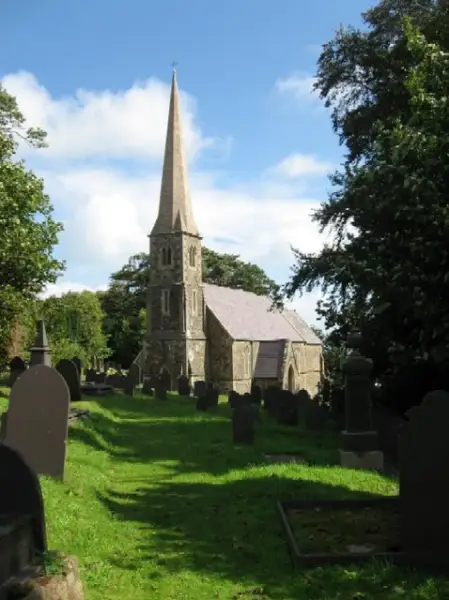
Gwenllwyfo was a Christian woman of early medieval Wales whom the Church honors as a saint; the seventh century is the era assigned to her. Almost nothing else about her has come down: the sources record no family, no life story, and no date of death. Her memory survives in the dedication of two churches near Dulas in Anglesey, the medieval Old Church of St Gwenllwyfo at Llanwenllwyfo, now in ruins, and its Victorian successor, St Gwenllwyfo's Church, built in 1856 on the same dedication. She is recorded in the Myvyrian Archaiology, the early nineteenth-century collection of medieval Welsh literature, as the patroness of the church at Llanwenllwyfo, with no further particulars of her life or kindred appended. Her feast day was observed on 30 November. As the historian Jane Cartwright observes, holiness in medieval Wales was a local matter, recognized by the community itself, and not one of the Welsh saints of the middle ages, so far as the record runs, ever passed through a Roman process; Gwenllwyfo belongs to that company, venerated by the devotion of the communities that built in her name.
The Complete Life
A Saint Without a Process
Gwenllwyfo's status as a saint illustrates how holiness was recognized in medieval Wales. She is venerated as a saint, yet she was never canonized by a pope, and in this she stands with virtually the whole company of the Welsh calendar. The historian Jane Cartwright states the point bluntly in her study of feminine sanctity: recognition as a saint in Wales rested on local repute, and the Roman Catholic Church never canonized a single one of the medieval Welsh saints. A holy woman's reputation for sanctity, her dedication of her life to God, and the devotion of the community around her were sufficient to raise her to the altars; no dossier went to Rome and no decree was required. For Gwenllwyfo this local recognition crystallized in the most durable form available, the dedication of a church. The parish that took her name, Llanwenllwyfo, enshrined her as its patroness, and the calendars fixed her feast at 30 November. Whatever canonization means in the context of the early Welsh church, for Gwenllwyfo it means simply that Anglesey never ceased to treat her as one of its saints.
§ Introduction
Two Churches by Dulas Bay
Gwenllwyfo endures through the dedication of two churches close to Dulas, on Anglesey's eastern shore. The elder was the medieval Old Church of St Gwenllwyfo at Llanwenllwyfo, which served the parish for centuries before falling into ruin, its walls still marking the ground where her community worshipped. In 1856 it was replaced by the new St Gwenllwyfo's Church, built nearby, which carries the same dedication into the present day. Between the medieval ruin and the Victorian church stretches the whole documented memory of the saint. The seventh century is the era to which her life is assigned, and the Myvyrian Archaiology, the great nineteenth-century gathering of medieval Welsh writing, names her patroness of the church at Llanwenllwyfo while appending nothing about her family or story. Her feast was celebrated on 30 November. Both the ruin and its Victorian successor were recorded by the antiquarian Harry Longueville Jones, and the modern heritage record of Cadw preserves the dedication of the church. Beyond these facts the tradition is silent, yet the persistence of her name across at least seven centuries of parish life, from medieval dedication to Victorian rebuilding, shows a cult that the people of Anglesey considered worth preserving in timber, stone, and calendar.
§ Introduction
Timeline
- 600
Lived, according to tradition, during the seventh century in Anglesey; few details of her survive
§ Introduction
- 1856
St Gwenllwyfo's Church at Llanwenllwyfo near Dulas, Anglesey, was built, replacing a ruined medieval church bearing her dedication
§ Introduction
In Their Own Words
In Wales sanctity was locally conferred and none of the medieval Welsh saints appears to have been canonized by the Roman Catholic Church
The Record
- Patron of
- Llanwenllwyfo, Anglesey
- Canonization
- Pre-congregation; sanctity in Wales was locally conferred and she was never canonized by the pope
Prayer
Bibliography
Show 4 sources
- Cadw (2009). "Church of St Gwenllwyfo". Historic Wales. Archived from the original on 31 March 2012. Retrieved 20 September 2011.
- Longueville Jones, Harry (July 1859). "Mona Mediaeva No. XXIII". Archaeologia Cambrensis. Third. XIX. Cambrian Archaeological Association: 170–171. Retrieved 21 September 2011.
- Baring-Gould, Sabine (1907). The lives of the British Saints: the Saints of Wales and Cornwall and such Irish Saints as have dedications in Britain (volume 3). Honourable Society of Cymmrodorion. pp. 197–198.
- Cartwright, Jane (Spring 2002). "Dead virgins: feminine sanctity in medieval Wales". Medium Aevum. 71 (1). The Society for the Study of Medieval Languages and Literature.
Profile text adapted from the Wikipedia article, licensed CC BY-SA 4.0.
Pray with this saint every day
Save St. Gwenllwyfo to your favorites, read the full profile, and get feast-day reminders in the Saints app.
Get the Saints AppFree on the App Store for iPhone and iPad