
died 6th century·Feast March 23
St. Gwinear
Irish Martyr of the Cornish Coast
Overview
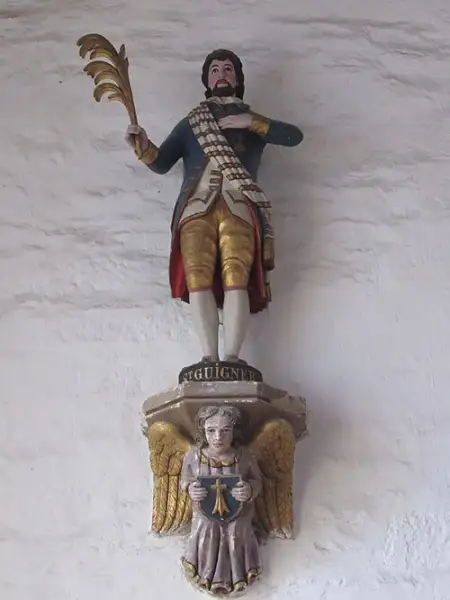
Saint Gwinear, also called Guigner, was a Celtic martyr of the age when Irish missionaries were carrying Christianity to Cornwall and Brittany, and he ranks among the very few early Cornish saints whose life story outlived the Reformation. He first saw the light in Ireland, where he was christened Fingar, and received the Christian faith at the preaching of Saint Patrick; after a sojourn in Brittany, crossed to Cornwall in the company of companions whose number tradition gives as seven, or in the fuller telling as seven hundred and seventy-seven. Landing at Hayle, the band fell into the hands of the local ruler, King Teudar, and there Gwinear and his followers won the crown of martyrdom, said in the legend to have been thrown into a pit of reptiles. A parallel Breton tradition sets the same drama across the channel, where Guigner was put to death at the order of Prince Tewdwr. The saint's Life was written in the early fourteenth century by a priest named Anselm and was at times printed among the works of Anselm of Canterbury. His feast is kept on 23 March, and his memory endures in Cornwall and in Brittany, where a statue honours him at Pluvigner.
The Complete Life
From Ossory to the Tamar
Gwinear's story begins in Ireland, where he was born under the Irish name of Fingar and where, according to his legend, he was brought to the Christian faith by Saint Patrick — an affiliation that would make him one of the earliest fruits of the Irish church. After spending time in Brittany, perhaps in one of the monastic settlements that linked the two Celtic shores, he set out with companions for Cornwall. Their number is given as seven in the shorter account, but the tradition loved the fuller figure of seven hundred and seventy-seven, a host rather than a band, and memory of the company is preserved in the dedications and holy wells of the far west. The party landed at Hayle, in the territory of King Teudar, a ruler who appears also in the early Cornish plays as the adversary of other saints. There the mission met its end: the king put Gwinear and his followers to death, the legend describing the martyrs as cast into a pit of reptiles. An alternative form of the story relocates the whole drama to Brittany, where the saint under his Breton name Guigner was slain at the hands of Prince Tewdwr — a doubling that suggests one cult serving two shores.
§ Introduction
A Life That Survived the Reformation
Gwinear holds a rare distinction among the saints of Cornwall: his Life is one of a bare two from the early Cornish church to escape the Reformation's destruction. That Life was composed in the early fourteenth century by a priest named Anselm, and its prestige was such that it was at times printed among the works of the great Anselm of Canterbury. The Breton form Guigner, preserved in that text, argued Doble, reveals the saint's ties with Brittany, whose church honours him as well — nowhere more visibly than at Pluvigner, where his statue stands in the parish church. Modern scholarship has read the legend in various keys. Sabine Baring-Gould, the Victorian clergyman and hagiographer, believed the story preserved, in distorted form, the memory of real events: Irish exiles uprooted from Ossory during the 400s who overran Penwith — a name he explained as pen-gwaeth, the bloody headland — with bloody consequences. However the legend is weighed, the cult itself is ancient and durable: a Cornish village and parish bear his name, his feast is kept on 23 March, and he is honoured in both the Catholic and Eastern Orthodox churches.
§ Introduction
Timeline
- 400
The antiquary Sabine Baring-Gould connected the legend with an Irish party driven from Ossory in the fifth century, which he held to have crossed to Penwith.
§ Introduction
- 500
Tradition places his martyrdom at Hayle in Cornwall in the sixth century, put to death with his companions by King Teudar.
§ Introduction
The Record
- Canonization
- Pre-congregation
Prayer
Bibliography
Show 4 sources
- Doble, G. H. (1960). The Saints of Cornwall: part 1. Truro: Dean and Chapter; pp. 100-110
- Ogden, R. A. The Life of Saint Gwinear [play originally written for Penzance Girls' Grammar School], in: Ogden, R. A., An Unknown Planet?, Park Corner Press, Warrington, 2008; pp. 1-52
- Ferrar, John William (1920). The Saints of Cornwall. London: Society for promoting christian knowledge. p. 15.
- Baring-Gould, Sabine, 1899, A Book of the West: Cornwall, Methuen, pp 285, 305
Profile text adapted from the Wikipedia article, licensed CC BY-SA 4.0.
Pray with this saint every day
Save St. Gwinear to your favorites, read the full profile, and get feast-day reminders in the Saints app.
Get the Saints AppFree on the App Store for iPhone and iPad