
died c. 500 or 523·Feast March 29
St. Gwladys
Queen of Gwynllyw and Mother of Cadoc
Overview
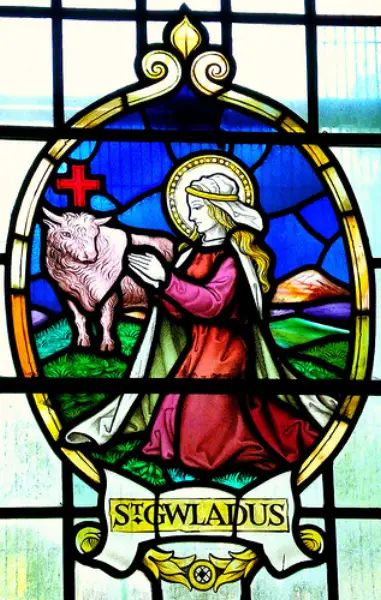
Gwladys ferch Brychan, in Latin Gladusa, was the daughter of King Brychan of Brycheiniog and the wife of the saint-king Gwynllyw Milwr, and she is best remembered as the mother of Cadoc the Wise, whose Life, set down by Lifris around 1086, may be the first hagiography anywhere to name Arthur. Cynidr, Bugi, Cyfyw, Maches, Glywys II, and Egwine were her other children. The medieval lives of Cadoc and of Gwynllyw preserve rival accounts of her marriage: in the Life of Gwynllyw the union is peaceful and the king just, while Lifris tells a story of abduction from Talgarth by Gwynllyw and his three hundred men, ending in a battle halted by Arthur, Cai, and Bedwyr. Both lives agree, however, on the marriage and on Cadoc's birth, and on the later transformation of the warrior king. Prompted by Cadoc and Gwladys, Gwynllyw abandoned violence and became a hermit on Stow Hill at Newport. Gwladys at first shared his ascetic life, then founded her own hermitage at Pencarn in Bassaleg, where a grave and a well are associated with her. She died, the sources say, around 500 or in 523, and is honored on 29 March.
The Complete Life
A Daughter of Brycheiniog
Gwladys entered history as a princess of Brycheiniog, the daughter of King Brychan, that semi-legendary patriarch whose enormous family of saintly children dominates the hagiography of Wales. Among all of Brychan's half-Irish children, the sources describe Gwladys as among the best attested, and her standing is confirmed by her appearance in the Welsh king-lists, which preserved the genealogical memory of the dynasties. Her Latin name was Gladusa, and the Welsh forms of her name, Gwladys or Gladus, have clung for centuries to churches, wells, and schools across the southeast of the country. Her father's court at Talgarth was the stage on which the first drama of her life was played, for it was from Talgarth, according to the tradition preserved by Lifris, that her future husband came to carry her off. As a daughter of Brychan she belonged to a network of sanctity rather than a merely political family: her siblings and half-siblings founded churches across Wales, Brittany, and Cornwall, and her own children would be counted among the saints of the land. Her royal birth thus became the raw material of a saintly lineage.
§ Traditional history
Two Tellings of a Marriage
The marriage of Gwladys to Gwynllyw Milwr, the warrior king of what is now Gwent, is the pivot of her story, and the two medieval lives that report it disagree about how it came to pass. The Life of Saint Gwynllyw, composed around 1120, presents the king as just and fair and the marriage as accomplished peacefully. Lifris's Vita sancti Cadoci, written around 1086, tells another tale altogether, one that resembles the abduction stories of other saints' lives and even of the Arthurian cycle, so much so that modern scholars suspect myth rather than history at work. In Lifris's version, when Gwladys's father refused to allow the marriage, Gwynllyw came with three hundred men and carried her off from Talgarth; a pitched battle followed, halted only by the intervention of King Arthur with Cai and Bedwyr on Gwynllyw's side, and even that rescue came about only once Cai had talked Arthur out of carrying off the lovely Gwladys on his own account. Be that as it may, both lives agree on the essentials: the marriage took place, and from it came Cadoc the Wise, whose fame would eclipse them both and carry his mother's name into every genealogy of Welsh saints.
§ Traditional history
From Court to Cold Water
Both medieval lives agree on the great turn of Gwynllyw's later years, and Gwladys was at the heart of it. At the urging of Cadoc and Gwladys the aged warrior gave up his violent career and sought pardon for his misdeeds; a vision then directed him to a hermitage on what is now Stow Hill in Newport. Gwladys accompanied her husband into the eremitical life, and for a while the two shared the austere manner of the Welsh ascetics, keeping fasts or a vegetable fare and bathing in the Usk's cold stream. Then, lest temptation intrude, they parted, and Gwladys established a life of her own. She founded a hermitage at Pencarn in Bassaleg, supposedly at Pont Ebbw, where tradition located her grave and where she was said to bathe in the river Ebbw, continuing the cold-water discipline of her years at Stow Hill. Her spirituality was thus double: first the hard vocation of converting a violent man by patient influence, then the solitary asceticism of a woman who had learned from the desert fathers that holiness sometimes requires putting distance even between the holy.
§ Traditional history
Pencarn and Gelligaer
The sources part company about where Gwladys's last years were spent. The tradition preserved at Bassaleg kept her memory at Pencarn, the hermitage she founded near Pont Ebbw, where a grave was shown as hers and the Ebbw's waters were recalled as her bath; the deserted site of Pencarn, together with the adjoining district of Coedkernew, keeps places that may bear on her cult. But the Life of Cadoc says that she later moved to Capel Wladus in Gelligaer, a dedication in the hill country north of Cardiff that still claims her, and the town honors her as patron to this day. A dedication to her has likewise been supposed at the Lady's Well of Tredegar, and some have thought that Bassaleg's church of St. Basil once carried her name in a latinized form. The date of her death is likewise doubled in the sources, which give it as around 500 or in 523. Her feast of 29 March is kept alike in the Roman Catholic and the Anglican calendars. The very controversy, noted already in the medieval material, testifies to more than one community claiming the honor of having sheltered her at the end.
§ Traditional history
Wells, Churches, and a School at Bargoed
Gwladys's memory settled into the landscape of southeast Wales in wells, chapels, and parishes. Her principal medieval shrine was at the hermitage of Pencarn in Bassaleg, now destroyed, where the supposed grave at Pont Ebbw drew devotion; possible further dedications survive in the Lady's Well at Tredegar and perhaps in St. Basil's, Bassaleg. She remains patroness of Newport, the city beneath the Stow Hill hermitage of her husband, and of Gelligaer, where Capel Wladus kept her name in the hills. Her family multiplied her presence: her son Cadoc became the great saint of Llancarfan, whose Life, penned by Lifris, may be the first saint's life anywhere to name Arthur, and her other children, Cynidr, Bugi, Cyfyw, Maches, Glywys II, and Egwine, were themselves enrolled among the saints. Today her main church and its associated school stand at Bargoed, where her name is borne by a living community rather than a ruin. Honored by the Roman Catholic Church and the Anglican Communion alike, and remembered on 29 March, she endures as the matriarch of one of Wales's holiest families and the queen who traded a throne for a hermit's cell.
§ Traditional history
Timeline
- 500
Dies about this year, though other sources give 523; the place of her death is disputed between Bassaleg and Gelligaer
§ Introduction
- 1086
Lifris composes the Vita sancti Cadoci, the main source preserving the stories of Gwladys's marriage and children
§ Traditional history
- 1120
The Vita sancti Gundleii is written, giving a divergent account of her union with Gwynllyw
§ Traditional history
The Record
- Major works
- Hermitage at Pencarn in Bassaleg, supposedly at Pont Ebbw
- Patron of
- Newport·Gelligaer
- Canonization
- Pre-congregation; venerated in the Roman Catholic Church and the Anglican Communion
Prayer
Bibliography
Show 7 sources
- Emanuel, Hywel David. "Brychan", Dictionary of Welsh Biography.
- Lifris, 'Vita sancti Cadoci', Vitae sanctorum Britanniae et genealogiae, ed. and trans. A. M. Wade-Evans (1944), 24–141.
- 'Vita sancti Gundleii', Vitae sanctorum Britanniae et genealogiae, ed. A. W. Wade-Evans (1944), 172–93.
- Cartwright, Jane (2002). "Dead Virgins: Feminine Sanctity in Medieval Wales". Medium Ævum. 71 (1): 1–28. doi:10.2307/43630386.
- Rees, Elizabeth (2012). A Dictionary of Celtic Saints. The History Press. ISBN 978-0-7524-9017-5.
- Baring-Gould, Sabine; Fisher, John (1911). The Lives of the British Saints: The Saints of Wales and Cornwall and Such Irish Saints as Have Dedications in Britain. Faustus to Gynaid. Part five. Honourable Society of Cymmrodorion, by C. J. Clark. ISBN 978-1-86143-099-1.
- Rees, William Jenkins (1853). Lives of the Cambro British Saints: Of the Fifth and Immediate Succeeding Centuries, from Ancient Welsh & Latin Mss. in the British Museum and Elsewhere. W. Rees.
Profile text adapted from the Wikipedia article, licensed CC BY-SA 4.0.
Pray with this saint every day
Save St. Gwladys to your favorites, read the full profile, and get feast-day reminders in the Saints app.
Get the Saints AppFree on the App Store for iPhone and iPad