
c. 450 – 529 (or 500/523)·Feast March 29
St. Gwynllyw
Warrior king of Gwynllwg and hermit of Stow Hill
Overview
Gwynllyw Filwr, known in English as Woolos the Warrior or Woolos the Bearded, was a king of Gwynllwg in South Wales around the turn of the sixth century, remembered both as a feared warlord and as a penitent hermit. The eldest and most powerful son of King Glywys of Glywysing, and by some accounts a descendant of Macsen Wledig, he received the cantref of Gwynllwg as his share of his father's divided kingdom and ruled as overlord of his brothers, among them Saint Petroc. Medieval lives portray him as a merciless raider of neighbouring kingdoms who, in the best-known tale, abducted Gwladys, daughter of King Brychan of Brycheiniog, after Brychan refused their marriage; their son was the great Saint Cadoc. Tradition holds that Cadoc's way of life and a dream in which an angel appeared beside an ox white as snow, marked with a single dark patch high upon its brow, turned the king from violence. Following the ox of his vision, he founded a wooden hermitage on Stow Hill at Newport, where he lived an ascetic life of fasting and prayer, at first with Gwladys. Dying, he was attended by his son and by Saint Dyfrig, who gave him the last sacrament. His cell became a major shrine, and the church raised above it grew into St Woolos Cathedral, seat of the Bishop of Monmouth.
The Complete Life
Eldest Son of Glywys
Gwynllyw came of the royal house of Glywysing, the powerful kingdom centred on Glamorgan whose north-west border, historians generally conclude, ran by the course of the River Loughor from near Black Mountain. His father was King Glywys, and on his death the realm was partitioned among his heirs, and Gwynllyw, firstborn and mightiest of them, ruled as overlord over the rest; the cantref of Gwynllwg, which took its name from him and which the English would later call Wentloog hundred, formed the heart of his power. Some accounts carried his pedigree higher still, making him a descendant of Macsen Wledig, while his mother Guaul was granddaughter of Cunedda, so that the blood of the legendary founders of Welsh kingdoms flowed on both sides. Among his brothers was Saint Petroc, who became a great saint of Cornwall and Brittany and the patron of Devon. Medieval king lists note Gwynllyw in his turn, and the lives of Cadoc and of Gwynllyw himself, written centuries later, agree that his deeds were celebrated by the bards — evidence of a real monarch remembered with fear and, eventually, with reverence.
§ Traditional history
The Dream of the White Ox
The turn from warrior to penitent came, by tradition, through his son. Cadoc had grown into a deeply religious man, and according to some sources it was the young saint's manner of life and words that moved Gwynllyw to lay violence aside and beg pardon for his misdeeds. Then came the dream: an angel addressed the king, and before him stood an ox, white as snow, bearing a dark mark high upon its brow. He set out in search of it, and when he found the beast of his dream he built a wooden hermitage on the spot — the summit of Stow Hill at Newport. Of that place he spoke the words his medieval life records: that no retreat in the world was like the space he was destined to inhabit, and that happy was the place, happier still the man who dwelt there. Renouncing a kingship for a hermit's cell was, the sources observe, a familiar theme among the Welsh saints, and even a violent past was no bar to holiness — Saint Illtyd shared it. What mattered was the turn: the raider of Brycheiniog became a pilgrim of God on his own hill.
§ Hermit
Ascetics of Stow Hill
Gwladys accompanied her husband into the religious life, and for a time the royal couple lived as ascetics together on Stow Hill. The discipline they followed was heroic even by the standards of the Age of Saints: fasting, abstinence from meat, and plunging into the chilly current of the Usk in every season of the year — preceded, tradition adds, by a night-time walk of a mile. On the waterless hill Gwynllyw prayed for a spring, and a miraculous fountain broke out in answer, the first of the marvels attached to the place. This shared solitude was eventually tempered at their son's urging: Cadoc persuaded his parents to separate, so that each might pursue the contemplative life without distraction, and Gwladys founded her own hermitage at Pencarn. The episode belongs to a recognisable pattern in Welsh hagiography, in which married saints part by mutual consent to follow God more freely. What remained at Stow Hill was the hermit king with his fountain and his ox, a picture that fixed itself so deeply in local memory that the beast of his dream still stands at the centre of the city's image of its founder.
§ Hermit
A Holy Death
When Gwynllyw lay dying, two figures attended him: his son Cadoc, the saint whose preaching had begun his conversion, and Saint Dyfrig, the venerable bishop of the Welsh church, who administered the last sacrament. It was a quiet ending for a man whose youth had been spent in battle and cattle-raiding, surrounded now not by warriors but by bishops and monks. His passing is commemorated on 29 March, the date tradition assigns to it, and his feast is still kept on that day. The year, however, was never settled: suggestions include 500 and 523, and the earliest reference gives 29 March 529. Even the place of his death was contested in the sources, though the strong tradition fixes it at his hermitage on Stow Hill. Controversy over such details matters little beside the fact they preserve — that the ex-warlord died in the odour of sanctity, mourned by the church he had entered late but served utterly, and was buried where he had found God, on the hill above the river. The very disagreement of the sources over the year is evidence of how widely his story circulated, each tradition fixing its own reckoning of the end.
§ Death
From Hermit's Cell to Cathedral
After his death the hermit's cell was transformed into a celebrated shrine, and believers raised a church upon the spot, rebuilding it in stone during the ninth century — a striking sign of his fame and the wealth of his shrine, for stone buildings were then rare in Wales. Part of that early fabric survives in the Galilee Chapel at the west end of the present St Woolos Cathedral, seat of the Bishop of Monmouth. His cult grew as wonders multiplied at his tomb: his fountain on Stow Hill healed those who drank from it, angels were seen near his grave, and a bard was protected from flood waters through his intercession. Devotion spread beyond the Welsh to the Saxons and Normans who settled the Newport area, and the Lords of Newport kept enlarging his church down the centuries. Later folklore made him a patron of pirates and smugglers, Sir Henry Morgan among them, and told how his Uskside ships had terrorised the Bristol Channel. In 1949 St Woolos became a full cathedral; schools and a hospital carry his name, and in 1996 Sebastien Boyesen's sculpture of the visionary and his ox set the saint at the heart of the city he founded.
§ Cathedral
Timeline
- 17 Jan 450
Born, by tradition at Gwynllwg, eldest son of King Glywys of Glywysing
§ Traditional history
- 29 Mar 529
Died on Stow Hill at Newport; one tradition fixes his death on this day, while others propose 500 or 523
§ Death
- 1100
Life of Saint Cadoc, written about this time, preserves the earliest fabled narratives of Gwynllyw's deeds
§ Traditional history
- 1949
St Woolos Church, raised over his hermitage shrine, becomes a full cathedral
§ Legacy
- 1988
Welsh-language secondary school Ysgol Gyfun Gwynllyw established at Pontypool in his memory
§ Legacy
- 1996
Sebastien Boyesen finishes The Vision of Saint Gwynllyw, a sculpture inspired by the ox of his dream, in central Newport
§ Legacy
In Their Own Words
There is no retreat in the world such as in this space which I am destined now to inhabit. Happy therefore is the place, happier then is he who inhabits it.
The Record
- Major works
- Hermitage on Stow Hill, Newport — the origins of St Woolos Cathedral
- Patron of
- Newport, Wales·Pirates·Soldiers
- Symbols
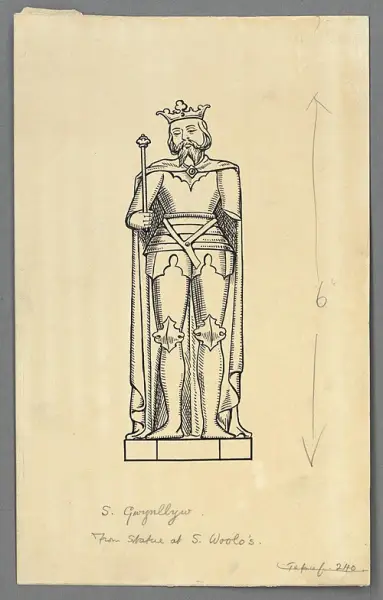
- Crowned warrior carrying a spear·Sometimes accompanied by an ox
- Canonization
- Pre-congregation; ancient cult centred at St Woolos, Newport
Prayer
Bibliography
Show 5 sources
- Farmer, David. The Oxford Dictionary of Saints, Fifth Edition Revised, p. 204. OUP Oxford, 2011. ISBN 9780199596607
- Lifris, 'Vita sancti Cadoci', Vitae sanctorum Britanniae et genealogiae, ed. and trans. A. M. Wade-Evans (1944), 24-141
- 'Vita sancti Gundleii', Vitae sanctorum Britanniae et genealogiae, ed. A. W. Wade-Evans (1944), 172-93
- Hando, F. J. (1958), Out and About in Monmouthshire, R. H. Johns, Newport
- Gwyndaf, Robin (1989), Welsh Folk Tales, National Museum of Wales, p. 96
Profile text adapted from the Wikipedia article, licensed CC BY-SA 4.0.
Pray with this saint every day
Save St. Gwynllyw to your favorites, read the full profile, and get feast-day reminders in the Saints app.
Get the Saints AppFree on the App Store for iPhone and iPad