
died c. 690·Feast February 3
St. Hadelin
Monk and Founder of the Abbey of Celles
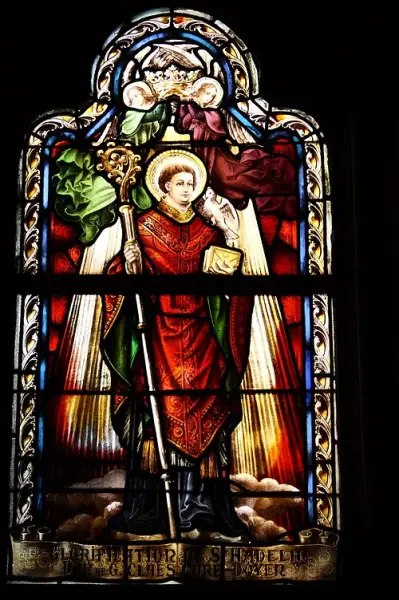
Overview
Saint Hadelin — also called Adelin or Hadelinus — was one of the scholarly monks who carried the Christian faith through the lands of the Meuse in the seventh century and helped make what is now Belgium a country of monasteries. Born of noble parentage in Guyenne, in the south-west of Gaul, he was brought north to the court of Sigebert of Austrasia, where religious and aristocratic life met. There he came under the influence of Saint Remaclus, the great missionary bishop, and became his disciple, studying first at Solignac Abbey and then at the abbey of Cougnon in the duchy of Luxemburg, before following his master to the new abbey of Stavelot in the Ardennes. When Remaclus was raised to the see of Maastricht around 651, Hadelin went with him as collaborator and confidant. His own foundations followed: in 669, aided by Remaclus and by Pepin of Herstal, he established the monastery of Celles near Dinant, and later a monastery at Visé. He ended his days in solitude as a hermit near Dinant, dying about 690, and is venerated especially in the Walloon diocese of Namur as the founder of Celles.
The Complete Life
From the Court of Sigebert to the Cloister
Hadelin's path to the cloister ran through the highest circles of Merovingian Gaul. Born in Guyenne to a noble family, he was presented at the court of Sigebert of Austrasia, the eastern kingdom in which the renewal of monastic life was then taking shape. There he encountered Saint Remaclus, the missionary abbot-bishop whose circle supplied much of the church's leadership in the Meuse valley, and he chose the scholar's habit over the courtier's cloak. Under Remaclus he received the full monastic formation of the age, beginning at Solignac Abbey in his southern homeland and continuing at the abbey of Cougnon, in what is now the duchy of Luxemburg. When Remaclus founded Stavelot Abbey in the Ardennes in 650, Hadelin moved there with him, joining the community that would become one of the great double abbeys of the Empire's borderlands. The apprenticeship made him one of the learned monks — scholarly in the best sense — on whom the evangelisation of the Belgic lands depended, and it bound him for life to the man who had formed him, a loyalty that would carry him from the cloister to the episcopal city and back again into the mission field.
§ Life
Bishop's Collaborator and Founder
Around 651 Remaclus was called from the abbacy to be bishop of Maastricht, one of the principal sees of Austrasia, and he brought Hadelin with him to share the work of the diocese. From that base the two laboured at the conversion of the region that is now Belgium, preaching, organising Christian life, and planting monastic houses as centres of the new faith. Hadelin's own foundation came in 669, and it was the work of a lifetime's connections: with the help of his old master Remaclus and of Pepin of Herstal, the potentate whose family dominated the region, he established the monastery of Celles in the wooded country surrounding Dinant. The house at Celles took root among the villages of the Namur country and endured for centuries. Hadelin did not stop there; he also founded a monastery at Visé on the Meuse, near Maastricht. But the pattern of his age drew holy men at last toward solitude, and Hadelin withdrew from his foundations to live as a hermit in the hills near Dinant, in whose quiet he died, probably around the year 690, leaving two monasteries and a wide reputation for holiness.
§ Life
Veneration in the Namur Country
Hadelin's cult settled where his work had been. He is venerated above all in the Walloon diocese of Namur as the founder of the monastery of Celles, and the town of Celles keeps him as its patron, keeping his festival on the Sunday after Our Lady's Nativity, the Marian feast the universal church observes on 8 September. His liturgical feast is observed on 3 February. The Meuse valley still bears the marks of his memory: the collegiate church of Saint Hadelin dominates Celles, parish churches carry his name at Remicourt and Maissin, and at Visé, where he founded his second house, the church of Saint Martin treasures a silver shrine in the Mosan style that holds his remains. Popular devotion assigned him a particular care for the smallest and most vulnerable — he has long been invoked against the ailments of children — and in the images of the church his attribute is a dove, the emblem of the peace his monasteries brought to the Ardennes frontier. Through the houses he planted, his quiet influence reached far beyond the Dinant country into the whole religious history of Belgium.
§ Veneration
Timeline
- 650
Moved to the abbey of Stavelot in the Ardennes, newly founded by his master Remaclus.
§ Life
- 651
Followed Remaclus, newly made bishop of Maastricht, to the episcopal city as one of his collaborators.
§ Life
- 669
Founded the monastery of Celles in the countryside around Dinant, with the help of Remaclus and Pepin of Herstal.
§ Life
- 690
Died about this year as a hermit near Dinant, after a life of monastic study and foundation.
§ Life
The Record
- Major works
- Monastery of Celles near Dinant·Monastery of Visé
- Patron of
- Patron of Celles; invoked against children's ailments
- Symbols
- Dove
- Canonization
- Pre-congregation
Prayer
Bibliography
Show 6 sources
- Goyau, Georges. "Namur." The Catholic Encyclopedia Vol. 10. New York: Robert Appleton Company, 1911.
- "Celles", Bienvenue à Houyet
- "Hadelin", Latin Saints of the Orthodox Patriarchate of Rome
- Monks of Ramsgate. "Hadelin". Book of Saints 1921. CatholicSaints.Info. 1 September 2013
- Baring-Gould, Sabine. "Hadelin", The Lives of the Saints, Volume II, London, John C. Nimmo, 1897
- Baird, Alice. "The Shrine of S. Hadelin, Visé", The Burlington Magazine for Connoisseurs, vol. 31, no. 172, 1917, pp. 20–24. JSTOR
Profile text adapted from the Wikipedia article, licensed CC BY-SA 4.0.
Pray with this saint every day
Save St. Hadelin to your favorites, read the full profile, and get feast-day reminders in the Saints app.
Get the Saints AppFree on the App Store for iPhone and iPad