
c. 1020 – 1043·Feast May 15
St. Hallvard Vebjørnsson
Norwegian martyr who died defending an innocent woman
Overview
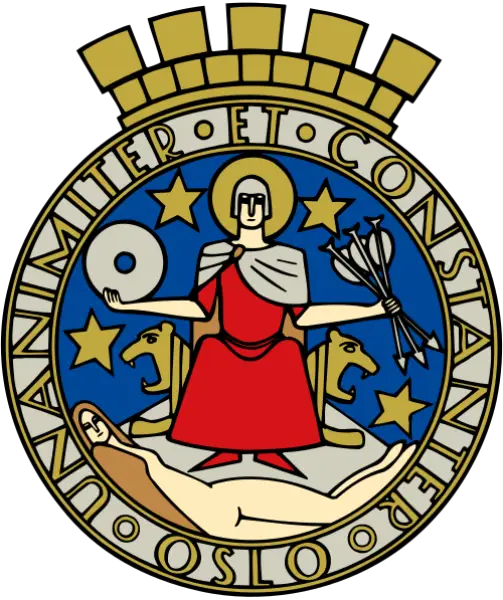
Hallvard Vebjørnsson, known in Norwegian as Hallvard Den Hellige, is the patron saint of Oslo and one of the earliest martyrs of the Norwegian church. He was born around 1020, the son of the wealthy farmers Vebjørn and Torny Gudbrandsdatter, who owned the Huseby farm at Lier in Buskerud; through his mother he was reckoned a kinswoman of St. Olaf, the patron saint of Norway. Almost nothing is recorded of his life apart from the traditional account of his death near Drammen. Taking his boat onto the Drammensfjord, he gave refuge to a pregnant enslaved woman who had fled three men accusing her of theft. Believing her innocent, he sheltered her, and both were killed by the pursuers' arrows. The killers weighted his body with a millstone and tried to sink it in the fjord, but it would not stay under the water, and the crime came to light. A village community buried him with Christian rites, and devotion to him as a martyr took root. His relics were later moved to St. Hallvard's Cathedral in Oslo, and his figure, holding the millstone and arrows of his Passion, has appeared in the city's seal since the Middle Ages. His feast falls on May 15, kept as St. Hallvard's Day, also called Oslo Day.
The Complete Life
A Farmer's Son of Lier
Hallvard was born around 1020 into a prosperous farming family of Lier in Buskerud, though the records preserve neither an exact birth date nor a certain birthplace, and every story that survives about him concerns the manner of his death near Drammen. Tradition names his father as the farmer Vebjørn, and together with his wife he owned the Huseby farm at Lier, so the household stood among the substantial freeholders of the district. Hallvard's mother, Torny Gudbrandsdatter, carried a pedigree of more than local weight: she was reported to be the daughter of Gudbrand Kula of Oppland, and through that line a sister of Åsta Gudbrandsdatter, the mother of St. Olaf. The boy thus grew up a kinsman of Norway's great royal saint and missionary king. Whatever this kinship meant in practice, it bound the family to the Christian order that Olaf's generation had impressed upon the country, and it helps explain why the memory of their son would be received so readily into the church's roll of martyrs within a generation of his death.
§ Background
The Death That Made a Saint
The whole sanctity of Hallvard rests on a single act recorded near Drammen. A pregnant woman, in all likelihood a thrall — an enslaved person — had been given sanctuary after fleeing three men who accused her of theft. When Hallvard encountered her, he judged her innocent, took her aboard his boat, and refused to surrender her. The pursuers answered with their bows: Hallvard and the woman he protected were both killed by arrows, and she was buried where she fell, on the beach. The killers then sought to erase their second victim. They bound a millstone around Hallvard's neck and tried to sink his body in the Drammensfjord, but the water refused to hold it down; the body would not remain submerged, and in this way the men's crime was discovered. The witness of the unquiet body did for the Norwegian church what formal processes would later do: a local village buried Hallvard in a Christian manner, and popular devotion acclaimed him a martyr — a man who died, as the martyrs of the early church had died, because he would not betray an innocent life entrusted to him. He was twenty-two or twenty-three years old.
§ Death
The Saint of Oslo
Devotion to Hallvard settled early and permanently at Oslo. His remains were translated to St. Hallvard's Cathedral, completed in 1130 on the hill just north of what is now the Old Town market square at the crossing of Bispegata and Oslo gate. For almost five hundred years that church stood at the center of the city's life: it was the bishop's seat, the coronation church, the setting for royal weddings, and the burial chapel of Norwegian kings. It served as a church until about 1655, decayed through the following century, and survives today as a ruin in Minneparken. Hallvard's image has stood for the city itself since the Middle Ages: the seal of Oslo shows the saint holding the millstone and the arrows that killed him, with the woman whose cause he had pleaded kneeling at his feet. May 15 is kept as St. Hallvard's Day, known also as Oslo Day. Modern Oslo has renewed the old bond: the city's highest honor, the St. Hallvard Medal, was instituted in 1950, and the saint appears within and without Oslo City Hall — Nic Schiøll's sculpture on its front face and the tapestry that Else Poulsson designed and woven by Else Halling for the Bystyresalen council chamber.
§ Veneration
Timeline
- 1020
Born at Lier in Buskerud, son of the wealthy farmers Vebjørn and Torny Gudbrandsdatter
§ Background
- 1043
Killed by arrows near Drammen together with the enslaved woman he had sheltered; his body, weighted with a millstone, refuses to sink in the Drammensfjord
§ Death
- 1130
His remains are relocated to the newly finished St. Hallvard's Cathedral in Oslo
§ Veneration
- 1950
Oslo's highest municipal honor, the St. Hallvard Medal, is named after him
§ Veneration
The Record
- Patron of
- Oslo·innocence
- Symbols
- millstone and arrows·depicted with the woman he defended at his feet
- Canonization
- Pre-congregation; acclaimed as a martyr by the local people soon after his death
Prayer
Bibliography
Show 5 sources
- "saints pour le 14 mai du calendrier ecclésiastique" [The Saints of 14 May on the Ecclesiastical Calendar]. www.forum-orthodoxe.com. Retrieved 31 May 2021.
- Anne Stensvold. "Hallvard – norsk helgen". Store norske leksikon. Retrieved 1 September 2017.
- Vera Henriksen. "Hallvard Den Hellige, helgen". Norsk biografisk leksikon. Retrieved 1 September 2017.
- "St. Hallvard". lokalhistoriewiki.no. Retrieved 1 September 2017.
- Bharti, Dr (3 September 2016). "The Gems of Oslo: The Hidden Treasures Inside Oslo City Hall". TheOsloBook. Retrieved 13 October 2024.
Profile text adapted from the Wikipedia article, licensed CC BY-SA 4.0.
Pray with this saint every day
Save St. Hallvard Vebjørnsson to your favorites, read the full profile, and get feast-day reminders in the Saints app.
Get the Saints AppFree on the App Store for iPhone and iPad