
c. 739 – 816·Feast July 12
St. Hananya
Metropolitan of Mardin and Rebuilder of Mor Hananyo
Overview
Mar Hananya, known in Syriac as Mor Hananyo and called Ananias of Mardin in Western writing, held the metropolitan see of Mardin and Kafartut in the Syriac Orthodox Church during the eighth century; he is remembered chiefly as the restorer of the monastery that has borne his name for more than a millennium. Trained as a monk — by the account of Bar Hebraeus at the Monastery of Mor Mattai near Mosul, by that of Michael the Syrian at the Knushia Monastery near Callinicus — he was consecrated metropolitan in 793 by Patriarch Quryaqos. Arriving at Mardin, he found the ancient monastery of Mor Shlemun half in ruin and bought it from the local rulers at the price of a great sum of gold, rebuilding its church and converting the derelict site into one of the chief intellectual and spiritual centres of Syriac Orthodoxy. He gathered a community of eighty monks, enriched the library with manuscripts, planted the surrounding hills with vineyards and olive groves, and endowed the house with a rebuilt village of a thousand houses and three churches. Across forty years as metropolitan he ordained close to seven hundred priests and deacons, gave away his considerable fortune to the poor, and died at seventy-seven in 816, leaving his name to Dayro d-Mor Hananyo.
The Complete Life
Formation of a Syriac Monk
Of Hananya's birth and family background almost nothing is recorded, a silence common to the biographies of Syriac prelates of the early medieval period. The sources begin with his formation, and even there they divide. According to Bar Hebraeus and the biographers who followed him, Hananya received his early education and was professed as a monk at the Monastery of Mor Mattai near Mosul, the great monastic citadel of the East that trained so many of the Syriac church's bishops. The chronicle of Michael the Syrian preserves a different memory, reporting that he may instead have been educated at the Knushia Monastery near Callinicus, the city later known as Raqqa on the Euphrates. Whichever house shaped him, both traditions agree on the essentials: a strict monastic training in the Syriac tradition of scholarship and asceticism, completed in the turbulent eighth century when the church under Umayyad and early Abbasid rule was consolidating its institutions. From the cloister he emerged onto the wider stage of the church, and in 793 his election to the metropolitan see of Mardin and Kafartut set the course of the rest of his life.
§ Life
Consecration and a Ruin Bought for Gold
In 793 Patriarch Quryaqos consecrated Hananya as the sixth metropolitan bishop ordained during his patriarchate, giving him charge of the diocese of Mardin and Kafartut in the Mesopotamian hill country of what is now south-eastern Turkey. The see he received was anchored to a disheartening inheritance: the Monastery of Mor Shlemun near Mardin, the ancient foundation that served the region, had lain partly in ruins since the early seventh century, its community dispersed and its structures failing. Hananya resolved to restore it, and the chronicle records the striking means by which he began — he purchased the site outright from the local rulers, paying a large sum of gold for the ruin. It was a transaction that joined two callings, the bishop's and the builder's, and it set the pattern of his episcopate. The monastery he took in hand was old beyond memory: the hill had first sheltered a shrine of Šamaš, the Mesopotamian sun deity, and afterwards served the Romans as a fortress, until monks gave it to Christian use in 493. Under Hananya the house was about to enter the greatest period of its history.
§ Life
Rebuilding House, Library, and Land
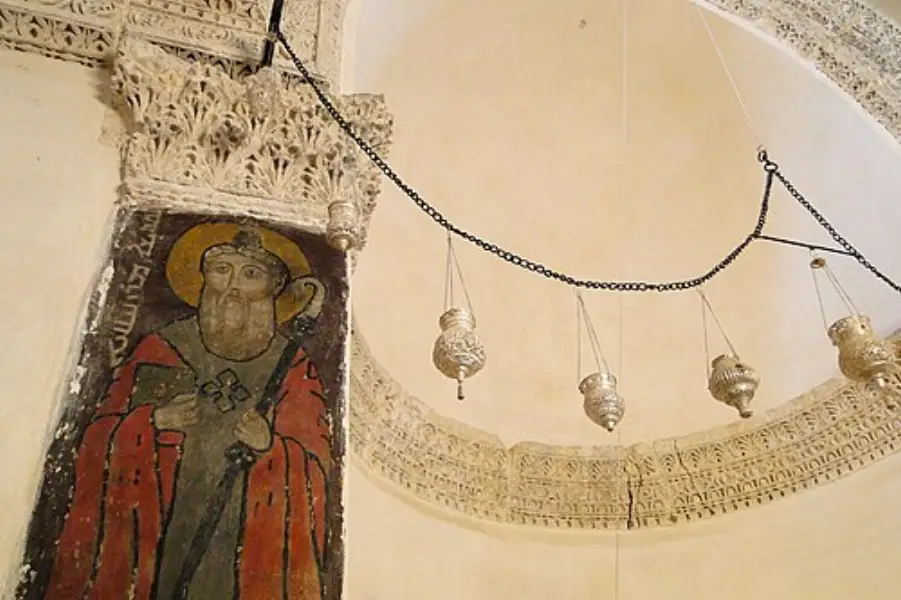
Hananya's restoration transformed the site in stone and in spirit alike. He rebuilt the monastery's church with such care that the structure — later known as the Church of Mor Hananyo, or the Domed Church — survives largely intact to this day, and within its walls future patriarchs, beginning with Michael the Great in 1166, would be enthroned. He strengthened the buildings, expanded the quarters needed for common life, and founded a grand library that grew into one of the foremost repositories of Syriac manuscripts in the whole region. Around the monastery he reshaped the land itself, planting extensive gardens, olive groves and vineyards that made the community self-sufficient and its terraces fruitful. To secure the house's income he raised from ruin the neighbouring village of Qal'at al-Imra'a — Qal'atmara — which came to number roughly a thousand dwellings and three churches at its peak, and he designated the whole village an endowment belonging to the monastery. Under his government the community grew to around eighty monks and became a flourishing centre of Syriac Orthodox monasticism, living under rules he enacted for its common life. In the church he built, a large painted portrait of Hananya himself survives, inscribed in Estrangelo script: The Saint Mar Hananya.
§ Role in the monastery
Forty Years of Ministry and a Holy Death
The measure of Hananya's episcopate is given in the numbers his biographers preserved. Across forty years as metropolitan he ordained nearly seven hundred priests and deacons for a diocese that stretched over Mardin, Dara, Khabur, Kafartut and Tellbsam — an astonishing harvest for one generation, and the sign of a church being rebuilt in the villages as surely as the monastery was rebuilt on its hill. He was widely known for piety, wisdom and generosity, and though he possessed considerable personal wealth, the memory the Syriac church kept of him was of a man who exhausted his fortune on charity, above all in support of the poor and marginalised. After twenty-three years leading the monastery he had raised from ruin, he died at the age of seventy-seven in the year 816, and was buried within the walls of the house he had restored — the house that from his time onward bore his name. His disciple Ignatius I succeeded him in the metropolitan see in the same year and carried forward his work, enlarging both the monastery and the library his master had founded.
§ Life
The Saffron Monastery and a Living Memory
Few saints have left their name to so enduring an institution. The monastery Hananya revived is known to this day as Dayro d-Mor Hananyo, named in recognition of his part in its revival, and under its Turkish name Deyrulzafaran — the Saffron Monastery, so called from the tradition that saffron was mixed into the mortar of its walls, giving them their yellow tint — it remains one of the most celebrated monuments of Syriac Christianity. For nearly eight centuries after his death the house served as the patriarchal seat of the Syriac Orthodox Church, the see from which Michael the Great and a line of patriarchs governed the church, and a centre of pilgrimage and remembrance. Hananya is honoured in the Syriac Orthodox Church on 12 July and on Whitsunday, and his commemoration dwells on the piety, wisdom and generosity of his life — on his love for the destitute and his reform of the community's discipline. In Tur Abdin and across the diaspora the faithful still sing hymns composed in his honour and make pilgrimage to the monastery where his relics rest, within the church he built beneath his own painted portrait.
§ Legacy and veneration
Timeline
- 493
The site of his future monastery, once a temple of the sun-god Šamaš and later a Roman citadel, was converted into a Christian monastery.
§ Role in the monastery
- 793
Consecrated metropolitan bishop of Mardin and Kafartut by Patriarch Quryaqos, the sixth metropolitan of his patriarchate.
§ Life
- 793
Purchased the ruined monastery of Mor Shlemun near Mardin from the local rulers for a large sum of gold and began its restoration.
§ Life
- 816
Died at the age of seventy-seven after leading the monastery for twenty-three years, and was buried within its church.
§ Life
- 816
His disciple Ignatius I took up the metropolitan office after him, going on to expand both the monastery and its library.
§ Life
- 1166
Patriarch Michael the Great was enthroned in the church Hananya had rebuilt, beginning a line of patriarchal enthronements there spanning centuries.
§ Life
The Record
- Major works
- Restoration and expansion of Mor Hananyo Monastery (Deyrulzafaran), Mardin·Rebuilding of the village of Qal'at al-Imra'a (Qal'atmara) as an endowment of the monastery
- Symbols
- Painted portrait inscribed in Estrangelo script with "The Saint Mar Hananya", preserved in the monastery church
- Canonization
- Venerated pre-congregation in the Syriac Orthodox Church; his name is held to be inscribed in the Book of Life among the saints
Prayer
Bibliography
Show 6 sources
- Ignatius Aphram I Barsoum (2008). History of the Za'faraan Monastery. Publications of the Archdiocese of the Syriac Orthodox Church. Translated by Matti Moosa. Piscataway, NJ: Gorgias Press. ISBN 978-1-59333-639-4.
- Ignatius Yacoub III (2008-09-11). History of the Monastery of Saint Matthew in Mosul. Translated by Matti Moosa. Gorgias Press. ISBN 978-1-4632-1397-8.
- Michael the Syrian (1996). Mar Gregorios Yohanna Ibrahim (ed.). Vol. 3, The General Chronicle of Michael the Syrian, Patriarch of Antioch. Translated by Mar Gregorios Saliba Shamoun. Beth Mardutho: The Syriac Institute. p. 498.
- Jin, De Wet and (2023-05-02). "Mor Hananyo Monastery: Visit Turkey's Saffron Convent in Mardin". Museum of Wander. Retrieved 2025-06-09.
- "Mor Hananyo Dayro, Turkey". www.syrianchurch.org. Archived from the original on 2007-09-27. Retrieved 2025-09-09.
- "Mor Hananyo Dayro, Turkey". syriacchristianity.in. Retrieved 2025-09-10.
Profile text adapted from the Wikipedia article, licensed CC BY-SA 4.0.
Pray with this saint every day
Save St. Hananya to your favorites, read the full profile, and get feast-day reminders in the Saints app.
Get the Saints AppFree on the App Store for iPhone and iPad