
1875 – 1969·Feast January 8
St. Harriet Bedell
Deaconess and missionary to the Cheyenne, Alaska, and Seminole
Overview
Harriet Bedell was an Episcopal deaconess and missionary whose ministry stretched from the plains of Oklahoma to the Arctic Circle and finally to the swamps of southern Florida. Born on March 19, 1875, into a prominent Buffalo family, she trained as a schoolteacher before hearing a call to missionary work and studying at St. Faith's Training School for Deaconesses in New York, where the curriculum ranged from nutrition and hygiene to medicine and theology. Her mother's fear of an overseas posting redirected her to the Cheyenne of Oklahoma, where she served ten years at the Whirlwind Mission alongside the deacon David Pendleton Oakerhater and was adopted into the tribe with the name Vicsehia, Bird Woman. Tuberculosis ended that chapter, and in 1916 she accepted the isolated mission station of Stevens Village, Alaska — forty miles below the Arctic Circle — laboring there on her own for three years among the Athabascan people and helping to bring into being an Episcopal boarding school at Tanana. Ordained a deaconess in 1922, she lost that school to the Depression in 1931 and turned instead to the Seminole of Florida, revitalizing the Glade Cross mission at Everglades City and founding the Mission of Our Savior at Collier City. For three decades she championed Seminole crafts as economic survival and cultural preservation, and she is remembered on the Episcopal Church's calendar of saints on January 8.
The Complete Life
A Buffalo Education
Harriet Bedell was born on March 19, 1875, in Buffalo, New York, into a prominent local family that counted a well-known hotelier among its members. She attended the city's public schools and qualified as a schoolteacher, the profession she was practicing when, in the early 1900s, preaching about vocations to imperial China caught her conscience and she learned of the pressing need for missionaries among the Native Americans of her own country. In 1906 she entered St. Faith's Training School for Deaconesses, a school first opened in 1891 that took the name New York Training School for Deaconesses in 1908. There she received an education of unusual breadth for a churchwoman of her day, studying topics that ran from nutrition and hygiene to medicine and theology. The combination of practical care and doctrinal formation would define her whole career, for her mission work was always at once medical, educational, and evangelical. She completed her training ready to serve wherever the Church sent her, though the first direction of her journey was settled less by her own resolve than by her mother's anxieties.
§ Early life and education
Bird Woman of the Cheyenne
When Bedell offered herself for overseas mission, her mother balked at the prospect of a posting across the ocean, and so the young deaconess went instead to Oklahoma as a missionary-teacher to the Cheyenne. Her field was the Whirlwind Mission, opened in 1897 and named after a friendly chief. There she worked alongside David Pendleton Oakerhater, the Cheyenne deacon and former warrior whose own path from Fort Marion prisoner to ordained churchman had made him a figure of national renown. Bedell cared for the sick and the poor, led religious services, and taught the women and children of the tribe. Across ten years among the Cheyenne she came to genuinely appreciate their culture, and the tribe's esteem found formal expression: she was adopted into the Cheyenne and given the name Vicsehia, meaning Bird Woman. The chapter closed through illness rather than choice. She developed tuberculosis, the occupational disease of the western missions, and was sent to Colorado to recover. Her years on the plains had formed the pattern of her vocation — service that began with learning the people before teaching them — a pattern she would repeat in Alaska and Florida.
§ Career
From the Arctic to the Everglades
In 1916 Bedell accepted one of the loneliest posts in the American church: Stevens Village, Alaska, forty miles south of the Arctic Circle, between Fort Yukon and Rampart. For three years she worked alone there among the Athabascan people, and she also helped establish an Episcopal boarding school at nearby Tanana for rural native children who had no way of reaching local day schools. Her formal ordination as deaconess came in 1922, at Portland, Oregon. The Depression proved a harder adversary than the subarctic: by 1931 the school's dependence on outside gifts had turned ruinous, and though Bedell traveled to New York and raised enough to pay off its debt, the school could not continue and closed. During her fundraising tours she had visited a Seminole reservation in South Florida, and in 1932 she returned there for good, revitalizing the Glade Cross mission at Everglades City, which Bishop William Crane Gray had founded in 1898, and opening her own Mission of Our Savior at Collier City. For the next three decades her ministry embraced whites, African Americans, and indigenous people across Southwest Florida.
§ Alaska
Crafts, Storms, and Old Age
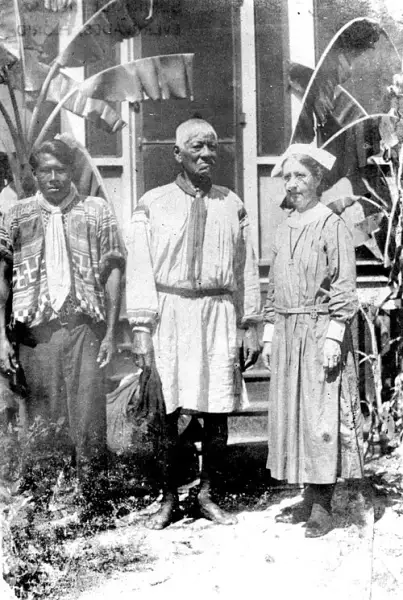
Among the Mikasuki, who called her Inkoshopie — the woman who prays — Bedell's practical wisdom found its fullest expression. Distressed that Seminole men along the Tamiami Trail wrestled alligators for tourists, she encouraged the tribe's women to revive their doll-making and basket-weaving, and to work their brilliant patchwork designs into clothing for men and women alike. She arranged sales of their work with the Collier Company and negotiated with department stores in the North, while campaigning against mislabeled imports sold in local tourist shops; the sales from the Glades Cross Mission store brought income and self-respect and preserved traditional ways. In 1947 she gave the invocation at President Truman's dedication of Everglades National Park. Officially retired by the Board of Missions at seventy-two, she kept working well into her eighties. Then Hurricane Donna struck in 1960, destroying her home and the Glade Cross mission amid a county-wide ruin of hundreds of homes. After the storm the bishop persuaded the eighty-five-year-old deaconess to take up residence at the Bishop Gray Inn in Davenport, her home for the rest of her days; there she went on recruiting missionaries, teaching Sunday School, and serving in the infirmary until her death on January 8, 1969.
§ Death and legacy
Remembered on the Calendar
Bedell was never formally canonized, for her church does not follow that process; instead the Episcopal Church keeps her memory on its calendar of saints. Southwest Florida's Episcopal diocese began keeping her memory each January 8, the day of her death, and in 2009 the observance was extended to the whole Episcopal Church in the United States when General Convention added her to the churchwide calendar. Her name had long been familiar to Episcopalians through her own pen, for she ranked among the most popular writers in the national mission periodical The Spirit of Missions, and through the biography A Woman Set Apart published in her lifetime's aftermath. The civil honors that followed her death matched the ecclesiastical ones: Florida listed her among its Great Floridians and placed a commemorative plaque at the museum in Everglades City. The state now keeps her papers, publishing many of the photographs of her Seminole missions online, so that scholars and the faithful alike can still follow the woman who prayed from the Arctic Circle to the Everglades.
§ Death and legacy
A Model of Respectful Mission
Bedell's legacy rests on a way of doing mission that anticipated much later thinking. In each of her three fields she learned the culture before attempting to change it, accepted honors from the peoples she served — adoption into the Cheyenne as Vicsehia, the Mikasuki name Inkoshopie — and directed her energy toward preserving what her hosts valued rather than erasing it. Her insistence that Seminole women sell genuine handicrafts, and her fight against mislabeled imports in the tourist trade, made economic justice an instrument of cultural survival, helping traditional doll-making, basketry, and patchwork endure into the present. The institutions she built outlasted her in varied forms: the Glade Cross mission's work passed to successors, the Mission of Our Savior moved to Goodland after Collier City disbanded in 1957, and the boarding school tradition she served in Alaska remained part of the church's memory of its northern work. Historians of Florida, notably Charlton Tebeau in his history of Collier County, recorded her as a founder figure of the region, and the Episcopal Church's calendar now sets her beside the missionaries and deacons she once served under. On January 8 each year the church thanks God for a woman who treated every people as fully her neighbor.
§ Florida
Timeline
- 19 Mar 1875
Born in Buffalo, New York, into a prominent local family
§ Early life and education
- 1906
Studies at St. Faith's Training School for Deaconesses in New York, covering nutrition, hygiene, medicine, and theology
§ Early life and education
- 1916
Accepts a remote missionary post at Stevens Village, Alaska, forty miles south of the Arctic Circle, serving the Athabascan people alone for three years
§ Alaska
- 1922
Travels to Portland, Oregon, and is formally ordained as a deaconess
§ Alaska
- 1931
Raises funds in New York to pay off the Tanana school's debt during the Great Depression, though the school still has to close
§ Alaska
- 1932
Returns to South Florida and revitalizes the Glade Cross mission at Everglades City among the Seminole
§ Florida
- 1943
Secures St. Stephens Episcopal Church in Coconut Grove as the funding source for the Glades mission
§ Florida
- 1947
Gives the invocation at President Harry S. Truman's dedication of Everglades National Park
§ Florida
- 1957
Her Mission of Our Savior moves from Collier City to Goodland after the former city disbands
§ Florida
- 1960
Hurricane Donna destroys her home and the Glade Cross mission
§ Florida
- 8 Jan 1969
Dies aged ninety-three; she is buried in Forest Hill Cemetery in Haines City, Polk County
§ Death and legacy
- 2009
Her January 8 feast day is extended to the whole Episcopal Church (USA)
§ Death and legacy
The Record
- Major works
- Whirlwind Mission, Oklahoma (missionary-teacher)·Episcopal boarding school at Tanana, Alaska·Glade Cross Mission, Everglades City, Florida·Mission of Our Savior, Collier City, Florida
- Patron of
- Seminole crafts revival·Episcopal Diocese of Southwest Florida
- Symbols
- deaconess habit·Seminole patchwork and basketry
- Canonization
- No canonization; commemorated on the calendar of saints of the Episcopal Church (USA), where her January 8 feast was extended churchwide in 2009
Prayer
Bibliography
Show 8 sources
- Tebeau, Charlton W. (1966) [1957]. Florida's Last Frontier: the History of Collier County (2nd ed.). Miami: University of Miami Press. ISBN 0-87024-002-1.
- "William Reed Huntington". The Churchman. C (5). New York City: 160–1. July 31, 1909.
- Huntington, W. R. (1909). "Report of the New York Training School for Deaconesses (November 11, 1908)". Journal of the Proceedings of the Annual Convention of the Protestant Episcopal Church in the State of New York (125). New York City: Episcopal Church, Diocese of New York: 100.
- "Harriet M. Bedell". Episcopal Women History Project.
- Lesser Feast and Fasts: 2006. Church Publishing, 2006.
- "Bedell Collection". Florida Memory, Institute of Library and Museum Services, State of Florida. July 18, 2022.
- "Deaconess of the 'Glades". St. Petersburg Times. August 8, 1954. p. 94.
- "Acts of Convention: Resolution # 2009-A095". www.episcopalarchives.org. Retrieved 2022-07-18.
Profile text adapted from the Wikipedia article, licensed CC BY-SA 4.0.
Pray with this saint every day
Save St. Harriet Bedell to your favorites, read the full profile, and get feast-day reminders in the Saints app.
Get the Saints AppFree on the App Store for iPhone and iPad