
1174 – 1243·Feast October 16
St. Hedwig of Silesia
Duchess, widow, and mother of Silesian sanctity
Overview
Hedwig of Silesia, born into the Bavarian comital house of Andechs in 1174, became by marriage the most consequential woman in thirteenth-century Poland. At twelve she was wed to Henry I the Bearded of the Piast line, and as Duchess of Silesia from 1201, Duchess of Greater Poland from 1231, and High Duchess consort of Poland from 1232, she stood beside a husband who united more Polish territory than any lord since the fragmentation of the realm. She used that station charitably: hospitals for the sick and lepers, the Augustinian provostry of Nowogród Bobrzański, the Templar commandery at Oleśnica Mała, and above all Trzebnica Abbey, the Cistercian nunnery founded in 1202 at her request, where Henry was buried in 1238 and where she then lived as a lay sister without vows. She welcomed German settlers and religious into Silesia, gave her whole fortune to the Church, and let no one leave her presence uncomforted. Her son Henry II the Pious fell at Legnica against the Mongols in 1241. She died at Trzebnica on 15 October 1243, was canonized by Clement IV in 1267, and remains principal patroness of Silesia.
The Complete Life
A Daughter of the Andechs
Hedwig was born in 1174 at Andechs Castle in the Duchy of Bavaria, a child of the comital house of Andechs, one of the most advantageously connected families of the German south. Her father, Count Berthold IV, was margrave of Carniola and Istria, and her mother was Agnes of Wettin. The marriages of her siblings read like a map of Latin Europe: her sister Agnes became queen of France, her sister Gertrude married Andrew II of Hungary, her brother Ekbert held the bishopric of Bamberg, Berthold rose to the archbishopric of Kalocsa and the patriarchal see of Aquileia, and Henry, holding the Istrian march, ranked as Carniola's first lord. Through Gertrude she became aunt to Elizabeth of Hungary, the great thirteenth-century saint of charity. Hedwig herself was educated at the Benedictine Abbey of Kitzingen in Franconia, where her youngest sister Matilda would one day serve as abbess. The formation given to a noble daughter in such a house joined rank with religion, and in Hedwig the two would prove inseparable: a princess whose piety was formed in a monastery before she was old enough to choose her own life.
§ Life
The Duchess of the Piast Lands
At twelve years old Hedwig was married to Henry I the Bearded, son and heir of Boleslaus the Tall, duke of Silesia of the Piast dynasty, and for four decades she was a partner in one of the most successful political enterprises of fragmented Poland. When Henry succeeded his father in 1201 he had at once to fight his Piast kin, beginning with Duke Mieszko IV Tanglefoot, who seized the Upper Silesian duchy of Opole. There followed the swap of the Lubusz Land for Kalisz agreed with Władysław III Spindleshanks in 1206, the furious resistance of Władysław Odonic, and the catastrophe of the congress at Gąsawa in 1227, where Henry barely saved his life while High Duke Leszek I the White was murdered. Hedwig's own political act is the best recorded: in 1229, when Konrad I of Masovia captured Henry and held him at Płock Castle, she went in person to Płock to plead for him and won his freedom. After Władysław III died in 1231, Henry gained Greater Poland and then, in 1232, the High Dukedom at Kraków — the first Silesian Piast to reunite rule over Silesia and the Seniorate Province since the testament of 1138 divided them.
§ Duchess consort
Founding, Settling, and Serving
The ducal couple governed as builders. In 1202, at Hedwig's request, Henry established Trzebnica Abbey, a Cistercian monastery of nuns in the Silesian hills that would become the family's burying place and the center of her widowhood. The two of them stood behind the Augustinian provostry of Nowogród Bobrzański and the house the Knights Templar kept at Oleśnica Mała. Hedwig threw herself into the settlement of her adopted land: she drew German religious from the Holy Roman Empire into Silesia and encouraged the German settlers who, in the movement known as the Ostsiedlung, founded numerous cities, towns, and villages and brought barren stretches of Silesia under the plough. Her charity was personal and unsparing. She helped the poor, widows, and orphans as a matter of course, founded several hospitals for the sick and for lepers, and in the end gave her whole fortune to the Church. She permitted no one to go away from her uncomforted, and once spent ten weeks teaching the Our Father, word by word, to a poor woman who wished to learn it. In her the ducal office became a form of alms distributed from the treasury of a whole province.
§ Widow
Piety of the Barefoot Duchess
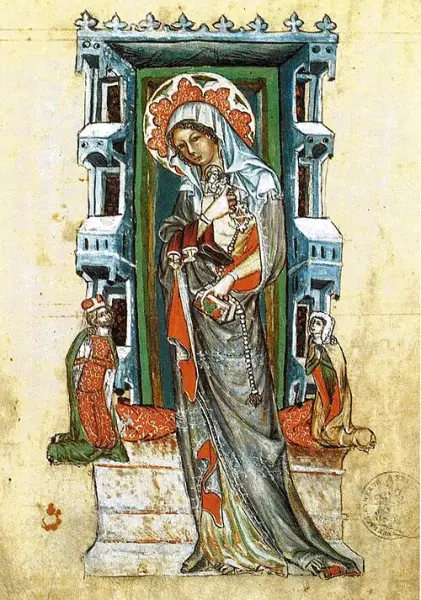
Contemporary memory preserved Hedwig's religion in details of the body rather than formulas. She and Henry had lived piously, but her zeal for the faith was remembered as something beyond her husband's. Legend tells that she went barefoot even in winter, and that when the Bishop of Wrocław urged her to protect her feet she carried her shoes in her hands instead — the image that iconography fixed forever, the duchess with a pair of shoes held before her. Her widowhood was lived as a kind of conversion without vows: after Henry's death in 1238 she accepted the loss with the words recorded of her, asking whether one would oppose the will of God, since their lives were His, and moved into Trzebnica Abbey, where her daughter Gertrude led the community. There she assumed the religious habit of a lay sister, taking no vows, obedient to the discipline of a house she had founded while remaining free of its legal bonds. Ten weeks spent teaching one poor woman a single prayer tells more of her spirituality than any chronicler's summary: faith received slowly, personally, and passed on hand to hand, at the pace of the weakest learner.
§ Widow
Legnica and the Widow of Trzebnica
The last years of Hedwig's life carried the heaviest blows of her long story. Henry I died in 1238 and was buried at Trzebnica, the abbey she had asked of him four decades earlier; she entered the community and lived there as a lay sister until her own death. Their only surviving son, Henry II the Pious, succeeded as Duke of Silesia and Polish High Duke, and in 1241 the Mongol invasion of Poland swept toward the west. At Legnica on 9 April 1241 Henry II was killed in the great battle, waiting in vain for the promised support of Emperor Frederick II. The hope of a reunited Poland died with him, and Silesia itself splintered into numerous Piast duchies under his sons. Hedwig, in her late sixties, answered the catastrophe in her habitual language of foundations: with her daughter-in-law Anna of Bohemia, the widowed queen consort, she established a Benedictine abbey on the battlefield itself at Legnickie Pole, settled with monks brought from Opatovice in Bohemia, so that the ground where her son fell would never again be prayed over by no one. There she spent her final seasons of prayer until her death on 15 October 1243.
§ Widow
Raised to the Altars, 1267
Hedwig was the first woman of the Piast lands to be canonized. On 26 March 1267 Pope Clement IV enrolled her among the saints, acting at the suggestion of her grandson, Prince-Archbishop Władysław of Salzburg, and with the goodwill of a pope who was himself a friend of the Cistercian order that her Trzebnica nunnery had planted in Silesia. The canonization came only twenty-four years after her death, within the living memory of those who had seen the barefoot duchess on the roads of her duchy, and it ratified a cult already flourishing around her tomb beside Henry's at Trzebnica. Her feast entered the General Roman Calendar on 16 October, the day after her death in the liturgical reckoning of the calendar; in Canada it is kept on 20 October. The Order of Saint Paul the First Hermit, who honor her as a great benefactor, celebrate her on 8 June. A seventeenth-century legend adds a final journey to her story: that while on pilgrimage to Rome she stopped at Bad Zell in Austria, where healing waters rose at a source that still bears her name.
§ Veneration
Patroness of Silesia and of Two Nations
Few medieval saints have remained so continuously useful to the communities that venerate them. Hedwig is patroness of Silesia, of Andechs, of the archdiocese of Wrocław and the diocese of Görlitz, of Berlin and Brandenburg, of Kraków, of Poland, of Trzebnica, and of orphans. In 1773 Frederick the Great, having annexed most of Silesia, ordered St. Hedwig's built in Berlin for the Catholic Upper Silesians streaming into his capital — a church that became in 1930 the cathedral of the Archdiocese of Berlin. When the Germans were expelled from Silesia after 1945, the exiles carried her veneration with them across the whole of remaining Germany, while Poles kept her as their own national patroness, calling her Jadwiga Śląska. Her major shrines stand at Andechs Abbey in Bavaria and at St. Hedwig's Cathedral in Berlin, while her body rested at Trzebnica until its traces were lost; in March 2020 the discovery of her remains was reported, found in her sanctuary in a silver casket whose lead tablet confirmed the identity of the saint. Even the everyday landscape remembers her: the drinking glasses called Hedwig glasses take their name from her. She belongs at once to Germany and to Poland, a saint of the border both peoples share.
§ Veneration
Timeline
- 1174
Born at Andechs Castle in Bavaria, daughter of Count Berthold IV of Andechs and Agnes of Wettin.
§ Life
- 1186
Married at the age of twelve to Henry I the Bearded, heir of the Piast duke Boleslaus the Tall of Silesia.
§ Duchess consort
- 1201
Became Duchess of Silesia when Henry succeeded his father and at once had to contend with Piast rivals for the duchies.
§ Duchess consort
- 1202
Trzebnica Abbey, the Cistercian nunnery that would define her widowhood, was established at her request.
§ Widow
- 1227
At the congress of Gąsawa her husband narrowly escaped death while High Duke Leszek I the White was killed by Pomerelian attackers.
§ Duchess consort
- 1229
Traveled to Płock to plead for Henry, whom Duke Konrad I of Masovia had seized and imprisoned, and obtained his release.
§ Duchess consort
- 1231
On the death of Władysław III Spindleshanks, Henry took rule of Greater Poland, extending Hedwig's ducal standing.
§ Duchess consort
- 1232
Henry prevailed as High Duke at Kraków, making Hedwig High Duchess consort of Poland until 1238.
§ Duchess consort
- 1238
Henry I died and was buried at Trzebnica; Hedwig accepted his death with faith and moved into the abbey as a lay sister.
§ Widow
- 9 Apr 1241
Her only surviving son, Henry II the Pious, was killed at the Battle of Legnica during the first Mongol invasion of Poland.
§ Widow
- 1241
Together with her daughter-in-law Anna of Bohemia, established a Benedictine abbey at the battlefield of Legnickie Pole, settled with monks from Bohemia.
§ Widow
- 15 Oct 1243
Died and was buried at Trzebnica Abbey beside her husband; her relics are also preserved at Andechs and in Berlin.
§ Widow
- 26 Mar 1267
Canonized by Pope Clement IV at the suggestion of her grandson, Prince-Archbishop Władysław of Salzburg.
§ Veneration
- 1773
Frederick the Great had St. Hedwig's church built in Berlin for Upper Silesian Catholics; it became a cathedral in 1930.
§ Veneration
- Mar 2020
Her remains, missing for centuries, were found at Trzebnica in a silver casket with a lead tablet confirming her identity.
§ Veneration
In Their Own Words
Would you oppose the will of God? Our lives are His.
The Record
- Major works
- Trzebnica Abbey, Cistercian nunnery established at her request in 1202·Hospitals for the sick and for lepers founded across Silesia·Augustinian provostry at Nowogród Bobrzański, supported jointly with Henry I·Commandery of the Knights Templar at Oleśnica Mała·Benedictine abbey at Legnickie Pole, founded with Anna of Bohemia
- Patron of
- Silesia·Andechs·Brandenburg·Kraków·Poland·Trzebnica·Wrocław·Dioceses of Berlin and Görlitz·orphans
- Symbols
- holding a church·a pair of shoes carried in her hands
- Canonization
- Canonized on 26 March 1267 by Pope Clement IV
Prayer
Bibliography
Show 7 sources
- Drake, Maurice and Drake, Wilfred (1916). Saints and their Emblems. London: T. Werner Laurie Ltd. p. 59.
- Knoblich, Augustin (1860). Lebensgeschichte der heiligen Hedwig, Herzogin und Landespatronin von Schlesien. 1174-1243. Breslau: Schletter.
- Kirsch, Johann Peter (1910). "St. Hedwig." The Catholic Encyclopedia. Vol. 7. New York: Robert Appleton Company. Retrieved 18 February 2007.
- Słownik historii Polski (in Polish). Warszawa: Wiedza Powszechna. 1973. p. 142.
- Pirlo, Fr. Paolo O., SHMI (1997). "St. Hedwig." My First Book of Saints. Sons of Holy Mary Immaculate - Quality Catholic Publications. pp. 243-244. ISBN 971-91595-4-5.
- "Liturgical Calendar." The Australian Province of the Order of Saint Paul the First Hermit. 29 August 2022. Retrieved 29 August 2022.
- Dowell, Stuart (16 March 2020). "Bones of 13th century saint found hidden inside small silver coffin." The First News.
Profile text adapted from the Wikipedia article, licensed CC BY-SA 4.0.
Pray with this saint every day
Save St. Hedwig of Silesia to your favorites, read the full profile, and get feast-day reminders in the Saints app.
Get the Saints AppFree on the App Store for iPhone and iPad