
c. 970 – 1019·Feast June 28
St. Heimerad
Wandering preacher and fool for Christ of Hasungen
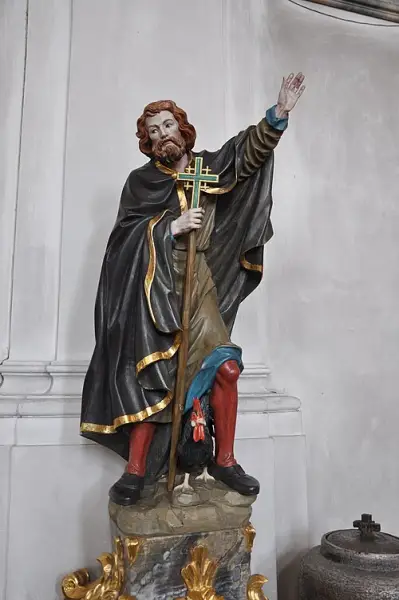
Overview
Heimerad — called also Heimrad, Haimrad, or Heimo — was a German priest and travelling preacher whose holy folly scandalized the abbeys and instructed the crowds of eleventh-century Germany. Born around 970 at Meßkirch near the Bodensee in Baden, to unfree parents, he made pilgrimages through Germany, Italy, and Palestine before attempting the cloistered life. As a monk of Hersfeld Abbey he was expelled after a quarrel over the garb the order wore; the monastery at Paderborn refused him as well. His odd and arresting manner of life got him expelled from town after town, and he grew more desolate as he went, until at last he lighted on the Hasunger Berg, the rise near Kassel now called Burghasungen, and made his hermitage there. Mocked at first even in that place, he came in time to be honored as a saint, and the great of the empire — the empress Kunigunde, Bishop Meinwerk of Paderborn, Archbishop Aribo of Mainz — asked his counsel. He died on 28 June 1019, the day kept as his feast. Two years later a church rose over his grave, and around it grew Hasungen Abbey, for a season among the most visited pilgrimages of Germany.
The Complete Life
Born Unfree at Meßkirch
Heimerad entered the world around the year 970 at Meßkirch, a small town near the Bodensee in what is now the German southwest, and the sources are explicit about the station of his family: he was born of unfree parents, a serf's child in a society that ranked men by the soil they were bound to. That origin throws the whole shape of his life into relief. He was not a nobleman's son offered to the Church as a career; he belonged to the class that could not travel, contract, or choose its lord, and yet he spent his youth in the most restless form of medieval piety there was. Pilgrimage was the unfree man's impossible vocation, for it required the very freedom he did not possess, and Heimerad took it nonetheless, walking through Germany and Italy and across the sea to Palestine, to the shrines where the Christian story had happened. Whatever conversion or compulsion set him on the road, the journey itself formed the man his biographer would later describe: a wanderer who never quite belonged to any house, any order, or any place, and who made of that homelessness a way to God.
§ Life
Expelled from Hersfeld, Refused at Paderborn
When the pilgrim at last tried to settle into the ordinary structures of religious life, the structures rejected him. He became a monk at Hersfeld Abbey, the great imperial monastery in Hesse, but his stay there ended when he was driven out over a quarrel concerning the garb of the order — a fight about the habit that suggests how far he already stood from the conventual temperament, taking the outward signs of the religious life with a literal or an eccentric seriousness that his brethren could not absorb. He presented himself next at the monastery of Paderborn, and was not accepted there either. The pattern then repeated through the German lands: his conspicuous, out-of-the-ordinary manner of life made him unwelcome everywhere, and with each rejection he grew more desolate. It is the biography of a failure by every conventional measure — no abbey would hold him, no bishop employed him, no rule governed him — and yet his eleventh-century admirers read the same record in exactly the opposite sense. The man whom the cloisters could not tame was being pruned for a different planting, and the desolation itself was the road to the hill where his life would find its place.
§ Life
The Fool on the Hasunger Berg
At length Heimerad lighted on the Hasunger Berg, the rise near Kassel that today bears the name Burghasungen, and settled his hermitage there; with that, the direction of his story turned. The honorific title his cult settled on — fool for Christ — names the form his sanctity took: a conspicuous, unusual manner of life that invited scorn and drew the Spirit's power at once. At first the neighbors mocked and scorned him even on his own hill, but with the passage of time mockery gave way to reverence, until he was honored as a saint and men of standing in the empire began asking what he thought. He was acquainted with the Empress Kunigunde, consort of Henry II; with Bishop Meinwerk of Paderborn, the same see whose monastery had refused him; and with Aribo, Archbishop of Mainz, the Primate of Germany. A man excommunicated by every cloister had become a counselor whom empresses and archbishops consulted. The reversal is the point of his cult: the hermitage on a bare hill became, without title or foundation charter, a place where the powerful came down from their stations to ask an unfree man's son how their souls stood before God.
§ Life
Grave, Abbey, and the Long Decline of the Cult
Heimerad died on 28 June 1019, and the movement from scorn to sanctuary continued after his death. Two years later, in 1021, Archbishop Aribo of Mainz built a church over his grave on the Hasunger Berg, and in 1074 that church became the nucleus of Hasungen Abbey, a monastery founded on the site of the hermitage that no abbey had wanted him to join in life. His story reached the learned world through the life composed by Ekkebert, a monk of Hersfeld, sometime in the years from 1072 to 1090, which stands as the chief source for everything known of him. Pilgrimage to his grave climbed to its high point in the later eleventh century, when Hasungen stood second among the pilgrimages of Germany, yielding first place only to Sebaldus's tomb at Nuremberg — an extraordinary rank for a local holy man of unfree birth. The cult could not survive the institutions that housed it. After the dissolution of Hasungen Abbey in the sixteenth century, veneration of Heimerad fell away drastically, and today he is honored quietly in both the Eastern Orthodox and Roman Catholic Churches, his feast kept on 28 June, the day of his death.
§ Life
Timeline
- 970
Born around this year at Meßkirch near the Bodensee in Baden, of unfree parents.
§ Life
- 28 Jun 1019
Died on the Hasunger Berg near Kassel; the date became his feast day.
§ Life
- 1021
Aribo, Archbishop of Mainz, raised a church above Heimerad's resting place on the Hasunger Berg within two years of his burial.
§ Life
- 1074
Hasungen Abbey was founded around the church at his grave, giving his memory a monastic home.
§ Life
The Record
- Canonization
- Pre-congregation; venerated in the Eastern Orthodox and Roman Catholic Churches
Prayer
Bibliography
Show 4 sources
- "Latin Saints of the Orthodox Patriarchate of Rome." www.orthodoxengland.org.uk. Retrieved 2024-09-22.
- Ekkebert von Hersfeld: Vita sancti Haimeradi, ed. R. Köpke, in: Monumenta Germaniae Historica, Scriptores in folio, Bd. 10.
- Keller, Hagen (1967). "Adelheiliger und pauper Christi in Ekkeberts Vita sancti Haimeradi." In J. Fleckenstein und Karl Schmid (eds.): Adel und Kirche. Gerd Tellenbach zum 65. Geburtstag. Freiburg. pp. 307-323.
- Struve, Tilman (1969). "Hersfeld, Hasungen und die Vita Haimeradi." Archiv für Kulturgeschichte, Band 51, Heft 2. pp. 210-233.
Profile text adapted from the Wikipedia article, licensed CC BY-SA 4.0.
Pray with this saint every day
Save St. Heimerad to your favorites, read the full profile, and get feast-day reminders in the Saints app.
Get the Saints AppFree on the App Store for iPhone and iPad