
c. 1235 – 1314·Feast November 12
St. Helen of Serbia
Queen of Serbia and Builder of Churches
Overview
Saint Helen of Serbia, known to Serbian tradition as Sveta Jelena Srpska, was queen consort of the Serbian Kingdom as the wife of King Stefan Uroš I, whose reign ran from 1243 to 1276, and mother of two further kings, Stefan Dragutin and Stefan Milutin. Born about 1235 into a family her biographer calls French, she married Uroš around 1245–1250 and proved one of the most capable figures of the Nemanjić dynasty. After her husband's overthrow in 1276 she became dowager queen, governing the provinces of Zeta and Travunija until 1308 with a success that won praise for her even-handed rule over a population mixed between Serbian Orthodox and Roman Catholic faithful — an instance of the religious tolerance for which she was known. Her cultural work was equally lasting: she kept a library at her court, had books copied out in the monasteries, opened a school for girls such as the kingdom had never seen, and raised and renewed churches and monasteries across the land, above all Gradac Monastery, where she was buried. She ended her life as a nun at the Church of St. Nicholas in Skadar and died there on 8 February 1314. The Eastern Orthodox Church venerates her as a saint, though her relics have been lost.
The Complete Life
A Queen of Uncertain Blood
The origins of Helen are among the most debated genealogical questions of medieval Serbia, and the sources that might answer it are tantalisingly brief. Her hagiography, written by Serbian Archbishop Danilo II, says no more than that she belonged to a family from France, and the life of her husband, King Stefan Uroš I, repeats the statement while adding that she came of imperial stock. By the early twentieth century, scholars attempting to trace her ancestry had fixed on her sister, or half-sister, Maria, whose family is better documented in western archives. The Angevine kings of Naples in the 1280s and 1290s addressed Queen Helen as their dear cousin, and from these notices some writers of the 1920s and 1930s — journalists, publicists and a few scholars — fashioned the theory of an Angevin birth, coining the name Helen of Anjou, though direct descent from the House of Anjou found no supporting evidence. The historian Gordon McDaniel later proposed a firmer reconstruction: that Maria of Cayeux and Helen were sisters or half-sisters, daughters of John Angelos of Syrmia and Matilda of Požega, and that through their father they descended from a collateral branch of the Byzantine House of Angelos and the Hungarian royal House of Árpád. Several scholars have since accepted this account.
§ Origin
Queen and Dowager Ruler
Helen married King Stefan Uroš I of Serbia around 1245–1250 and bore him at least three children who reached maturity: the future kings Stefan Dragutin and Stefan Milutin, and a daughter, Brnjača, who in time became a nun. Her years as queen ended in family tragedy: in 1276 the king quarrelled with their firstborn son, Dragutin, and was forced from the throne, dying four years later. Yet Helen's public career continued and, in material terms, flourished. Through the reigns of her sons Dragutin (1276–1282) and Milutin (1282–1321), the dowager queen held provincial administration over the regions of Zeta and Travunia, retaining the governorship until 1308. Contemporaries judged her a successful administrator, governing territories whose population was mixed between Serbian Orthodox and Roman Catholic believers, and her even-handedness became the byword for the religious tolerance that marked her whole career. She maintained her own court and household in the western lands, with a palace at Brnjak in what is now Kosovo and the town of Jeleč at Rogozna mountain among her possessions — a dowager's domain administered with the competence of a born ruler.
§ Queen of Serbia
Schools, Scribes, and Sanctuaries
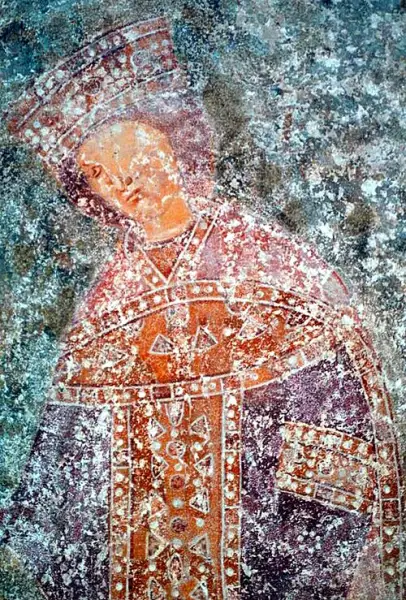
Among the women of her dynasty, Helen did more than any other to advance the culture of the Serbian kingdom. At her court she maintained a library, and she actively encouraged the transcription of books in the monasteries, feeding the young Serbian literary culture with copies of the works it needed. She opened a school for girls — the first the kingdom had seen — an undertaking without precedent in the land. Like other members of the Nemanjić dynasty she was a builder on a grand scale: she raised the Gradac Monastery, in which she would be buried; she built the Church of St. Nicholas in Skadar, in which she would die; and she renewed the Monastery of Saints Sergius and Bacchus. Her charity reached beyond her own foundations, for she repaired and rebuilt many of the churches and monasteries around Lake Skadar that the Mongol invasion of 1242 had left devastated. Frescoes of her survive in Serbian monasteries — at Sopoćani, where she appears with her husband and eldest son, and at Gračanica — testimony to the honour in which the dynasty and the church held her even in her lifetime. Her signature, preserved on documents from 1304, is among the earliest known autographs of any Serbian royal woman.
§ Life
The Nun of Skadar
Helen's last years followed the pattern she had already set for her daughter: withdrawal from the world into the monastic habit. Toward the end of her long life she became a nun at the Church of St. Nicholas in Skadar, the church of her own founding on the shore of the lake, and there, on 8 February 1314, she died at the age of about seventy-eight, outliving both her husband and, by then, the governorship she had exercised into her seventies. Her body was carried to the monastery she had built at Gradac, and she was buried there among the foundations of her own making. The church she had served honoured her memory from the first; her cult as a saint grew in the Serbian lands, and her feast came to be kept on 12 November, corresponding to 30 October in the old calendar. Of her earthly remains the sad note must be recorded: in the centuries of war and upheaval that followed, her relics were lost, so that the church venerates her memory without her body. The loss has not diminished her standing among the saints of the Serbian people.
§ Queen of Serbia
Saint of the Serbian Orthodox Church
Helen was canonized by the Serbian Orthodox Church and stands in its calendar of saints as Sveta Jelena Srpska, Saint Helen of Serbia, her feast day falling on 12 November (30 October old style). Her veneration unites two strands of her memory: the queen of the Nemanjić dynasty, depicted in the frescoes of Sopoćani and Gračanica among the rulers of the holy house, and the church-builder whose monasteries and schools carried Serbian Christian culture forward. She is numbered among the royal saints of Serbia, in the company of her dynasty's monk-kings and queens, and the lists of Serbian saints keep her name beside those of her descendants' church. As a Western-born woman who died a nun of the Orthodox Church, she embodies the meeting of Latin and Byzantine Christianity that her tolerant governance practised in life; her rule over mixed Orthodox and Catholic populations is remembered alongside her sanctity as the quality that made her governance praiseworthy. Pilgrims venerate her at Gradac Monastery, the house she built for her burial, which remains a working monastery and a place of her cult to this day.
§ Life
Timeline
- 1235
Born around this year into a family of French origin, according to the hagiography written by Archbishop Danilo II.
§ Origin
- 1242
The Mongol invasion devastated the churches and monasteries around Lake Skadar, which she would later repair and rebuild.
§ Life
- 1245
Married King Stefan Uroš I of Serbia, becoming queen consort of the Serbian Kingdom.
§ Queen of Serbia
- 1276
Open strife arose between King Uroš and his heir Dragutin, and the king gave up his throne.
§ Queen of Serbia
- 1280
Her deposed husband, King Stefan Uroš I, died.
§ Queen of Serbia
- 1308
Her governorship of Zeta and Travunija, held under the reigns of her sons Dragutin and Milutin, came to an end.
§ Queen of Serbia
- 8 Feb 1314
Died as a nun at the Church of St. Nicholas in Skadar, aged about seventy-eight, and was buried at Gradac Monastery.
§ Queen of Serbia
In Their Own Words
was of a French family
The Record
- Major works
- Gradac Monastery·Church of St. Nicholas in Skadar·Renewal of the Monastery of Saints Sergius and Bacchus·First girls' school in medieval Serbia
- Symbols
- Church Builder
- Canonization
- Canonized by the Serbian Orthodox Church; feast kept on 12 November (O.S. 30 October)
Prayer
Bibliography
Show 7 sources
- Fine, John Van Antwerp Jr. (1994) [1987]. The Late Medieval Balkans: A Critical Survey from the Late Twelfth Century to the Ottoman Conquest. Ann Arbor, Michigan: University of Michigan Press. ISBN 0472082604.
- Ćirković, Sima (2004). The Serbs. Malden: Blackwell Publishing. ISBN 9781405142915.
- McDaniel, Gordon L. (1984). "On Hungarian-Serbian Relations in the Thirteenth Century: John Angelos and Queen Jelena". Ungarn-Jahrbuch. 12 (1982-1983) [1984]: 43–50.
- McDaniel, Gordon L. (1986). "The House of Anjou and Serbia". Louis the Great: King of Hungary and Poland. Boulder: East European Monographs. pp. 191–200. ISBN 9780880330879.
- Živković, Vojislav (2021). Serbian Kings Dragutin and Milutin. The Problem of the Succession of the Serbian Throne at the End of the 13th and Beginning of the 14th Century. Niš & Vranje: Centar za crkvene studije. ISBN 978-86-84105-59-4.
- Porčić, Nebojša (2020). "Serbia in the registers of the Angevin chancery (1265-1295): An attempt at reconstruction". Initial: A Review of Medieval Studies. 8: 119–163.
- Van Tricht, Filip (2020). "Latin Emperors and Serbian Queens Anna and Helena: Genealogical and Geopolitical Explorations in the Post-1204 Byzantine World". Frankokratia. 1 (1–2): 56–107.
Profile text adapted from the Wikipedia article, licensed CC BY-SA 4.0.
Pray with this saint every day
Save St. Helen of Serbia to your favorites, read the full profile, and get feast-day reminders in the Saints app.
Get the Saints AppFree on the App Store for iPhone and iPad