
c. 246 – 330·Feast August 18
St. Helena
Empress mother of Constantine the Great
Overview
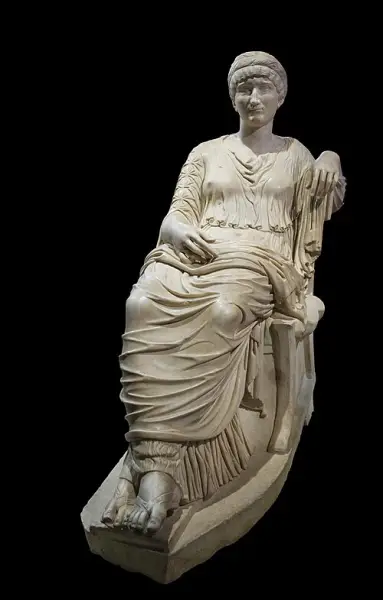
Flavia Julia Helena, remembered in the Church as Saint Helena, was a Greek Augusta of the Roman Empire and the mother of Constantine the Great. Born around 246 to 248, probably at Drepanon in Bithynia, she came from the lower classes; Ambrose of Milan called her a stable-maid, and praised her as a good one. She joined herself to the officer Constantius Chlorus and bore him Constantine, most likely at Naissus around 272, but Constantius set her aside before 289 to marry Theodora, daughter of Maximian. She took no second husband and passed those years in quiet retirement, near the only child who held her in deep affection. Constantine's elevation in 306 restored her to public life; by 312 she had returned to the imperial court, and in 324, after the defeat of Licinius, he named her Augusta and gave her, according to Eusebius, unrestricted use of the imperial treasury. Converted to Christianity by her son, in 326 to 328 she made a celebrated pilgrimage to Palestine and the eastern provinces, founding and beautifying churches at Bethlehem and on the Mount of Olives. Later tradition attached to her the discovery of the True Cross. She died around 330 with Constantine at her side.
The Complete Life
Humble Origins in Bithynia
Helena's birthplace cannot be fixed with certainty, but the strongest tradition, going back to the sixth-century historian Procopius, makes her a native of Drepanon in Bithynia, the Asia Minor town her son later renamed Helenopolis. If that identification holds, she was a Greek speaker, or possibly bilingual, from the Greek-speaking eastern half of the empire; her very name is of a kind common in the eastern provinces. Coins give her name as Flavia Helena and as Flavia Julia Helena, with Aelena appearing here and there as a variant. Whatever the town of her birth, the ancient testimony is unanimous that her beginnings were lowly. Authors of the fourth century, drawing on Eutropius, speak of her humble origin, and Ambrose of Milan, the first to describe her station, called her a stabularia, a stable-maid or inn-keeper, and did so as a compliment, hailing her as a good stable-maid. Hostile pagan writers stooped to coarser insinuations about her girlhood. A much later medieval tradition, popularized by Geoffrey of Monmouth, imagined her a British princess, daughter of King Cole of Colchester, but that story has no historical foundation and probably arose from confusion with the Welsh saint Elen. The empress who would help transform the empire's religion began life at its bottom.
§ Early life
Union and Repudiation
Where Helena first met Constantius Chlorus is unknown; one modern suggestion places the encounter in Asia Minor while he served under Aurelian in the campaign against Zenobia, and a romantic legend claims the two were wearing identical silver bracelets when they met. The legal character of their bond remains disputed: some scholars judge it a common-law marriage recognized in fact but not in law, others an official union, since the more reliable sources describe her as his wife, while the propaganda of Constantine's rival Maxentius dismissively called her a concubine. There, at Naissus in what is now Serbia, she bore the future emperor Constantine, probably around 272. Her security did not last. As Constantius rose through the imperial hierarchy he wanted a wife matched to his new rank, and he put Helena aside before 289, when he married Theodora, daughter of the emperor Maximian. Helena and her small son were sent to the court of Diocletian at Nicomedia, where Constantine grew into the emperor's inner circle. She never took another husband. The years that followed were obscure, but she lived near her only child, who regarded her with deep affection and unwavering loyalty.
§ Marriage to Constantius
Augusta and Pilgrim
Constantine's acclamation by his father's troops in 306 changed his mother's fortunes. By 312 she had been restored to public life and readmitted to the court; the Eagle Cameo, probably carved at the birth of Constantine's son Constantine II in 316. She resided in Rome, where she converted the Horti Spei Veteris into an even grander palace. Eusebius records that Constantine himself led his mother to Christianity, and his favor toward her took formal shape: she was first styled nobilissima femina, and in 324, after the defeat of Licinius made him master of the whole empire, he proclaimed her Augusta and, as Eusebius tells, placed the imperial treasury wholly at her disposal. She devoted it to the holy places. In 326 to 328, by then about eighty years old, she toured Palestine and the East, seeing to the raising or the adornment of the Bethlehem basilica at Christ's birthplace and of the Eleona church on the Mount of Olives, which commemorates his ascension; local legend in Egypt credits her with the church built to identify the Burning Bush at Sinai.
§ Pilgrimage and relic discoveries
The Cross and the Holy Sepulchre
The discovery with which Helena's name is forever joined is the finding of the True Cross, though the historical record is more cautious than the legend. Emperor Hadrian had built a temple to Venus, or perhaps Jupiter, over the supposed site of Jesus's tomb near Calvary in the 130s, and renamed the city Aelia Capitolina. Eusebius, the earliest witness, attributes the demolition of the temple and the uncovering of the burial place to Constantine, and says nothing of the empress; the story that Helena directed the excavation grew up only at the end of the fourth century, told by Ambrose and at length by Rufinus. In that account she chose the site to dig, three crosses were recovered, and their identity was tested: a dying woman brought from Jerusalem recovered instantly at the touch of the third, which Helena therefore declared to be the Cross of Christ. Constantine built the Church of the Holy Sepulchre on the site of the discovery. Sozomen and Theodoret add that she found also the nails of the crucifixion, one of which was set in her son's helmet and another in his horse's bridle; another tradition gives her the Holy Tunic, sent to Trier.
§ The True Cross and the Church of the Holy Sepulchre
Last Years and Burial
Helena quitted Jerusalem and the East in 327 and went back to Rome, where she lived, and where later legend depicted her arriving with great portions of the True Cross and other relics for the palace chapel that became the Basilica of Santa Croce in Gerusalemme. In Cyprus, where she spent some time, relics said to be hers were received: fragments of the tunic and cross, the rope of the Crucifixion kept at Stavrovouni Monastery, which tradition says she founded, and a strange memorial in the hundreds of cats she is said to have imported from Egypt or Palestine to rid a monastery of snakes. She died around 330, at roughly eighty-two to eighty-four years of age, with Constantine at her side, and was buried in the mausoleum built for her outside Rome on the Via Labicana; her porphyry sarcophagus now stands in the Vatican Museums. In 1154 her remains were removed to make room for those of Pope Anastasius IV and transferred to Santa Maria in Ara Coeli, while other historians relate that her body was taken to the Church of the Holy Apostles in Constantinople.
§ Death and burial
Equal to the Apostles
Helena is venerated across the divided Church: by Catholics, Eastern and Oriental Orthodox, Anglicans, Lutherans, and the Church of the East, honored in Orthodoxy as Equal to the Apostles. Her Catholic feast falls on 18 August; the Orthodox keep 21 May jointly with her son, and Anglican and Lutheran calendars largely follow, while Episcopalians keep 22 May, the Copts 9 Pashons, and the Ethiopian and Eritrean churches celebrate the great feast of Meskel each September in memory of her finding of the Cross, kindling a bonfire whose smoke, tradition says, showed her where it lay. Her cult left deep marks on Britain, where the legend of her royal birth won her 135 church dedications, patronage of Abingdon and Colchester, and at least twenty-five holy wells. Her relics are spread from Trier Cathedral, which claims her skull, to Venice, where Sant'Elena enshrines her body under the altar, to Rome and Paris. In the Philippines her discovery of the Cross is reenacted each May in the Santacruzan processions, and her image in St. Peter's Basilica shows her crowned, holding the cross she made famous.
§ Sainthood
Timeline
- 27 Feb 272
Gave birth to the future emperor Constantine I at Naissus, in an uncertain year probably around this date.
§ Marriage to Constantius
- 289
Was set aside by Constantius, who married Theodora, daughter of Maximian, to advance his rising status.
§ Marriage to Constantius
- 306
Her son Constantine was proclaimed augustus by his father's troops, beginning her return to prominence.
§ After Constantine's ascension to the throne
- 312
Was brought back to public life, returning to the imperial court after years of obscurity.
§ After Constantine's ascension to the throne
- 324
Was appointed Augusta by Constantine following his defeat of Licinius, with unlimited access to the imperial treasury.
§ After Constantine's ascension to the throne
- 326
Set out on a pilgrimage through Palestine and other eastern provinces that lasted until 328.
§ Pilgrimage and relic discoveries
- 327
Quitted Jerusalem and the East to go back to the capital where she made her home.
§ Rome
- 330
Died in Rome around this year, with her son at her side, and was buried in her mausoleum on the Via Labicana.
§ Death and burial
- 1154
Her remains were moved from her sarcophagus to Santa Maria in Ara Coeli to make room for those of Pope Anastasius IV.
§ Death and burial
The Record
- Major works
- Church of the Nativity, Bethlehem (construction or beautification)·Church of the Eleona on the Mount of Olives·Chapel at Saint Catherine's Monastery, Sinai (attributed)·Stavrovouni Monastery, Cyprus (attributed)
- Patron of
- archaeologists·converts·difficult marriages·divorced people·empresses·new discoveries
- Symbols
- crown·cross·nails
- Canonization
- Pre-congregation; her veneration predates formal papal canonization
Prayer
Bibliography
Show 7 sources
- Drijvers, Jan Willem (1991). "Helena's position at the court of Constantine". Helena Augusta: The mother of Constantine the Great and the legend of her finding of the true cross. Brill's Studies in Intellectual History. BRILL. ISBN 9789004246768.
- Harbus, Antonina (1 October 1994). "Text as Revelation: Constantine's Dream in "Elene"". Neophilologus. 78 (4): 645–653. doi:10.1007/BF01003514.
- Lavezzo, Kathy (2016). "1 Sepulchral Jews and Stony Christians: Supersession in Bede and Cynewulf". The Accommodated Jew: English Antisemitism from Bede to Milton. Ithaca: Cornell University Press. pp. 28–63. ISBN 978-1-5017-0615-8.
- Bodden, Mary Catherine (1987). "Anglo-saxon self-consciousness in language". English Studies. 68 (1): 28–39. doi:10.1080/00138388708598490.
- Norwich, John Julius (1990). Byzantium: The Early Centuries. London: Penguin Books. ISBN 0-14-011447-5.
- Socrates, Scholasticus (1853). The ecclesiastical history of Socrates, surnamed Scholasticus, or the Advocate. London: H. Bohn.
- Stephenson, Paul (2010). Constantine, Roman Emperor, Christian Victor.
Profile text adapted from the Wikipedia article, licensed CC BY-SA 4.0.
Pray with this saint every day
Save St. Helena to your favorites, read the full profile, and get feast-day reminders in the Saints app.
Get the Saints AppFree on the App Store for iPhone and iPad