
died c. 1160·Feast July 31
St. Helena of Skövde
Widowed Swedish martyr of Götene
Overview
Helena of Skövde, also called Helen or Elin, stands among the earliest canonized saints of Sweden. She was born in Västergötland, in the country's southwest, into a family of rank; her father may have been the duke, or jarl, named Guthorm. Widowed while still young, she declined to take a second husband and instead consecrated her resources to the poor, keeping her doors open to the needy and clothing them at her own cost. Her greatest visible work was the church at Skövde, most of which she raised at her own expense, together with a portico joining it to the tower in which she hoped a saint's relics would one day rest. While visiting Götene she dreamed that the village church, with her inside it, flew away to Skövde, and she understood the vision to mean that she would die in the first place and be buried in the second. After her son-in-law was killed by his own servants, who falsely accused her of inciting the deed, his family turned against her, and one of them stabbed her to death at Götene. Miracles followed immediately, and Pope Alexander III canonized her in 1164.
The Complete Life
A Noble Widow of Västergötland
Helena was born in Västergötland, the province of southwest Sweden whose patroness she would one day be numbered among. Her family belonged to the governing class of the region, and hagiographers have preserved the name of her father, Guthorm, remembered as a duke or jarl, though the details of her childhood have otherwise not survived. What the early accounts chiefly record is the turning point of her youth: the death of her husband while she was still a young woman. For a noble widow of twelfth-century Sweden, a second marriage was the ordinary expectation, and her standing made her an attractive match. Helena refused it. Instead of remarrying she resolved to live for God alone, and she directed her wealth and her household toward the poor of the district. The sources describe her as a woman whose gates stood open to the destitute and whose charity clothed them; her widowhood, which might have left her isolated, became for her a form of freedom. In this she joined the long company of Christian widows whose unmarried state was treated not as misfortune but as a vocation, and in her own province she gave that calling a public and enduring shape.
§ Saint Helena of Skövde
Builder of the Church at Skövde
The chief outward work of Helena's life was the church of Skövde, in south-central Sweden, most of which she caused to be built at her own expense. It was not a private devotion but a gift to the whole Christian community of the place, and from the Middle Ages onward it bore her name. To this church she added a covered portico running between the building and its tower, and when she was asked what purpose the structure would serve she gave an answer that has been preserved: God, she said, would provide some saint whose body and relics could be suitably placed there. The remark was remembered because it proved prophetic. Helena herself came to be interred in the space she had prepared, and her burial chamber lies in the oldest part of the church. In her, builder and relic became one: the shrine she anticipated for another saint's remains received her own. The church was burned in the town fire of 1759, but it was rebuilt on its original foundations and remains in use, so that the building she raised still gathers worshippers more than eight centuries after her death.
§ Saint Helena of Skövde
The Dream at Götene and a Martyr's Death
Two events shadowed the end of Helena's life, one mysterious and one violent. While visiting Götene in western Sweden she dreamed that the village church, with her within it, flew away toward Skövde. She interpreted the vision herself: she would die at Götene and be carried to Skövde for burial, and the early biographer Agnes Dunbar records that in the event this is exactly what came to pass. The violence came through her daughter's marriage. While Helena was away on pilgrimage to Jerusalem, her son-in-law was killed by his own servants. They confessed to the deed but claimed that Helena had prompted them to it, and though the accusation was baseless it planted a deadly enmity. The murdered man's family became her persecutors. The blow fell when she visited Götene again, on this occasion to obtain indulgences at the consecration of the village church. One of her enemies came upon her there and stabbed her to death. She had gone to a church dedication and died at an assassin's hand, and the place of her death proved to be the one her dream had named.
§ Saint Helena of Skövde
Signs Following and a Papal Decree
Miracles were reported from the day Helena died. A blind man, being led past the spot of the murder by a boy, spied what he described as a brightness like a lamp gleaming among the shrubs; a search found Helena's finger, wearing the ring she had brought back from Jerusalem, and when the blind man touched his eyes with blood from the finger his sight returned at once. As her body was carried to Skövde, a spring rose where the bearers rested, afterward known as Lene Kild, St. Helen's Fountain. At the cemetery her body was washed upon a great stone that split in two, and the half stained with her blood was raised so that no one would tread on it; it became a place of veneration that endured even past the Reformation. On the strength of such reports In 1164 Alexander III, at the urging of Uppsala's first metropolitan, Stefan, inscribed her name among the saints. She is counted the first Swedish nun to be canonized, an unusual title for a widow and builder, and her feast is kept on the thirty-first of July.
§ Saint Helena of Skövde
Fountains, Pilgrims, and an Enduring Shrine
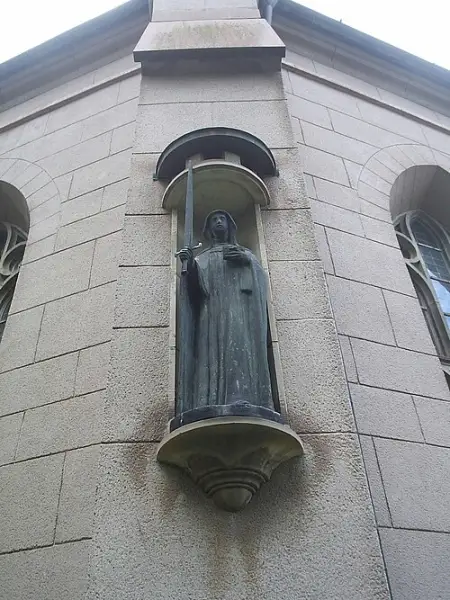
Devotion to Helena proved stubborn. In the late sixteenth century Abraham Angermannus, the fourth Lutheran Archbishop of Uppsala, had her fountain at Skövde filled with stones and rubbish together with other springs of religious repute, yet the pilgrimages continued. Every summer travelers came to her grave, kept vigil through the night there, and reported healings; they carried away small bags of earth from beneath her tombstone and left their crutches behind, making votive offerings in gratitude. Another tradition held that the coffin bearing her body floated across to Tiisvilde on the Danish island of Zealand, where a spring broke forth where it touched land, and the historian Francis Mershman thought this might explain her veneration in that town, though she may equally have visited it or sent relics there. Her church, burned in Skövde's fire of 1759, rose again on its first foundations and still serves the town, with her burial chamber in its oldest part. A statue by the sculptor Astri Taube, made in the 1950s, stands outside it, and the patronage of Västergötland and of Skövde remains hers.
§ Saint Helena of Skövde
Timeline
- 1160
Murdered at Götene by a kinsman of her slain son-in-law while she attended the consecration of the village church.
§ Saint Helena of Skövde
- 1164
Received the papal decree of canonization from Alexander III at the urging of Uppsala's first metropolitan, Stefan.
§ Saint Helena of Skövde
- 1759
Her church at Skövde burned in the great town fire and was afterward rebuilt on its original foundations.
§ Saint Helena of Skövde
In Their Own Words
God will give us some saint whose body and relics can be suitably placed there
The Record
- Major works
- Church of Skövde, raised largely at her expense·Portico joining the church of Skövde to its tower
- Patron of
- Västergötland·Skövde
- Canonization
- Canonized in 1164 by Pope Alexander III
Prayer
Bibliography
Show 3 sources
- "St Helena's Church, Skövde". Skövde Tourist Centre. Retrieved 2 June 2021.
- Dunbar, Agnes B. C. (1901). A Dictionary of Saintly Women. Volume 1. London: George Bell & Sons, p. 373.
- Mershman, Francis (1910). "St. Helen of Sköfde". Catholic Encyclopedia. Vol. 7.
Profile text adapted from the Wikipedia article, licensed CC BY-SA 4.0.
Pray with this saint every day
Save St. Helena of Skövde to your favorites, read the full profile, and get feast-day reminders in the Saints app.
Get the Saints AppFree on the App Store for iPhone and iPad