
died 555·Feast July 16
St. Helier
Hermit and martyr of Jersey
Overview
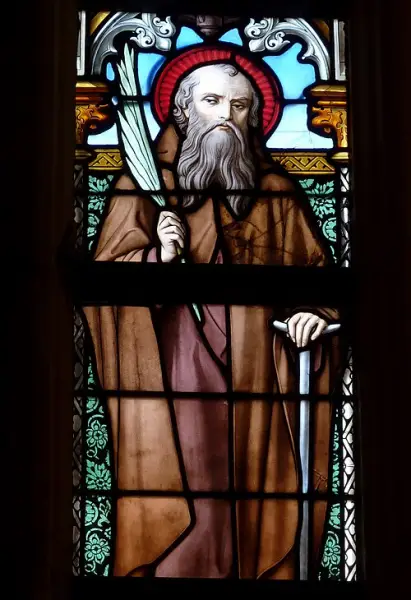
Helier, sometimes called Hellerius, was a sixth-century ascetic hermit whose death at the hands of raiders made him the first martyr in the sight of the Channel Islands and their patron saint. Born to pagan parents at Tongeren, in what is now Belgium, he was the long-prayed-for child of the nobleman Sigebert and his wife Lusigard, who had been promised by the Christian teacher Cunibert that a son granted in answer to prayer would be given back to God. The boy's precocious holiness so angered his father that Cunibert was killed, and Helier fled. His wanderings brought him to the Cotentin and the monastery of Marculf at Nantus, whose discipline proved too gentle for his love of solitude. When the few Christians of the island then called Gersut, now Jersey, begged for a shepherd, Marculf sent Helier there with the companion Romard. For some fifteen years he lived in fasting and prayer on a tidal rock, warning the islanders of pirate sails, until around 555 raiders beheaded him with an axe. His cult spread through Normandy and Brittany, where he was honored as a healer of diseases of the skin and eyes, and Jersey's capital, Saint Helier, bears his name.
The Complete Life
A Promised Child of Tongeren
Helier was born at Tongeren, the ancient Frankish town now lying in Belgium, to parents who were pagans: his father Sigebert, a nobleman and governor of the place, and his mother Lusigard. The marriage had been childless for long, and in their trouble the couple turned to a Christian teacher named Cunibert. He counseled them to pray to God for a child and promised that, if their request were granted, they must surrender the boy to God, and that he himself would rear him in the Christian faith. Their prayers were answered and Helier was born. The child proved precocious in holiness, and his youthful wonders caused consternation in his father's household. As the boy grew, Sigebert came to resent the influence Cunibert exercised over his son, and his anger ended in murder: he had the teacher killed. Deprived of his master and unsafe in his father's house, Helier fled. His flight carried him to the Cotentin peninsula, and he entered the monastery that Marculf kept at Nantus, the site of today's Saint-Marcouf-de-l'Isle in the Manche region of Normandy. In that house, under a master of holiness, the fugitive child of Tongeren grew into the ascetic the coast would one day venerate.
§ Early years
From Nantus to the Island of Gersut
Helier did not find at Nantus the silence his soul demanded; the common life of the monastery left too little room for the unbroken contemplation he sought. An opening came from an unexpected quarter. Marculf had received appeals from the few souls left on the isle then known as Gersut, or Agna — Jersey of today — which pirate raids had all but emptied. They begged that someone be sent to their relief and to preach the gospel among them, being without a shepherd to lead them. Marculf responded by dispatching Helier, in the company of a brother named Romard, to the beleaguered island. There Helier found only a small settlement of fishermen on the sand dunes of the bay where the town of Saint Helier was one day to rise. He chose for himself a tidal islet off the shore, the rock now known as the Hermitage Rock beside the L'Islet that later carried Elizabeth Castle, and made it his dwelling. A hollow in the rock, remembered as St. Helier's Bed, sheltered him, and a medieval chapel was eventually raised over it, becoming the goal of annual pilgrimage.
§ Jersey
Watchman of the Jersey Shore
From his rock Helier served the fragile Christian community of Jersey as its pastor and its sentinel. Raised high above the tideline, he could see the sails of approaching raiders long before the fishermen could, and he would signal to the shore so that the inhabitants could scatter into the surrounding marshes and escape the attackers' violence. The islanders kept the memory of their guardian in their language: to this day small dark clouds on the horizon are called in Jèrriais the sails of St. Helier. Romard ferried between the hermitage and the village, binding the hermit to the people he served. The legend records one healing wrought on the island, the curing of a lame man named Anquetil. It also tells of a deliverance during a visit of Marculf, when a band of raiders suddenly appeared: the two servants of God gave themselves to prayer and traced the cross, whereupon a furious tempest arose that wrecked the raiders' fleet. For some fifteen years Helier kept this life of fasting and vigilance, wasting his body with ascetic severity while holding the island's safety and faith before God.
§ Miracles
Martyrdom on the Rock
Around the year 555 the raiders came again, and this time they reached the hermit. The accounts relate that they beheaded Helier with an axe, the instrument whose crossed image still appears on the crest of the parish that bears his name. The Passion preserves a wonder that spread his fame through Normandy: though famine and fasting had reduced him to weakness, the martyred hermit was said to have taken up his severed head and carried it in his hands as far as the shore. There Romard found the body on the beach, still clasping the head, and placed it in a boat to carry it to the mainland. The vessel, steered by the hand of God, made land at Bréville-sur-Mer, and where the body rested overnight a spring of healing water was said to have broken forth; a church rose beside it, surmounted in time by a statue, and still draws those seeking a cure. Critics have judged the Passion's chronology impossible, and scholars regard the tale as largely legendary, but the bare facts of a hermit on the rock, the healing of the sick, and death at pirates' hands underlie it.
§ Commentary
Patron of Jersey and Healer of Normandy
Marculf honored his dead pupil by founding an abbey on the L'Islet near the hermitage and naming it for him, a house that Samson of Dol would one day visit. His relics passed to the abbey of Bellus-Beccus at Beaubec-la-Rosière, in Seine-Maritime, and stayed there until the French Revolution destroyed the abbey. His cult took root on both sides of the Channel. Jersey remembers him as the one who brought Christianity to the island; the capital town and one of its parishes bear the name Saint Helier, and each sixteenth of July a municipal and ecumenical pilgrimage makes its way to the Hermitage rock, which is engraved on the island's two-pence coin and appeared on the 2010 ten-pound note. In Normandy and Brittany he was better known as a healing saint: churches were dedicated to him at Rennes, Beuzeville, Amécourt, Barentin, and Monhoudou, and healing springs rose at Bréville and at Saint-Jouan-des-Guérets, where folk etymology reshaped his name into St. Délier, the unbind, in allusion to loosening the bonds of sickness. A thirteenth-century mural at Omonville-la-Rogue pairs him with Thomas Becket.
§ Veneration
Timeline
- 555
Put to death around this year by sea-raiders, who took his head with an axe upon his island hermitage at Jersey.
§ Jersey
- 1870
Hermitage Rock, the site of his shelter, was joined to L'Islet and Elizabeth Castle by a breakwater.
§ Veneration
- 2010
The Hermitage associated with him appeared on that year's issue of the Jersey ten-pound note.
§ Veneration
The Record
- Major works
- Abbey on L'Islet at Jersey, founded by Marculf and named for his pupil
- Patron of
- Jersey·against diseases of the skin·against diseases of the eyes
- Symbols
- crossed axes
- Canonization
- Pre-congregation; venerated as a martyr since the early medieval period
Prayer
Bibliography
Show 7 sources
- "How saintly was St. Helier?", Jersey Evening Post, January 29, 2000.
- Butler, Alban. "St. Elier or Helier, Hermit and Martyr", The Lives of the Saints, vol. VII, 1866.
- "St Helier - The fabled life of St Helier", BBC - Local Legends.
- Falle, Samuel. "Saint Helier the Martyr", Société Jersiaise.
- Britannica, The Editors of Encyclopaedia. "Saint Helier". Encyclopedia Britannica.
- "Saint Helier", Societe Jersiaise.
- Bellows, A. M., "St. Helier: The Man and the Myth", Societe Jersiaise.
Profile text adapted from the Wikipedia article, licensed CC BY-SA 4.0.
Pray with this saint every day
Save St. Helier to your favorites, read the full profile, and get feast-day reminders in the Saints app.
Get the Saints AppFree on the App Store for iPhone and iPad