
died c. 410·Feast July 3
St. Heliodorus of Altino
First bishop of Altinum, companion of Jerome
Overview
Heliodorus of Altino, honored in Italian as Sant'Eliodoro, was the first bishop of Altinum, the great Roman city of the Venetian lagoon whose ecclesiastical duties he discharged in the fourth century. A Dalmatian by birth, he was formed in the faith under Valerianus, bishop of Aquileia, whose disciple he was alongside the future saint Chromatius. From that circle he passed into the company of Jerome himself, sailing with him to the Holy Land and remaining so close to the great exegete that Jerome mentions him in his letters. After his mother's death Heliodorus settled in Italy and was raised to the see of Altino. There he contended against Arianism, which threatened the faith of his flock, and in 381 he took part in the Council of Aquileia, the anti-Arian assembly gathered in his native region's metropolitan city. Among the priests he ordained was his own nephew Nepotianus, who had left his post as an officer of the imperial bodyguard. A later legend, written around the tenth century, makes him the teacher of Liberalis of Treviso and relates his withdrawal to a hermit's life on a deserted island of the lagoons. His relics rest at Torcello.
The Complete Life
A Dalmatian Disciple of Aquileia
Heliodorus came from Dalmatia, on the eastern shore of the Adriatic, the same Illyrian world that had given the Church Jerome. His formation belonged to Aquileia, the learned and steadfast metropolis of northeastern Italy, where he became a disciple of Bishop Valerianus. In that school of faith he was companion to Chromatius, Valerianus's other famous pupil, who would succeed him as bishop and as a defender of orthodoxy. The Aquileian circle stood in close fellowship with Jerome, and Heliodorus's association with the great scriptural scholar became the deed by which later ages most loved to remember him: he accompanied Jerome on the voyage to the Holy Land, sharing the pilgrimage to the places of Scripture that so marked the ascetic movement of the fourth century. The bond was lasting enough that Jerome names him in his letters, a rare testimony to the esteem in which the cantankerous exegete held him. Of his mother the record preserves only the fact of her death, the event after which Heliodorus left for Italy and took up the life that led him to the episcopate.
§ Saint Heliodorus of Altino
First Shepherd of Altinum
After his mother's death Heliodorus went to Italy and there received the bishopric of Altino, becoming the first occupant of a see whose cathedral city, Altinum, was among the wealthiest of the Venetian plain. His episcopate fell in the age when Arianism, endorsed by many of the barbarian powers and divisive within the Italian churches, menaced the Nicene faith of his people, and Heliodorus set himself against it in his diocese. His opposition to the Arian cause found public expression in 381, when he attended the Council of Aquileia, the assembly convoked at his old home city under its bishops to condemn the Arian teachers and to reaffirm the Catholic faith. He was also a maker of clergy: among those he ordained to the priesthood was his nephew Nepotianus, who renounced his commission as an officer of the imperial bodyguard to serve the altar, a vocation his uncle recognized and clothed. A legend composed around the tenth century, weaving in material from other saints' lives, adds that Liberalis of Treviso received his instruction in the Christian faith from Heliodorus, tying the bishop of Altino to the rising church of the Veneto.
§ Saint Heliodorus of Altino
The Legend of the Deserted Island
The later hagiography preserves a tradition, unhistorical in its details but old in its outline, of how Heliodorus's episcopate ended. According to the legend, which took shape around the tenth century and borrowed freely from the lives of other saints, opposition from Arians and pagans in the see grew so strong that the aged bishop withdrew from his charge. He entrusted the church of Altino to a man named Ambrose and retired to live as a hermit on a deserted island among the lagoons near the city. The story continues with the young Liberalis, troubled that Ambrose lacked the strength to withstand the advance of Arianism in the see, resolving to seek out his old teacher and prevail on him to return to his flock. Liberalis set out on the search but died on the way, and for his devotion was himself venerated as a saint. Whatever the truth of the withdrawal, it reflects a church hard pressed in the age of the barbarian invasions, and it fixed in local memory the image of the first bishop of Altino ending his days in prayer on a lonely island of the northern Adriatic.
§ Saint Heliodorus of Altino
Relics at Torcello
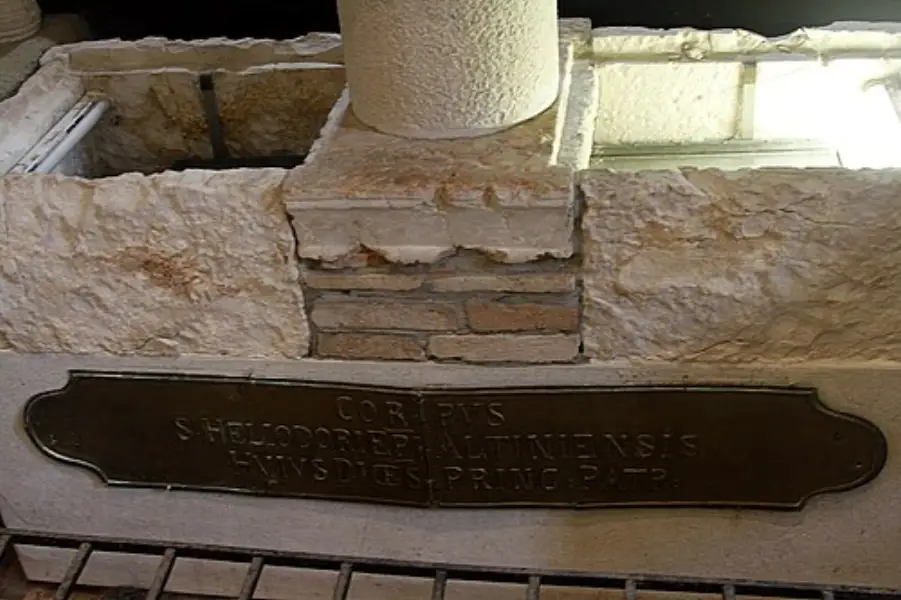
Heliodorus's body remained venerated at Altino until the violence of the barbarian invasions overtook the mainland city, and his relics were carried off for safety, eventually finding a home on the island of Torcello, to whose cathedral they were translated. A tomb in the cathedral of Santa Maria Assunta, the ancient mother church of the Venetian lagoon, receives them, and the saint is honored as Torcello's particular patron. His feast is kept on the third of July, the day on which the old calendars of the Latin Church commemorate him together with Pope Leo II. Both the Roman Catholic and the Eastern Orthodox Churches number him among the saints, a fitting doubleness for a bishop of the undivided early Church. Through the legend of Liberalis he is remembered too as a teacher of saints, and through his link with Jerome he stands for the union of scholarship and sanctity that marked the great churchmen of the fourth century. The city he served has vanished, its stones carried away to build Venice, but his shrine at Torcello still keeps his name alive in the lagoon.
§ Veneration
Timeline
- 381
Attended the anti-Arian Council of Aquileia as bishop of Altino.
§ Saint Heliodorus of Altino
- 410
Died at about this time, having led the see of Altinum as its first bishop.
§ Saint Heliodorus of Altino
The Record
- Patron of
- Torcello
- Canonization
- Pre-congregation; venerated by the Roman Catholic and Eastern Orthodox Churches
Prayer
Bibliography
Show 5 sources
- "Sant' Eliodoro". Santiebeati.it.
- "Lives of the Saints, July 3, Saint Leo II, pope, Saint Heliodorus". Archived from the original on 2008-05-05. Retrieved 2008-05-30.
- "St. Jerome". www.ewtn.com.
- "Latin Saints of the Orthodox Patriarchate of Rome". www.orthodoxengland.org.uk.
- "San Liberale". Santiebeati.it.
Profile text adapted from the Wikipedia article, licensed CC BY-SA 4.0.
Pray with this saint every day
Save St. Heliodorus of Altino to your favorites, read the full profile, and get feast-day reminders in the Saints app.
Get the Saints AppFree on the App Store for iPhone and iPad