
died 633·Feast February 18
St. Helladius of Toledo
Abbot of Agali and Archbishop of Toledo
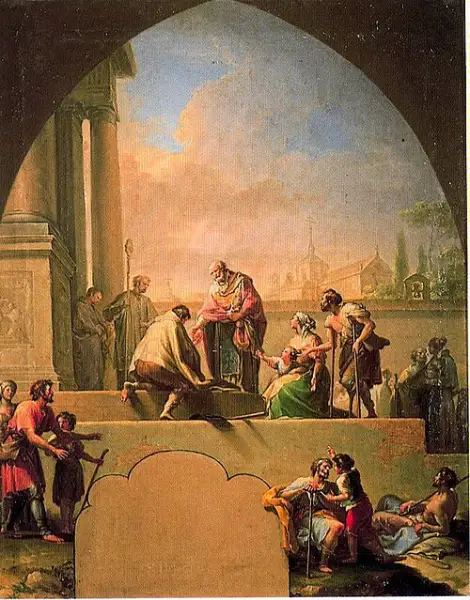
Overview
St. Helladius of Toledo, honored in Spanish as Eladio, moved from the heights of the Visigothic court to the humility of the cloister and finally to the chief bishopric of Spain. Born to a noble family, he served as a major functionary of the royal administration, and in 589 King Reccared I chose him to represent the crown at the Third Council of Toledo, the assembly that concluded with a condemnation of Arianism in the Visigothic kingdom. Court rank did not hold him. Drawn to the monastery of Agali, he took his vows there and in 605 was made its abbot, yet he continued to shoulder the lowliest work of an ordinary monk, hauling firewood with his own hands. When Archbishop Aurasio died in 615, Helladius accepted the see of Toledo with great reluctance and governed it for eighteen years. His pupil Ildefonsus, ordained deacon by him, later recorded his lavish generosity to the poor and wrote the biography that preserves his memory.
The Complete Life
A Nobleman of the Visigothic Court
Helladius was born into the Visigothic nobility of Spain at a moment when the kingdom's ruling class was turning decisively toward Catholic unity. As a young man he entered the royal service, where his ability raised him to the rank of a major functionary at the Visigothic court. His competence and standing brought him to the attention of King Reccared I, who in 589 dispatched him to the Third Council of Toledo as a representative of the crown. That assembly stands among the great turning points of Spanish church history, for its sessions ended with a formal condemnation of Arianism, closing the long period in which the Visigothic peoples had followed the rival creed. To serve as the king's envoy at so consequential a gathering demanded administrative skill and personal weight, and Helladius evidently possessed both. Yet the splendor of the palace never fully claimed him. Even amid the business of state he began to look toward another kind of life, one governed not by the affairs of the kingdom but by prayer, obedience, and monastic discipline, and the attraction would soon prove stronger than any career.
§ Life
From Palace to Cloister at Agali
The monastic life took hold of Helladius gradually and then completely. He began to visit the monastery of Agali frequently, drawn by its discipline and its silence, and the visits became the fixed longing of his heart. Before long he received the habit there and made his vows, exchanging the courtier's belt for the monk's cowl. His brothers in religion soon recognized the quality that had served the king now placed at the service of God, and in 605 they elected him abbot. Promotion, however, changed nothing in his manner of living. Helladius insisted on doing every lowly chore that fell to a rank-and-file brother, and contemporaries remarked that he could be seen bringing in firewood like the humblest novice in the house. This refusal to let rank spare him labor became the mark of his abbatial years at Agali. In an age when churchmen could rise through noble connection and royal favor, he climbed instead by descending, treating the lowest task as the surest ladder, and the monastery prospered under an abbot whom the brothers could watch at work beside them every day.
§ Life
Archbishop of Toledo
In 615 Archbishop Aurasio of Toledo died, and the choice of a successor fell upon the abbot of Agali. Helladius accepted the dignity with extreme reluctance, resisting the elevation as long as he could before taking up the chief bishopric of the Visigothic church. He would hold the post for eighteen years, shepherding the metropolitan see with the same hidden humility that had governed his cloister. His charity toward the poor became proverbial in the city; his biographer records that he gave to them constantly and that his help seemed to carry a warmth passing into body and soul alike. As archbishop he also worked in close season with the crown, and historians have conjectured that he supported King Sisebut in that monarch's harsh policy of forcing the conversion and expulsion of the Jews, an aspect of his episcopate that later ages have weighed with sorrow. In 632 he ordained the learned Ildefonsus a deacon, the act that bound his memory to one of Spain's greatest writers, who repaid his teacher by composing the account of his holy life. Contemporaries understood the unwillingness they witnessed at his election; power had shown him its face early, and he had turned from it once before. That he governed so long and so well despite it speaks to a obedience deeper than ambition.
§ Life
The Close of an Eighteen-Year Episcopate
The final years of Helladius's life were spent in the unrelenting duties of the see he had never wanted. Eighteen years is a long tenure for any bishop of that turbulent age, and the record suggests an administration of steady faithfulness rather than of spectacular deeds. In 632 he ordained Ildefonsus to the diaconate, a quiet ceremony that would prove one of the most consequential acts of his last decade, for the young deacon devoted himself to his old master and eventually set down the biography through which Helladius is known. The following year brought the archbishop's death at Toledo in 633, closing an episcopate that had spanned the reigns of the kings whose court he had once served. He died as he had lived, amid the ordinary round of prayer and pastoral care, mourned by the poor who had known his generosity best. The church of Toledo laid him to rest as a father, and the memory of the reluctant archbishop, the firewood-carrying abbot, passed at once into the devotional tradition of the Spanish church. The episcopate he had dreaded became, in its closing season, the quietest testimony of his life: the nobleman of the Visigothic court died as a bishop the poor could claim as their own.
§ Life
Memory, Images, and Feast
Helladius lives in history chiefly through the affectionate biography his deacon Ildefonsus wrote of him, a work that fixes his portrait as a giver to the poor whose charity had an almost bodily warmth. The image that attached itself to his cult is equally telling: artists show him carrying straw or firewood to an oven, recalling the menial chores the archbishop never abandoned even as abbot of Agali. It is a rare iconography, one that makes a household chore the emblem of sanctity and preaches more directly than any scene of episcopal pomp. The Roman Martyrology keeps his feast on 18 February, and Spain has numbered him for centuries among the ancient bishops who adorned the church of Toledo between its councils and its conversions. Later historians have debated the political shadow cast over his episcopate by the forced-conversion policies attributed to the reign of Sisebut, a reminder that even saints move within the compromises of their age. Yet the enduring picture remains the simpler one: a nobleman who let go of power, a superior who carried wood, and a bishop whose warmth reached the poorest first.
§ Iconography
Timeline
- 589
Represented King Reccared I at the Third Council of Toledo as a royal envoy; the council ended by condemning Arianism.
§ Life
- 605
Chosen abbot of the monastery of Agali, yet he still carried out the lowliest chores of a rank-and-file brother, even hauling in the wood.
§ Life
- 615
Succeeded the deceased Aurasio as archbishop of Toledo, accepting the office only with the greatest reluctance.
§ Life
- 632
Ordained the young Ildefonsus a deacon; the cleric would later write an account of Helladius's life.
§ Life
- 633
Died at Toledo after holding the archbishopric for eighteen years.
§ Life
In Their Own Words
It was as if his warmth and vitality flowed directly into their limbs and their souls
The Record
- Symbols
- carrying straw or firewood to an oven
- Canonization
- Pre-congregation; his feast of 18 February is recorded in the Roman Martyrology
Prayer
Bibliography
Show 3 sources
- Guérin, Paul (ed.), Vie des Saints des Petits Bollandistes, Paris, Bloud et Barral, 1876, vol. VII, p. 584.
- Ildefonsus of Toledo, De viris illustris 7: PL 96,202.
- Butler, Alban, Il primo grande dizionario dei santi secondo il calendario, Casale Monferrato, Edizioni PIEMME, 2001, ISBN 88-384-6913-X.
Profile text adapted from the Wikipedia article, licensed CC BY-SA 4.0.
Pray with this saint every day
Save St. Helladius of Toledo to your favorites, read the full profile, and get feast-day reminders in the Saints app.
Get the Saints AppFree on the App Store for iPhone and iPad