
c. 1100 – 1156·Feast January 19
St. Henry, Bishop of Finland
Missionary Bishop and Martyr of Lake Köyliö
Overview
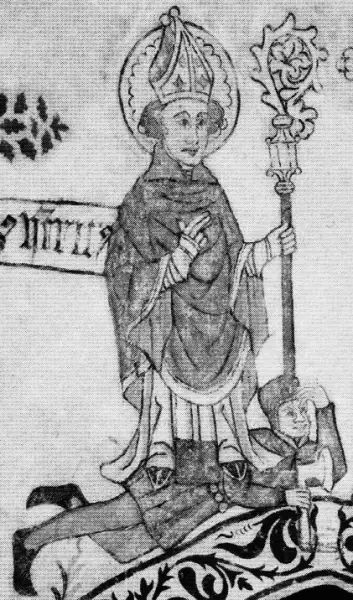
Henry, known in Finnish as Henrik and in Latin as Henricus, was a medieval English clergyman honored as the apostle and martyr of Finland. He is said to have come to Sweden in 1153 in the retinue of Cardinal Nicholas Breakspear, the future Pope Adrian IV, and to have been destined for the archbishopric of Uppsala; when that province could not yet be established, he would have been sent to organize the church among the Finns, among whom Christians had already existed for two centuries. The legend, written some 150 years after his time, relates that he entered Finland with King Eric the Saint during the First Swedish Crusade, baptized the people, planted churches, and remained behind as a preacher rather than a high bishop. Attempting to impose a canonical punishment on a murderer, he was slain on the ice of Lake Köyliönjärvi by the enraged peasant Lalli, whose wife Kerttu had falsely accused the bishop of theft. Honored as a martyr from the end of the thirteenth century, he became the patron of the Cathedral of Turku and of the Catholic Church in Finland. His historical existence remains disputed, with not one document attesting his birth, his death, or that he lived at all.
The Complete Life
An Englishman of Obscure Origins
Henry is said to have been born around the year 1100 in the Kingdom of England, yet everything about his origins rests on late testimony. The legend of his life, composed some 150 years after his supposed death at the end of the thirteenth century, contains little concrete information about him and is so devoid of local detail that it could have been written anywhere; its scholastic Latin, however, is exceptionally accomplished. Folk tradition told a different story altogether. The great Finnish death-lay about his killing says that Henry had grown up in 'Cabbage Land' (Kaalimaa), a name that has puzzled historians for centuries: some connect it with the coastal district of Kaland in Finland Proper, others with a Gaelic word that would point to Scottish origins, though the church legend makes him a native Englishman. Behind these uncertainties stands a recurring figure in the sources: a bishop named Henry appears in a Swedish chronicle among the early bishops of Uppsala, and the annals and the legend of Saint Botvid record a Bishop Henry of Uppsala consecrating a church in 1129, while other authorities describe a bishop of that name who died in battle at Fotevik in 1134. Whether any of these men was the martyr of Finland no one can now determine.
§ Henry's origins
Called North with a Cardinal's Company
The thread that later tradition seized upon is Henry's arrival in Sweden in 1153 in the retinue of Cardinal Nicholas Breakspear, the English-born papal legate who would become Pope Adrian IV. Henry, himself an English clergyman, was probably the man intended for Uppsala's long-awaited archbishopric. Yet the independent church province of Sweden could be established only in 1164, after the civil war had spent itself, and in the interval the plan of the legate's mission came to nothing as designed. According to the reconstruction of later historians, Henry would have been sent instead to organize the church in Finland, whose Christian communities were already two hundred years old yet still lacked any settled hierarchy. The legend of a later age gave the story its heroic shape: the legenda nova of the fifteenth century states that Nicholas had appointed Henry Bishop of Uppsala and dated the crusade to 1150, though it is certain from other sources that the cardinal was in Sweden in 1153. Whatever the precise arrangement, the young clergyman of the cardinal's company stood at the edge of a mission field that would make or unmake his memory.
§ Bishop of Uppsala
The Crusade and the Preacher of Finland
The church legend tells how King Eric the Saint and Bishop Henry ruled Sweden like two great lights in mutual love, an idyl of harmony between throne and altar, until the perceived threat of the non-Christian Finns forced them to arms. The two crossed the sea in the First Swedish Crusade, conquered the land, baptized its people, and built many churches. When the victorious king returned home, Henry stayed behind with the Finns, choosing, as the vita tells it, a preacher's wandering over a high episcopal throne; no one ever formally made him bishop of the land, for he remained out of pity alone. The folk traditions remember him differently, as a solitary evangelist who wandered the Finnish southwest largely unaccompanied, a figure who spoke at Kokemäki and elsewhere, with little in common beyond the name with the prelate of the church's legend. History, in the strict sense, records nothing of the crusade or of the man. No historical source confirms a bishop named Henry in Finland; papal letters of 1209, 1221, 1229, and 1232 speak of an unidentified Bishop of Finland, and the first certainly known holder of that office was Thomas, first mentioned in 1234. The mission belongs to legend; the veneration it inspired is altogether real.
§ Legend
The Humble Martyr and His Miracles
The writer of the legend shaped Henry deliberately as a humble martyr, a bishop who set aside his rank and, at the cost of his life, insisted on the discipline of the church. To the vita was appended a miracula, a list of eleven wonders said to have followed his death, nearly all of them set in Finland. The murderer who placed the bishop's stolen hat on his head lost his scalp; the bishop's severed finger was found the next spring; a boy at Kaisala and a girl at Vehmaa were raised from the dead; the sick were healed at Sastamala and Kyrö, a blind woman recovered her sight, a paralyzed man his walk; a Franciscan named Erlend was freed of headache; fishermen from Kokemäki survived a storm after praying to him. Only one wonder, the stomach ache of a mocking priest in Skara, was a punishment. The cult that these stories served grew late but flourished: the annual feast existed by 1335, was marked in the calendar from the early fifteenth century, and the dioceses of Sweden ranked Turku's martyr among their own, giving him totum duplex honor at Turku, Linköping, and Strängnäs. A Gregorian introit, Gaudeamus omnes, composed for his Mass, survives in the Graduale Aboense.
§ Vita and miracula
Death on the Ice of Köyliönjärvi
The tradition of Henry's death reached its classic form in the Finnish folk poem, the Death-lay of Bishop Henry, which ignores his life and ministry almost entirely to concentrate on his end. According to the lay, the bishop, traveling alone in midwinter, lodged at the manor of a man named Lalli. Lalli's wife Kerttu falsely told her husband that the ungrateful guest had taken food, cake from the oven, beer from the cellar, and hay for his horse, without permission or payment, leaving nothing but ashes. Enraged, Lalli seized his skis and pursued the bishop across the country, overtaking him on the ice of Lake Köyliönjärvi in Eura and killing him on the spot, with an axe in most versions and a sword in older ones. Lalli then tore the mitre from the dead man's head and set it on his own; when his mother questioned him, the hat came away with his scalp, and after a series of torments, the loss of hair, the withering of his hand as he took the ring, he drowned himself in a lake. Henry himself was said to have instructed his coachman to gather his remains in a cloth tied with blue string and follow a stallion, then an ox, building a church where it stopped, the origin of his grave at Nousiainen.
§ Death and burial
A Saint Without a Canonization
Henry belongs to the ranks of the saints the church honored before the Congregation for the Causes of Saints existed and before canonization had taken its modern legal form; his acknowledgment as a martyr rested on the traditional death-stories alone, reached long before the church possessed any machinery of formal process. No date of canonization is known. The story of a canonization in 1158 leads back only to a work printed by Johannes Vastovius in 1623, and scholars treat it as an invention. What the record shows is a cult that emerged suddenly and officially in the mid-1290s, supported strongly by the church and bound up with the war then beginning between Sweden and Novgorod over Karelia: Henry is first called a saint in a papal document of 1296, first appears in historical sources at the synod of Telge in 1298, and is invoked that same year, together with King Eric, as a martyr whose intercession was needed for Karelia. His image appeared on the seal of the bishops of Turku from 1299, and in 1391 Pope Boniface IX addressed him as patronus of the cathedral and as a saint. He has never received formal canonization, yet the church has never ceased to call him blessed.
§ Appearance in the historical record
Relics, Pilgrimage, and National Memory
Few medieval figures loom as large in the memory of Finland as Henry and his alleged murderer Lalli, two of the best-known persons of the country's Middle Ages. His cult radiated from the Cathedral of Turku, where his alleged bones were brought from Nousiainen in 1300 and honored for centuries; a piece of his ulna rested in Bishop Hemming's reliquary of 1514 and now lies in the altar of the Catholic Cathedral of St. Henry in Helsinki, consecrated in 1860, the sole Catholic cathedral of Finland, dedicated to him as patron. His feast is kept on 19 January by Lutherans, Anglicans, and Catholics alike; 19 January is also his name day, Heikinpäivä, in Sweden and Finland, and a second medieval memorial, the Summer Henry of 18 June, recalled the translation of his relics. Kirkkokari, the islet in Lake Köyliönjärvi where tradition placed his death, remains the only Catholic pilgrimage site in Finland, with an annual service on the second Sunday of June, and the 140-kilometre Saint Henry's Way from Köyliö to Nousiainen has been waymarked for modern walkers. The municipalities of Nousiainen, Köyliö, and Kokemäki bear images of his legend in their coats of arms, and Finnish metal bands still sing of the deed upon the frozen lake.
§ Henry's status today
Timeline
- 1100
Born around this year in the Kingdom of England, according to the reconstructed chronology of his life.
§ Legend
- 1129
A Henry recorded as Bishop of Uppsala in the medieval annals and the legend of Saint Botvid, taking part in the consecration of a newly built church.
§ Bishop of Uppsala
- 1134
A Bishop Henry, possibly the same man, died at the Battle of Fotevik fighting alongside the Danes after being banished from Sweden.
§ Bishop of Uppsala
- 1153
Came to Sweden in the company of Cardinal Nicholas Breakspear, later Pope Adrian IV, and was most likely designated the new Archbishop of Uppsala.
§ Henry
- 20 Jan 1156
Traditionally slain with an axe on the ice of Lake Köyliönjärvi by the peasant Lalli, after attempting to punish him for murder.
§ Death and burial
- 1296
Referred to as a saint in a papal document of this year, the earliest such testimony to his cult.
§ Henry's status today
- 1298
Mentioned together with King Eric in a document of a provincial synod of Uppsala at Telge, his first appearance in historical sources.
§ Appearance in the historical record
- 1300
His alleged remains were translated from Nousiainen to the newly consecrated Cathedral of Turku, for which his legend is commonly thought to have been written.
§ Development of the legend
- 14 Aug 1320
First recorded as patron saint of the Cathedral of Turku, named as its second patron after the Virgin Mary.
§ Appearance in the historical record
- 1335
The existence of his feast day is mentioned for the first time in the sources.
§ Veneration
- 1391
Pope Boniface IX addressed him as patronus of the Cathedral of Turku, together with the Virgin Mary, and referred to him as a saint.
§ Appearance in the historical record
- 1514
A piece of his ulna was enclosed in the reliquary of Bishop Hemming in the Cathedral of Turku, with a parchment attesting the bone.
§ Relics
- 1720
The bones still in Turku were catalogued for transfer to Saint Petersburg during the Russian occupation in the Great Northern War; their later fate is unknown.
§ Relics
- 1860
The Catholic Cathedral of St. Henry in Helsinki, today the sole Catholic cathedral of Finland and his principal shrine, was consecrated.
§ Henry's status today
In Their Own Words
Now the bishop is in joy, / Lalli in evil torture. / The bishop sings with the angels, / Performs a joyful hymn.
The Record
- Patron of
- Catholic Cathedral of Helsinki·Catholic Church in Finland
- Canonization
- Pre-congregation; never formally canonized, but referred to as a saint in a papal document as early as 1296
Prayer
Bibliography
Show 9 sources
- Heikkilä, Tuomas (2005). Pyhän Henrikin Legenda. SKS. ISBN 951-746-738-9.
- Kari, Risto (2004). Suomalaisten keskiaika. WSOY. ISBN 951-0-28321-5.
- Linna, Martti (1989). Suomen varhaiskeskiajan lähteitä. Gummerus kirjapaino Oy. ISBN 951-96006-1-2.
- Linna, Martti (1996). Suomen alueellinen pyhimyskultti ja vanhemmat aluejaot. Vesilahti 1346–1996. Edited by Helena Honka-Hallila, Jyväskylä.
- Agricola, Mikael (1987). Mikael Agricolan teokset 1. Söderström. ISBN 951-0-13900-9.
- Paulsson, Göte (1974). Annales suecici medii aevi. Bibliotheca historica Lundensis XXXII.
- Purhonen, Paula (1998). Kristinuskon saapumisesta Suomeen. Vammalan Kirjapaino Oy. ISBN 951-9057-31-5.
- Åsbrink, Gustav (1935). Svea Rikes Ärkebiskopar. Uppsala.
- ECLA (2006). Evangelical Lutheran Worship. Minneapolis: Augsburg Fortress. ISBN 951-746-441-X.
Profile text adapted from the Wikipedia article, licensed CC BY-SA 4.0.
Pray with this saint every day
Save St. Henry, Bishop of Finland to your favorites, read the full profile, and get feast-day reminders in the Saints app.
Get the Saints AppFree on the App Store for iPhone and iPad