
973 – 1024·Feast July 13
St. Henry II, Holy Roman Emperor
Ottonian Emperor, Church Reformer, Only Royal German Saint
Overview
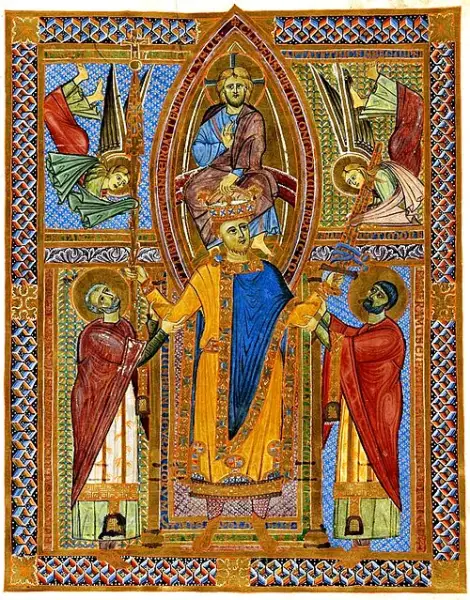
Henry II, called Saint Henry and remembered as an oblate of the Order of St. Benedict, was Holy Roman Emperor from 1014 until his death in 1024 and the last ruler of the Ottonian line. Born at Abbach in Bavaria on 6 May 973, son of Duke Henry II of Bavaria and Gisela of Burgundy, he passed much of his childhood in exile caused by his father's rebellions and received an ecclesiastical education under Bishop Wolfgang of Regensburg and at the cathedral school of Hildesheim. Elected Duke of Bavaria in 995 and married to Cunigunde of Luxembourg in 999, he seized the German throne in 1002 on the sudden death of his second cousin Otto III, was crowned King of Italy in 1004, and received the imperial crown from Pope Benedict VIII in Rome on 14 February 1014. His reign renewed imperial government north of the Alps, fought sixteen years of war against Duke Bolesław I of Poland, and climaxed the Ottonian Imperial Church System, raising bishops to princely power and founding the Diocese of Bamberg in 1007. Dying childless at Göttingen on 13 July 1024, he left the empire to Conrad II, the first Salian. For his striking personal piety he was canonized in 1147, the only medieval German monarch ever honored as a saint.
The Complete Life
Exile and an Ecclesiastical Education
Henry was born on 6 May 973 at Abbach in Bavaria, the son of Duke Henry II of Bavaria and his wife Gisela of Burgundy. Through his father he was grandson of Duke Henry I of Bavaria and great-grandson of King Henry I of Germany, the Fowler; through his mother, grandson of King Conrad I of Burgundy. His earliest years were shadowed by his father's quarrel with the empire. The elder Henry had disputed Otto II's right to dispose of the Duchy of Swabia, rose in revolt twice, and after the failure of the second rising was deposed as Duke of Bavaria and sent in April 978 into exile under the custody of the Bishop of Utrecht, while the duchy's southeastern lands were carved into the new Duchy of Carinthia. During those years the boy lived at Hildesheim, instructed in the Christian faith as a child by Bishop Wolfgang of Regensburg and then educated at the Hildesheim cathedral school. The emperor himself made sure the young Henry was given a religious education, reasoning that a son trained for the cloister could never contest the throne. The policy failed in its design but stamped the future ruler for life: no Ottonian came to power more deeply formed by the church, and none would govern more consciously as its servant.
§ Early life and marriage
Duke of Bavaria and King of the Romans
The death of Otto II in 983 released Henry's father from custody, and after his failed bid for the throne in 985 the elder Henry was restored as Duke of Bavaria, with his thirteen-year-old son appointed regent of the duchy. On the father's death in 995 the Bavarian nobles elected the younger Henry duke in his place, and in 999 he married Cunigunde of Luxembourg, daughter of Count Siegfried, a match that wove his Bavarian house into the nobility of the west. The sudden death of Emperor Otto III in January 1002, at twenty-one and without heir, opened the succession to the whole kingdom. Henry pressed his claim with ruthless energy: he met the dead emperor's funeral procession at Polling and demanded the Imperial Regalia from Archbishop Heribert of Cologne, imprisoned the archbishop and the Bishop of Würzburg when they withheld them, and was twice rebuffed by the assembled nobles. He then took the radical course of having himself anointed King of Germany by Willigis of Mainz on 9 July 1002, the first German king crowned outside Aachen since Otto I began the custom and the first to take the throne without election. Duke Herman II of Swabia resisted until his defeat forced his submission on 1 October 1002.
§ Disputed succession
Italy, Poland, and the Imperial Crown
Henry's reign was spent in the hard politics of three fronts. In Italy, where Arduin of Ivrea had proclaimed himself king after Otto's death, Henry marched south in 1004 through the Brenner Pass and was crowned King of Italy at Pavia in the Basilica of San Michele Maggiore, though a riot that followed nearly cost him his life and kept him from Rome for a decade. Against Bolesław I of Poland, whose power had swelled across Lusatia, Meissen, and Bohemia, he waged three wars between 1004 and 1018, alternating invasion with treaty: the peace of Poznań, the treaty of Merseburg sealed by a dynastic marriage, and finally the Peace of Bautzen on 30 January 1018, which left the contested marches to the Polish duke on nominal terms of vassalage. The imperial crown itself came through the fortunes of Rome: when the Crescentii faction drove Pope Benedict VIII into exile, Henry restored him in exchange for coronation, and on 14 February 1014, in Old St. Peter's Basilica, he was made Holy Roman Emperor. A synod held under pope and emperor decreed against simony and for the restitution of church property, and Henry established the Diocese of Bobbio before returning north, his third Italian campaign, against the Byzantines in 1022, ending in failure before the fortress of Troia.
§ Reign as emperor
The Piety of a Sacred King
Contemporaries and later generations alike were struck by the genuineness of Henry's religion. Sincerely devout, he promoted monastic reform, encouraged missionary activity, enforced clerical celibacy, and set up numerous houses of alms for those in need. He is said to have wished to become a monk outright, and by virtue of his imperial power ordered the Abbot of Verdun to receive him; the abbot, with equal authority, commanded him in virtue of his vows to continue governing the empire, and Henry obeyed, ruling thereafter as one convinced that his earthly throne existed to serve the welfare of his subjects. His policy toward the church was the instrument of this spirituality and of his statecraft alike. He brought the Ottonian Imperial Church System to its climax, expanding the dynasty's custom of employing celibate clerics as a counterweight to the secular dukes, granting counties, regalia, and lavish lands to bishops and monasteries until the chronicler Thietmar of Merseburg judged his cooperation with the bishops more intense than that of any other medieval ruler. He re-founded the Diocese of Merseburg in 1004, suppressed the Gandersheim Conflict in 1007 and again in 1021, and persuaded Pope Benedict VIII to insert the word Filioque into the Nicene Creed, a decision whose consequences for the unity of Christendom would prove immense.
§ Ecclesiastical affairs
Bamberg, Widow's Vows, and Death
The foundation closest to Henry's heart was Bamberg, the Bavarian town he loved from his youth and gave to Cunigunde as her dower. Out of the abolished March of the Nordgau he created the Diocese of Bamberg in 1007, overcoming the resistance of the Bishop of Würzburg, whose territory was quartered to make room, and winning approval at the Frankfurt synod of 1 November 1007; his chancellor Eberhard was ordained its first bishop, and the emperor enriched the new see with counties spread across Franconia, Saxony, Carinthia, and Swabia. In May 1017, when Cunigunde lay gravely ill at the imperial estate of Kaufungen, Henry vowed to found a monastery there if she recovered; on her restoration to health in 1018 he built Kaufungen Abbey, to which the widowed empress would withdraw after his death. Henry died on 13 July 1024 at his palace near Göttingen, aged fifty-one, worn out by a chronic and painful urinary infection, while working with the pope toward a council meant to ratify his reordered arrangements between throne and church, work that death interrupted. Cunigunde arranged his burial in Bamberg Cathedral. Childless, he ended the Ottonian line, and in September 1024 the nobles at Kamba elected Conrad II, first of the Salians, in his place.
§ Death and successor
The Holy Emperor
Henry's canonization came barely more than a century after his death, an exceptional fate for a fighting king. In July 1147 Pope Eugenius III inscribed him among the saints in Rome, in honor of the conspicuous devoutness and tireless advancement of the church that had distinguished his rule; no other medieval ruler of Germany has ever received the same honor. His cult was active almost at once: in the 1160s his remains traveled with armies sent against heretical movements, and he was venerated as patron of the city of Basel in Switzerland. The liturgical celebration of the holy emperor had its own long history. The Roman calendar received his feast in 1631, keeping it on 13 July, the anniversary of his death; in 1668 the observance shifted to 15 July with the rank of semidouble; Pope Pius XII reduced that rank in 1955, Pope John XXIII made it a third-class feast in 1960, and the reform of 1969 returned the optional memorial to 13 July. An oblate of the Benedictine order himself, he stands as heavenly patron to the oblates of that rule, to disabled people, and to those rejected from religious orders, and he is patron also of St Henry's Marist Brothers' College in Durban, South Africa. His empress Cunigunde followed him to the altars in 1200.
§ Veneration
The Emperor in History and Memory
Henry's historical reputation rests on the extraordinarily full testimony of Thietmar of Merseburg, whose eight-book Chronicon, written between 1012 and 1018, treats the reign with the detail of an eyewitness and judges its wars, bishops, and politics without flattery. What it records is a reign that changed the shape of the empire. Where Otto III had dreamed of renovating the Roman empire, Henry's seal proclaimed the renovation of the Frankish kingdom, and his government turned north of the Alps, centralizing authority through the church, incorporating Bohemia permanently into the empire, and disciplined by twenty-two years of campaigning against Poland, Italy, and Byzantium. His marriage to Cunigunde, pious and childless, became one of the celebrated unions of medieval memory, a royal pair whom the church would eventually honor with joint sainthood, their figures joined by Tilman Riemenschneider over the tomb in Bamberg Cathedral where Henry lies. The dynasty died with him, but his model of a sacred kingship exercised through bishops and monasteries shaped the empire until the investiture controversies tested it to destruction. Today Bamberg keeps his tomb, Basel keeps his patronage, and Benedictine oblates keep his feast, remembering the ruler who sought a monk's cell and accepted, as obedience, an emperor's cross.
§ Sources
Timeline
- 6 May 973
Born at Abbach in Bavaria, son of Duke Henry II of Bavaria and Gisela of Burgundy.
§ Henry II
- 28 Aug 995
Elected by the Bavarian nobles as Duke of Bavaria on the death of his father.
§ Early life and marriage
- 999
Married Cunigunde of Luxembourg, daughter of Count Siegfried, gaining a network of contacts in Germany's western territories.
§ Early life and marriage
- Jan 1002
Emperor Otto III died unexpectedly of fever at twenty-one, leaving no heir and precipitating a disputed succession.
§ Disputed succession
- 9 Jul 1002
Anointed and crowned King of Germany at Mainz by Archbishop Willigis, the first king crowned outside Aachen and without noble election.
§ Disputed succession
- 10 Aug 1002
His wife Cunigunde was crowned Queen of Germany at Paderborn by Archbishop Willigis.
§ Disputed succession
- 1 Oct 1002
Duke Herman II of Swabia submitted to his authority after defeat near Strasburg, ending the contest for the throne.
§ Consolidation of power
- 1004
Crowned King of Italy at Pavia in the Basilica of San Michele Maggiore, and incorporated the Duchy of Bohemia into the empire alongside Duke Jaromír.
§ First Italian expedition
- 1 Nov 1007
Held a synod at Frankfurt that approved the establishment of the Diocese of Bamberg, with his chancellor Eberhard as its first bishop.
§ Diocese of Bamberg
- 14 Feb 1014
Crowned Holy Roman Emperor by Pope Benedict VIII in Old St. Peter's Basilica in Rome, after restoring the pope to his throne.
§ Imperial coronation
- 30 Jan 1018
Signed the Peace of Bautzen with Bolesław I of Poland, ending sixteen years of intermittent warfare.
§ Third Polish War
- 1022
Led his third Italian expedition against Byzantine dominance in the south, but his three armies failed to take the fortress of Troia.
§ Conflict with Byzantium
- 13 Jul 1024
Died at his imperial palace near Göttingen, aged fifty-one, after a chronic urinary infection, and was buried in Bamberg Cathedral.
§ Death and successor
- Sep 1024
The German nobles gathered at Kamba and elected Conrad II, first of the Salian dynasty, as his successor.
§ Death and successor
- Jul 1147
Canonized by Pope Eugenius III in Rome, the only medieval German monarch ever to be honored as a saint.
§ Veneration
- 29 Mar 1200
His wife, the Empress Cunigunde, was canonized by Pope Innocent III.
§ Veneration
The Record
- Major works
- Diocese of Bamberg, established in 1007·Re-establishment of the Diocese of Merseburg in 1004·Diocese of Bobbio, established in 1014·Kaufungen Abbey, vowed in 1017 and built after Cunigunde's recovery·Charitable foundations for the poor and promotion of monastic reform
- Patron of
- Benedictine oblates·disabled people·those rejected from religious orders·city of Basel, Switzerland
- Canonization
- Canonized in July 1147 in Rome by Pope Eugenius III
Prayer
Bibliography
Show 11 sources
- Bernhardt, John W. (1993). Itinerant Kingship Royal Monasteries in Early Medieval Germany c.936–1075. Cambridge University Press.
- Thietmar of Merseburg. Thietmari merseburgiensis episcopi chronicon, 1018.
- Wolfram, Herwig (2010). Conrad II, 990–1039: Emperor of Three Kingdoms. Penn State Press. ISBN 978-0-271-04818-5.
- Reuter, Timothy (2011). "The 'Imperial Church System' of the Ottonian and Salian Rulers: a Reconsideration". The Journal of Ecclesiastical History 33 (3): 347–374.
- Fuhrmann, Horst (1986). Germany in the High Middle Ages: c. 1050–1200. Cambridge University Press. ISBN 978-0-521-31980-5.
- Wangerin, Laura (2019). Kingship and Justice in the Ottonian Empire. University of Michigan Press. ISBN 978-0-472-13139-6.
- Blumenthal, Uta-Renate (1988). The Investiture Controversy: Church and Monarchy from the Ninth to the Twelfth Century. University of Pennsylvania Press. ISBN 0-8122-1386-6.
- Bryce, James (1871). The Holy Roman Empire. Macmillan.
- Pirlo, Paolo O., SHMI (1997). "St. Henry". My First Book of Saints. Sons of Holy Mary Immaculate – Quality Catholic Publications, p. 148. ISBN 971-91595-4-5.
- The New Cambridge Medieval History: Volume 3, c. 900–c. 1024 (1995). Cambridge University Press. ISBN 978-0-521-36447-8.
- Tellenbach, Gerd (1966). "Benedetto VIII". Dizionario Biografico degli Italiani, Volume 8. Treccani.
Profile text adapted from the Wikipedia article, licensed CC BY-SA 4.0.
Pray with this saint every day
Save St. Henry II, Holy Roman Emperor to your favorites, read the full profile, and get feast-day reminders in the Saints app.
Get the Saints AppFree on the App Store for iPhone and iPad