
1781 – 1812·Feast October 19
St. Henry Martyn
Missionary to India and Persia, Translator of Scripture
Overview
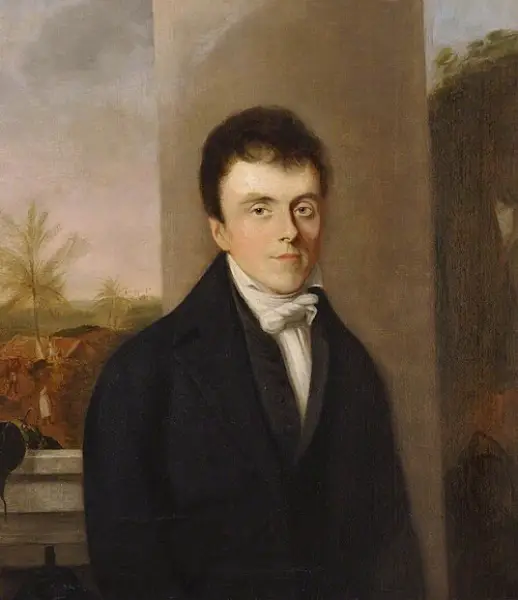
Henry Martyn was an Anglican priest whose brief life carried the gospel to India and Persia and gave the Bible to peoples who had never read it in their own tongues. Born at Truro in Cornwall, the son of a mine-agent, he rose to the very top of the Cambridge mathematical tripos before a chance hearing of Charles Simeon turned his ambition from the bar to the mission field. Ordained deacon in 1803 and priest soon after, he took a chaplaincy with the British East India Company to support his sister after a family financial disaster, and reached India in 1806. At Dinapur and Cawnpore he preached in the vernacular, opened schools, and pressed on through ill health and quarrelsome assistants to translate the entire New Testament into Urdu and Persian, besides rendering the Psalms, the Judaeo-Persic Gospels, and the Book of Common Prayer. Ordered to sea for his health, he carried his Persian Bible through Bushire, Shiraz, and Tabriz to the court of the Shah, and died of fever at Tokat in Ottoman territory on 16 October 1812, aged thirty-one. He is remembered for courage, selflessness, and consuming religious devotion.
The Complete Life
A Cornish Scholar at Cambridge
Henry Martyn was born at Truro, in Cornwall, on 18 February 1781, the son of John Martyn, a mine-agent or 'captain' at Gwennap in the Cornish mining country. Educated at Truro Grammar School under Dr. Cardew, he matriculated at St John's College, Cambridge, in autumn 1797, and his career there was one of extraordinary brilliance: in 1801 he came out senior wrangler, the first mathematician of his year, and took the university's first Smith's prize, and in 1802 he was elected a fellow of his college. Law, not the church, was his first destination. Yet during the October term of 1802 a sermon by Charles Simeon, the evangelical incumbent of Holy Trinity, Cambridge, recounted what one man, William Carey, had achieved in India; not long afterward Martyn read the biography of David Brainerd, apostle to the Native Americans. The twin impressions fixed his course: he too would give himself to the mission field. He received deacon's orders at Ely on 22 October 1803, priest's orders soon after, and ministered under Simeon while overseeing the village parish of Lolworth in Cambridgeshire.
§ Early life
Chaplain of the East India Company
The path to the mission field ran through unexpected hardship. Martyn would have offered himself to the Church Missionary Society, but a financial disaster in Cornwall stripped away the income his father had left him and his unmarried sister, and he could no longer labor without pay. He therefore sought a chaplaincy under the British East India Company, the one post that would give him India while also providing for his sister as well as himself, and on 5 July 1805 he sailed for the East. The voyage itself became a lesson in his calling. He found himself in the expedition that seized the Cape Colony on 8 January 1806 and gave that day to nursing its dying soldiers, distressed by the horrors of war around him. From the experience he came away convinced that Britain's destiny was to convert, not colonize, the world, and he confided to his diary the hope that England, waging war overseas, would not stay 'proud and ungodly' at home, and would dispatch clergy rather than soldiers to carry the gospel. In April 1806 he arrived in India, stationed first at Aldeen near Serampur.
§ Missionary work
Preaching and Translating in India
In October 1806 Martyn proceeded to Dinapur, where he was soon conducting worship among the local people in their own vernacular and establishing schools, while in his quarters he worked over the proofs of a Hindustani New Testament. April 1809 brought a move to Cawnpore, where from his own compound he addressed Britons and Indians together, weathering heckling and menace from some local hearers without abandoning the post. The great labor of these years was linguistic. He translated the whole New Testament into Urdu, and into Persian twice; he rendered the Psalms into Persian and the Gospels into Judaeo-Persic, and put the Book of Common Prayer into Urdu, all in spite of failing health and the arrogance, pedantry, and raging temper that Sabat, his head language-teacher, directed against the work. When the doctors prescribed a sea voyage, leave was granted for Persia, where he could polish his Persian New Testament, with an Arabic rendering for Arabia dreamed of afterward. On 1 October 1810, having seen a church open at Cawnpore on the previous day, he left for Calcutta, sailing thence for Bombay on 7 January 1811 and landing on his thirtieth birthday.
§ India
Persia and the Last Journey
From Bombay Martyn set out for Bushire, carrying recommendations from Sir John Malcolm to leading men of that port, of Shiraz, and of Isfahan. The ride up from the coast drained him, yet at Shiraz he was at once surrounded by arguers of every sort, Sufi, Muslim, Jew, Jewish Muslim, even Armenian, pressed upon the first English priest they had ever seen, eager to match their argument against his. He then traveled on to Tabriz hoping to lay his rendered New Testament before the Shah in person. No audience proved possible: Sir Gore Ouseley, the British ambassador, could not arrange one, though he passed the manuscript along, and the Shah later thanked him in writing, admiring how clear and unadorned the rendering proved. Fever now seized Martyn, and though the attack passed, only a milder sky could restore him; he aimed for Constantinople, whence he meant to sail home to England, regain his strength, and gather helpers for the Indian missions. On 12 September 1812 he rode out of Tabriz with two Armenian servants, crossing the Aras to Erivan, Kars, and Erzurum, until at plague-stricken Tokat he could go no farther. He wrote his last journal entry on 6 October and died there on 16 October 1812, buried by Armenian clergy.
§ Final voyage and death
Commemoration and Institutions
Martyn's devotion to his task won him deep admiration in Great Britain, where he became the hero of many literary publications. Thomas Babington Macaulay composed an epitaph early in 1813 that fixed his image for the Victorian age, hailing the Christian hero who found a pagan tomb and won trophies not stained with carnage but trophies of the cross. The historian John McManners summarized the verdict of posterity in remembering him for courage, selflessness, and religious devotion. The archive of his correspondence and notebooks rests with the Cambridge Centre for Christianity Worldwide in Westminster College, Cambridge. His name endures in institutions as well: the Henry Martyn Institute, an interfaith centre for reconciliation and research, was established at Hyderabad in India, and in 1881, on the centenary of his birth, a trust was founded in Cambridge to build a hall for a library and public lectures on missions. The Henry Martyn Library opened there in 1898 and remained a collection of missionary biography until 1995; re-founded as the Henry Martyn Centre in the 1990s under Canon Graham Kings, the first Henry Martyn Lecturer in Missiology, it was renamed the Cambridge Centre for Christianity Worldwide in 2014. The Church of England and the Episcopal Church keep his Lesser Festival on 19 October.
§ Legacy
Timeline
- 18 Feb 1781
Born at Truro, Cornwall, the son of John Martyn, a mine-agent at Gwennap.
§ Early life
- 1797
Entered St John's College, Cambridge, in the autumn after schooling at Truro Grammar School.
§ Early life
- 1801
Took his degree as senior wrangler and first Smith's prizeman at Cambridge.
§ Early life
- 1802
Elected a fellow of St John's College, and in the October term heard Charles Simeon describe William Carey's work in India.
§ Early life
- 22 Oct 1803
Received diaconal ordination at Ely, then priesthood, and ministered as Simeon's assistant clergyman at Holy Trinity in Cambridge.
§ Early life
- 5 Jul 1805
Sailed for India as a chaplain of the British East India Company, having chosen the post to support his sister.
§ Missionary work
- 8 Jan 1806
Witnessed Britain's seizure of the Cape Colony and passed that day nursing its wounded and dying soldiers.
§ Missionary work
- Apr 1806
Arrived in India and was stationed for some months at Aldeen, near Serampur.
§ India
- Oct 1806
Moved to Dinapur, where he conducted worship in the vernacular, established schools, and revised his Hindustani New Testament.
§ India
- Apr 1809
Transferred to Cawnpore, preaching to Britons and Indians alike despite threats and interruptions.
§ India
- 1 Oct 1810
Left Cawnpore for Calcutta the day after a church he had worked for opened there.
§ India
- 7 Jan 1811
Sailed from Calcutta for Bombay on leave to perfect his Persian New Testament in Persia.
§ India
- 12 Sep 1812
Set out from Tabriz with two Armenian servants, crossing the Aras River toward Constantinople and England.
§ Final voyage and death
- 6 Oct 1812
Wrote his final journal entry at Tokat, where plague was raging and he could ride no farther.
§ Final voyage and death
- 16 Oct 1812
Died of fever at Tokat, aged thirty-one, and was buried by Armenian clergy with Christian rites.
§ Final voyage and death
In Their Own Words
Oh! when shall time give place to eternity? When shall appear that new heaven and new earth wherein dwelleth righteousness?
Here Martyn lies. In Manhood's early bloom / The Christian Hero finds a Pagan tomb.
The Record
- Major works
- Translation of the New Testament into Urdu·Translation of the New Testament into Persian (twice)·Revision of the Hindustani version of the New Testament·Translation of the Psalms into Persian·Translation of the Gospels into Judaeo-Persic·Translation of the Book of Common Prayer into Urdu
- Canonization
- Not canonized; celebrated with a Lesser Festival on 19 October in parts of the Anglican Communion, including the Church of England and the Episcopal Church
Prayer
Bibliography
Show 10 sources
- "Martyn, Henry (MRTN797H)", A Cambridge Alumni Database, University of Cambridge.
- Hughes, Philip Edgcumbe (1988). No cross, no crown. Morehouse-Barlow. ISBN 978-0-8192-1423-2.
- Cross, F. L.; Livingstone, E. A., eds. (1997). The Oxford Dictionary of the Christian Church (3rd ed.). Oxford University Press. ISBN 019211655X.
- Lee, Sidney, ed. (1893). "Martyn, Henry". Dictionary of National Biography. Vol. 36. London: Smith, Elder & Co.
- McManners, John (2001). The Oxford Illustrated History of Christianity. Oxford University Press. ISBN 978-0-19-285439-1.
- Wilberforce, Samuel, ed. (1837). Journal and Letters of the Rev. Henry Martyn B.D. London: Seeley and Burnside.
- Chisholm, Hugh, ed. (1911). "Martyn, Henry". Encyclopædia Britannica. Vol. 17 (11th ed.). Cambridge University Press, p. 804.
- Padwick, Constance E. (1925). Henry Martyn: Confessor of the Faith. Student Christian Movement.
- Cameron, J. E. M. (2019). Charles Simeon of Cambridge: Silhouettes and Skeletons. Eugene, OR: Wipf & Stock. ISBN 9781532663536.
- Ayler, Scott D., ed. (2019). The Letters of Henry Martyn, East India Company Chaplain. Woodbridge: Boydell Press.
Profile text adapted from the Wikipedia article, licensed CC BY-SA 4.0.
Pray with this saint every day
Save St. Henry Martyn to your favorites, read the full profile, and get feast-day reminders in the Saints app.
Get the Saints AppFree on the App Store for iPhone and iPad