
1595-1645·Feast February 1 (with the Forty Martyrs on October 25)
St. Henry Morse
Priest, Religious and Martyr (Jesuit)
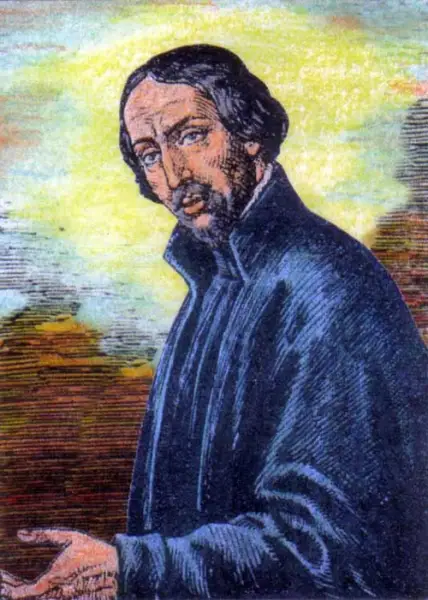
Overview
Henry Morse came into the world a Protestant in 1595, born at his grandmother's Suffolk house in Brome, son of a minor Norfolk landowner. Sent at sixteen to study law at Corpus Christi, Cambridge, and Gray's Inn, he changed course after his father's death in 1614, joining his brother William at Douai and becoming a Catholic at the English College there. A return trip to England to settle family affairs ended in prison at Dover for refusing the Oath of Allegiance; he spent four years in Southwark gaol among priests until James I's amnesty of 1618, then studied at the English College in Rome under the alias Henry Claxon to foil the Crown's spies. Ordained at Rome, he set out for England's hunted Catholic mission on 19 June 1624 and was assigned to the Jesuits at Newcastle just as plague broke out; he nursed the sick there, and again in the London epidemic of 1635, catching the disease himself and recovering while working with John Southworth to raise funds for food and medicine. He entered the Society of Jesus during an earlier imprisonment, taking vows under a fellow prisoner. Arrested in 1636 and bailed in 1637 at Queen Henrietta Maria's insistence, banished in 1641, he returned in 1643 and was finally condemned in January 1645 on his old conviction. He was executed at Tyburn on 1 February 1645, with foreign ambassadors' servants dipping handkerchiefs in his blood.
The Complete Life
Early Life
Henry Morse came into the world a Protestant in 1595, at Brome in his grandmother's Suffolk house in Suffolk, a son of Robert Morse, a small landowner of Tivetshall St Mary, Norfolk. His was the ordinary gentry route: at sixteen he went up to Corpus Christi College, Cambridge, to study law, and continued at Gray's Inn in London. The family finances changed with his father's death in 1614, and Morse went out to France, where his brother William was studying for the priesthood at Douai in the Spanish Netherlands. At the English College there Henry Morse became a Catholic — the decisive turn of his life, taken in the very institution that produced most of the priests who would be executed in England over the following decades. The choice of Douai was natural for a Catholic-leaning gentleman's son: the college in the Spanish Netherlands had been founded to supply English mission priests, and its alumni were already being hanged for the work it trained them in.
§ Biography
Conversion and Vocation
Returning to England to settle family affairs, Morse was arrested at Dover for refusing the Oath of Allegiance and confined in Southwark gaol among a number of priests. He stayed there four years. It was, by accident, a seminary of martyrs: he later completed his Jesuit novitiate under a fellow prisoner, the Jesuit Father John Robinson, and made simple vows in the Society while still in prison. In 1618 James I, negotiating a Spanish marriage for Prince Charles, ordered amnesty and banishment for about a hundred priests, and Morse was released to Douai, arriving in August. Sent on to the English College in Rome, he studied under the alias 'Henry Claxon' to shield himself from the Crown's spies, was ordained, and set out for the English mission on 19 June of 1624. The path from convert to Jesuit priest thus ran almost entirely through prisons, and Morse seems never to have regarded the four lost years as wasted; the men he was confined with became his models and his confessors.
§ Biography
Mission and Ministry
Morse's ministry was spent in the two great emergencies of Stuart England. Assigned in 1624 to help the Jesuits then working at Newcastle-upon-Tyne, he arrived in an outbreak of plague and nursed the sick with his companions; arrested the following year and moved from Newcastle gaol to York Castle, he tended the sick there too. After three years' imprisonment he was banished, and served as chaplain to the Irish and English soldiers of the Spanish army in the Low Countries. At the very end of 1633 he came back to England and labored in the St Giles-in-the-Fields district of London, and when plague was brought in on boats from Flanders in 1635 he nursed again, contracting the disease himself and recovering. In that epidemic he worked alongside Father John Southworth, raising money for food and medicine for the stricken poor — work that made both priests visible, and famous, in the capital. It was during these years that he became known in London as a priest of the plague-stricken poor, a reputation that would matter at his death.
§ Biography
Trial and Final Years
Arrested on 27 February 1636, Morse was imprisoned in Newgate and brought to the bar on 22 April, charged with being a priest and withdrawing the king's subjects from their allegiance. At the intercession of Queen Henrietta Maria, a Catholic, he was released on bail in 1637 — the queen's intervention being the nearest thing to a reprieve the English mission could obtain. He continued to work in London and the countryside until 1641, when he was banished once more; the Civil War then made the position of priests hopeless, and he returned in 1643 to a country in which the law had no mercy to spare. He was seized and, in January 1645, condemned on the strength of his old conviction, no new trial being thought necessary. He was executed at Tyburn on 1 February 1645, and the servants of the foreign ambassadors present dipped their handkerchiefs in his blood — a diplomatic insult, and a relic.
§ Biography
Canonization
Morse was beatified with the English and Welsh martyrs in stages through the nineteenth and early twentieth centuries, his own beatification falling in 1929. He was canonized by Paul VI on 25 October 1970 among the Forty Martyrs of England and Wales, the representative group of some six hundred Catholics put to death between 1535 and 1679 whose causes were then being completed piecemeal. The forty were chosen to include priests and laymen, religious and seculars, and the famous with the obscure; Morse stands in it beside his collaborator John Southworth, the only one of the forty whose body survives entire, and his execution date, 1 February, is kept as his individual feast. The Forty were canonized as a group precisely to avoid the endless subdivision of six hundred individual causes, and the decision to proceed by representation was itself controversial at the time; Paul VI, at the ceremony, spoke of the martyrs as men who died for the priestly office rather than against the English state. The group's feast is 25 October. Devotion to Morse in the Church of England's calendar and in Catholic Suffolk has kept his name attached to the counties of his birth and his labors.
§ Introduction
Legacy
Morse is remembered chiefly for the two plague epidemics. A priest who spent his years of freedom nursing, who caught the disease he was treating, and who was eventually killed by the state rather than by the infection, made an unusually clean case for the argument the Forty Martyrs were canonized to carry — that the English mission existed for the pastoral care of Catholics and was punished as treason. In the Jesuit historiography of the English province he is one of the order's plague saints, and in Suffolk and Norfolk his cult attaches to the recusant families whose chaplains he was. The handkerchiefs dipped at Tyburn belong to the wider relics of the English martyrs, venerated since the seventeenth century. Historians of the English mission use Morse as a test case for its political context: his bailing at the queen's intervention in 1637 and his survival until 1645 show how much depended on the weather of court politics, and how little on the law. When the weather changed, the law did its work.
§ Biography
Timeline
- 1595
Born a Protestant at his grandmother's house in Brome, Suffolk, son of Robert Morse, a minor Norfolk landowner.
§ Biography
- 1614
After his father's death he joined his brother at Douai and converted to Roman Catholicism at the English College there.
§ Biography
- Aug 1618
Released under James I's amnesty banishing about a hundred priests, he arrived back at Douai and was sent to study in Rome.
§ Biography
- 19 Jun 1624
Ordained at Rome, he departed for the English Mission on 19 June and was posted to help the Jesuits serving at Newcastle-upon-Tyne.
§ Biography
- 1625
Arrested during the plague outbreak and moved from Newcastle Gaol to York Castle, he finished his novitiate in prison and took simple Jesuit vows.
§ Biography
- 1633
Returned to England at the end of the year and laboured in the St Giles-in-the-Fields area of London.
§ Biography
- 1635
While nursing plague victims brought from Flanders he caught the disease himself, but recovered.
§ Biography
- 27 Feb 1636
Arrested again and imprisoned in Newgate.
§ Biography
- 22 Apr 1636
Tried for being a priest and withdrawing subjects from their allegiance; convicted on the first count, with sentence deferred.
§ Biography
- 23 Apr 1636
Made his solemn profession of the three Jesuit vows before Father Edward Lusher.
§ Biography
- 20 Jun 1637
Released on bail of 10,000 florins at the insistence of Queen Henrietta Maria.
§ Biography
- 7 Apr 1641
Went into voluntary exile to free his sureties as the proclamation ordering all priests out of England took effect, becoming chaplain to Gage's regiment.
§ Biography
- 1643
Returned to England on mission, and within about eighteen months was arrested and imprisoned at Durham and Newcastle.
§ Biography
- 30 Jan 1645
Brought to the bar once more under the Parliamentarian regime and condemned on his previous conviction.
§ Biography
- 1 Feb 1645
Drawn to Tyburn behind four horses and hanged until dead, with the French and Portuguese ambassadors attending; aged about forty-nine.
§ Biography
- 8 Dec 1929
Declared venerable.
§ Biography
- 15 Dec 1929
Beatified in Rome by Pope Pius XI.
§ Introduction
- 25 Oct 1970
Canonized in Rome by Pope Paul VI as one of the Forty Martyrs of England and Wales.
§ Introduction
- 2012
A Catholic church dedicated to him opened on Shelfanger Road in Diss, replacing the church of the Most Holy Trinity.
§ Biography
The Record
- Patron of
- Plague victims·Diss, Norfolk (St. Henry Morse Church)
- Symbols
- Martyr's palm
- Canonization
- Beatified by Pope Pius XI on 15 December 1929; canonized by Pope Paul VI among the Forty Martyrs of England and Wales on 25 October 1970
Prayer
Bibliography
Show 6 sources
- ↑ Holmes P, 'Morse, Henry (1595–1645)', Oxford Dictionary of National Biography , Oxford University Press , 2004; online edn, Sept 2012 accessed 2014-03-15 .
- ↑ Us, All Of. ".: The Jesuit Singapore Website :" . jesuit.org.sg . Archived from the original on 14 June 2014 . Retrieved 24 August 2018 .
- 1 2 3 "St Henry Morse" . St Henry Morse . Retrieved 24 August 2018 .
- 1 2 Donovan 1913 .
- ↑ Malcolm Pullan (30 April 2008). The Lives and Times of Forty Martyrs of England and Wales 1535 - 1680. Athena Press. pp. xvii–xxii; ISBN 978-1-84748-258-7
- ↑ "St Henry Morse" . St Henry Morse Catholic Church . Archived from the original on 20 January 2021 . Retrieved 3 June 2024 .
Profile text adapted from the Wikipedia article, licensed CC BY-SA 4.0.
Pray with this saint every day
Save St. Henry Morse to your favorites, read the full profile, and get feast-day reminders in the Saints app.
Get the Saints AppFree on the App Store for iPhone and iPad