
1558-1595·Feast April 7
St. Henry Walpole
Jesuit Priest and Martyr
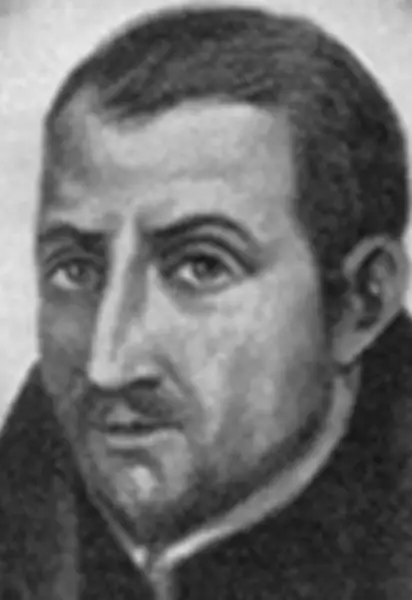
Overview
Henry Walpole, born at Docking in Norfolk in 1558, was a law student of Gray's Inn whose life turned at Tyburn: standing near at Edmund Campion's execution in 1581, he found his clothes sprinkled with the martyr's blood, gave up his practice, and wrote a small book of verse in Campion's honour whose secret printing in London brought the authorities down on everyone connected but him. He slipped abroad to Reims in 1582 and to the English College in Rome the next year, entered the Jesuits in 1584, and was ordained at Paris in December 1588. Serving as military chaplain to Catholic exiles fighting for Spain in the Low Countries, he was captured and tortured at Flushing before being ransomed, then helped plant the new seminaries for English students at Seville and Valladolid and obtained from Philip II the licence that began St Omer's, the school that survives as Stonyhurst. Landing from a storm-tossed voyage at Flamborough Head in December 1593, he was betrayed within a day by a fellow passenger and arrested at an inn in Bridlington. Sixteen months of imprisonment followed, including a stretch in the Tower in which he was racked some fourteen times; he carved his own name beside those of six saints on the wall of the Salt Tower. Tried at York with Alexander Rawlins, he refused the Oath of Supremacy and was executed on 7 April 1595.
The Complete Life
Early Life
Docking in Norfolk, in 1558, was Henry Walpole's birthplace — eldest son of Christopher Walpole by Margery, the Narford heiress of Richard Beckham — and the county gentry stock produced other Catholic sons with him: Michael and Thomas, his brothers, both figure later in his story. Norwich School, Peterhouse at Cambridge, and Gray's Inn trained him, a lawyer by first profession. Even in the Inns he was already watched: his known habit of consorting with recusant gentry kept him in the government's papers of suspicion, the Elizabethan state being an exact registrar of such company.
§ Early life
Conversion and Vocation
The turn of Walpole's life was a public execution. He attended the disputations Edmund Campion held with Anglican divines, and stood near enough at Campion's hanging at Tyburn in 1581 that his clothes were sprinkled with the martyr's blood. Hitherto lukewarm in religion, he gave up his law practice and followed Campion's road: he wrote a small book of verse honoring the martyr, printed covertly for London circulation. The authorities hunted everyone connected with it; the printer, a friend named Valenger, was fined and had his ears cropped but did not betray Walpole, who fled first to his father's house in Norfolk and then to France. He reached Reims on 7 July 1582, was admitted to the English College in Rome on 28 April 1583, received minor orders that October, and became a Jesuit probationer on 2 February 1584. Studies at Pont-à-Mousson and ordination at Paris on 17 December 1588 — the subdiaconate and diaconate at Metz along the way — completed his formation. Italian, French, Latin, Spanish, and his own English were all at his command.
§ Jesuit
Mission and Ministry
Walpole's ministry ran along the whole missionary supply line of the English Catholic cause. After a year at Brussels he served as military chaplain to English and Irish Catholic refugees fighting in the Spanish forces in the Netherlands — seized and held in the English fort at Flushing, tortured there, and ransomed by his brother Michael and the Jesuit superiors. He made his third probation at Tournai, then helped raise the new seminaries for English students at Seville and Valladolid, and in 1593 traveled to Philip II of Spain himself to obtain the license for St Omer — the college that survives today as Stonyhurst in Lancashire. The English mission itself was the last step: he sailed from Dunkirk with his brother Thomas and an English soldier on a French privateer bound for Scotland, the southern ports being closed by plague, and after ten stormy days was put ashore at Flamborough Head in Yorkshire on 4 December 1593.
§ Jesuit
Trial and Final Years
The party split up at once, but a fellow passenger — earning, as was common, money to buy his own way out of prison — had betrayed Walpole, who was arrested at an inn in Bridlington within a day of landing. Three months at York Castle followed, until the priest-hunter Richard Topcliffe had him moved to the Tower of London in February 1594. There he was racked and hung by his wrists for hours through fourteen sessions, spaced so that interrogation would not kill him; in the Salt Tower he carved his own name on the wall beside those of earlier martyrs, and it is still shown. His father's failing health gave the case a property dimension: as heir, Henry's conviction for treason would escheat the estate to the crown. Brought back to York in the spring of 1595, he stood trial on 3 April alongside Alexander Rawlins, both accused of acting as Catholic priests. Walpole, once a lawyer, argued the statute's technicalities — he had been arrested within a day of arrival, not beyond the three days allowed for surrender — but the court demanded the Oath of Supremacy with its acknowledgment of the queen's full authority over religion, and his refusal sealed the verdict. Both were hanged, drawn, and quartered at York on 7 April 1595; Rawlins died first, and Walpole was allowed to hang until dead.
§ Jesuit
Canonization
The cause of the English martyrs lifted him in the twentieth century: beatified in 1929, and among the Forty Martyrs of England and Wales whom Paul VI canonized in 1970. His feast is 7 April. Of the early literature, Joseph Creswell's Spanish account of 1596 — the story of the martyr sent out from the Valladolid college, first fruit of the Spanish seminaries — appeared within a year of his death; Augustus Jessopp in the nineteenth century wrote the modern biography and edited the letters.
§ Commemoration
Legacy
Walpole's legacy lives chiefly in two institutions and one piece of graffiti. St Omer, the school he obtained from Philip II, evolved into Stonyhurst College, one of the enduring schools of English Catholicism. The Salt Tower inscription stands as the most personal relic of the Elizabethan martyrs. And his trajectory — gentleman, lawyer, witness at Tyburn, Jesuit, seminary founder, racked prisoner, martyr — made him the pattern of what the English Catholic revival asked of its sons; a church at Burnham Market in his native Norfolk now bears his name.
§ Jesuit
Timeline
- 1558
Born at Docking, Norfolk, eldest son of Christopher Walpole
§ Introduction
- 1581
Present at Campion's execution; his clothes sprinkled with the martyr's blood
§ Early life
- 7 Jul 1582
Reached Reims after fleeing England by way of Rouen and Paris
§ Jesuit
- 28 Apr 1583
Admitted to the English College in Rome, receiving minor orders that October
§ Jesuit
- 2 Feb 1584
Became a probationer of the Jesuits
§ Jesuit
- 17 Dec 1588
Ordained priest at Paris, then posted to Brussels
§ Jesuit
- 1593
Traveled to Philip II and secured leave to found the English college of St Omer
§ Jesuit
- 4 Dec 1593
Put ashore at Flamborough Head after ten stormy days; arrested at Bridlington within a day
§ Jesuit
- Feb 1594
Transferred to the Tower of London by Topcliffe; racked across fourteen interrogation sessions
§ Jesuit
- 3 Apr 1595
Stood trial at York alongside Alexander Rawlins, accused of serving as a Catholic priest
§ Jesuit
- 7 Apr 1595
Hanged, drawn and quartered at York for refusing the Oath of Supremacy
§ Jesuit
- 15 Dec 1929
Beatified by Pope Pius XI
§ Commemoration
- 25 Oct 1970
Canonized by Pope Paul VI as one of the Forty Martyrs of England and Wales
§ Commemoration
The Record
- Major works
- A book of poetry honouring Edmund Campion, secretly printed in London
- Symbols
- Jesuit cassock·The rack and the Salt Tower carving·Martyr's rope
- Canonization
- Beatified by Pope Pius XI on 15 December 1929; canonized by Pope Paul VI on 25 October 1970 among the Forty Martyrs of England and Wales
Prayer
Bibliography
Show 8 sources
- ↑ "Walpole, Henry (WLPL575H)" . A Cambridge Alumni Database . University of Cambridge.
- ↑ Chapman, John H. "The Persecution under Elizabeth" Transactions of the Royal Historical Society , Old Series Vol. 9 (1881), pp. 33-34. Retrieved 2012-02-19.
- ↑ "Henry Walpole SJ | Jesuits in Britain" . www.jesuit.org.uk . Archived from the original on 21 August 2018 . Retrieved 24 August 2018 .
- 1 2 3 Wainewright, John. "Ven. Henry Walpole." The Catholic Encyclopedia Vol. 15. New York: Robert Appleton Company, 1912. 18 August 2018
- ↑ "The Jesuit Curia in Rome" . www.sjweb.info . Retrieved 24 August 2018 .
- ↑ Jessopp, Augustus. "Walpole, Henry (1558-1595)", The Dictionary of National Biography , (Leslie Stephen, ed.), Macmillan, 1899 This article incorporates text from this source, which is in the public domain .
- ↑ Cresswell, Joseph (1596). Historia de la vida y martyrio que padecio en Inglaterra, este año de. 1595. el p. Henrique Valpolo sacerdote de la Compañia de Iesus, ... Con el martyrio de otros quatro sacerdotes: los dos dela misma Compañia,
- ↑ Augustus Jessopp (1879). One generation of a Norfolk house [ the Walpoles of Houghton ] . Oxford University.
Profile text adapted from the Wikipedia article, licensed CC BY-SA 4.0.
Pray with this saint every day
Save St. Henry Walpole to your favorites, read the full profile, and get feast-day reminders in the Saints app.
Get the Saints AppFree on the App Store for iPhone and iPad