
died c. 550·Feast August 12
St. Herculanus of Brescia
Sixth-century Bishop of Brescia in Lombardy
Overview
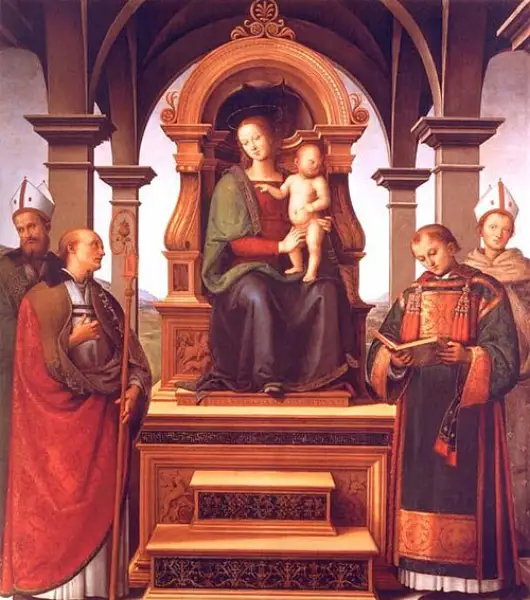
Herculanus of Brescia was a bishop of the Lombard city during the sixth century, dying around the year 550. His episcopate fell in an age of profound upheaval in northern Italy, when the collapse of imperial order and the coming of new peoples transformed the world in which the Italian church carried out its work. A bishop of Brescia in those decades stood among the shepherds who held Christian communities together across the ruin of the old order, catechizing, governing, and interceding for their people. Of Herculanus's own acts almost nothing survives; his memory rests instead on the veneration that gathered around his name and remains. By 1228 those relics were kept at Maderno, on the western shore of Lake Garda, where they continued to draw the devotion of the faithful. His feast is kept on 12 August, and he is honored by both the Roman Catholic and Eastern Orthodox churches, a sign that his cult belongs to the undivided Christianity of the first millennium. Renaissance artists also gave him a place in sacred painting: Pietro Perugino's altarpiece of 1497 sets Herculanus among the saints flanking the Virgin and Child, fixing his features in the visual imagination of Umbria and beyond.
The Complete Life
A Bishop in a Breaking World
To serve as bishop of Brescia around the middle of the sixth century was to hold one of the most demanding offices in northern Italy. The city, set at the foot of the Alps between the Po valley and the lakes, belonged to a peninsula passing through the agony of the Gothic War and the great movements of peoples that redrew the map of the West. In such times the bishop was often the one figure of continuity left standing: the guardian of his people's faith, the arbiter of their quarrels, the negotiator with whatever power held the walls. Herculanus carried that burden for the church of Brescia, and around the year 550 his earthly course ended. What kind of shepherd he was, what letters he wrote or judgments he gave, the passing of the centuries has not preserved; ancient bishops rarely survive in the record unless they clashed with someone or wrote something memorable. Yet the silence of the sources should not be mistaken for insignificance. The affection that later attached to his name, enough to carry his body in honor across the centuries, suggests a pastor remembered by his people as holy. His cult belongs to the ancient, pre-congregational recognition by which the church first named its saints.
§ Introduction
Relics at Maderno and a Place in Art
The clearest trace of Herculanus after his death is the history of his remains. Since 1228 his relics have been kept at Maderno, the town on the western shore of Lake Garda whose church thus became a center of his devotion, drawing the faithful across the surrounding country. The survival of a sixth-century bishop's cult into the high Middle Ages and beyond marks it as one of the old, deep devotions of the Lombard region, transmitted from generation to generation rather than revived by scholarly fashion. The feast of 12 August kept that memory in the calendar year after year, and the fact that both Catholic and Orthodox churches venerate him shows that his cult took shape before the separation of East and West. Herculanus also received an unexpected form of honor at the height of the Italian Renaissance. In 1497 Pietro Perugino painted an altarpiece of the Virgin and Child flanked by saints in which Herculanus of Brescia stands among the chosen companions, beside Louis of Toulouse, Lawrence, and Constantius of Perugia. For a bishop of whom almost nothing is recorded, that company is eloquent: the painters and their patrons still knew his name, six centuries after his death, as one worth setting next to the Mother of God.
§ Introduction
Timeline
- 550
Dies around this year while serving as bishop of Brescia
§ Introduction
- 1228
His relics are recorded at Maderno on Lake Garda, where they have been kept since this date
§ Introduction
The Record
- Canonization
- Pre-congregation; venerated since antiquity in East and West
Prayer
Bibliography
Show 1 sources
Profile text adapted from the Wikipedia article, licensed CC BY-SA 4.0.
Pray with this saint every day
Save St. Herculanus of Brescia to your favorites, read the full profile, and get feast-day reminders in the Saints app.
Get the Saints AppFree on the App Store for iPhone and iPad