
died 549·Feast November 7 (also March 1)
St. Herculanus of Perugia
Bishop and martyr of Perugia under the Ostrogoths
Overview
Herculanus of Perugia, remembered in Italian as Ercolano, was bishop of the Umbrian city when it fell to the Ostrogoths and died a martyr's death in 549. His story reaches us above all through Pope Gregory the Great, who recounted it in the Dialogues, and it has made him the foremost patron saint of Perugia. When Totila, king of the Ostrogoths, besieged the city, Herculanus sought to save his people by a stratagem of desperate ingenuity: he fed the city's last sack of grain to its last lamb, so that the besiegers, seeing the animal so well nourished, would believe Perugia still had food in abundance and could withstand a long siege. The ruse failed to deceive Totila, who took the city regardless. The conqueror then ordered the bishop to be flayed alive, but the soldier charged with the sentence took pity and beheaded him before the torture had run its course. Gregory records a final wonder: forty days after the execution, the severed head was found miraculously reunited to the body. Perugia never forgot its bishop. His principal feast is kept on 7 November and a second on 1 March, and centuries of devotion, coinage, and painting have kept his memory at the heart of the city's life.
The Complete Life
Shepherd of Perugia
Herculanus governed the church of Perugia in the darkest hour of the Italian peninsula, when the war between the Ostrogoths and the armies of Constantinople turned Umbria into a corridor of armies and reprisals. A hill city of ancient Etruscan walls, Perugia looked to its bishop not only for the sacraments and the ordering of the church but for leadership of the whole community in a time of mortal danger. Herculanus held that trust as king Totila's forces closed in. The story that posterity has treasured most reveals the cast of his mind: with the siege grinding on and the city's provisions exhausted, he chose to gamble the last sack of grain on deception. He had it fed to the last remaining lamb, so that when the animal appeared before the walls in apparent health and fatness, the Ostrogoths would conclude that Perugia had food to spare and could keep resisting indefinitely. The plan tells us a great deal about its author, a bishop thinking like a commander, wagering on the psychology of an enemy camp in order to buy his people's survival. That Totila was not deceived detracts nothing from the shepherd's intent; it only fixed the terms on which his final witness would be made.
§ Introduction
Martyrdom Under Totila
When the city fell in 549, the king's fury turned on its bishop. Totila gave orders that Herculanus be flayed entirely, a sentence of exquisite cruelty designed for a leader who had defied him. The soldier to whom the task fell proved capable of pity: before the flaying could be completed he cut off the bishop's head, sparing him the full agony of the sentence. Thus Herculanus died a martyr in his own city, in the cause of the people he had tried to save. Pope Gregory the Great, writing in the Dialogues within living memory of the events, added the wonder that crowned the story: forty days after the beheading, the severed head was found to have been miraculously rejoined to the body, a sign read by the faithful as heaven's own vindication of the martyred shepherd. Around this account, old and cherished, gathered the rest of the legend that kept his memory green, including the tale of the townsfolk of the Umbrian castle of Cisterna, who under Perugian rule owed Perugia an annual tribute of three pounds of wax for the saint's feast day, a humble tribute that carried his name through the countryside century after century.
§ Introduction
Patron of Perugia
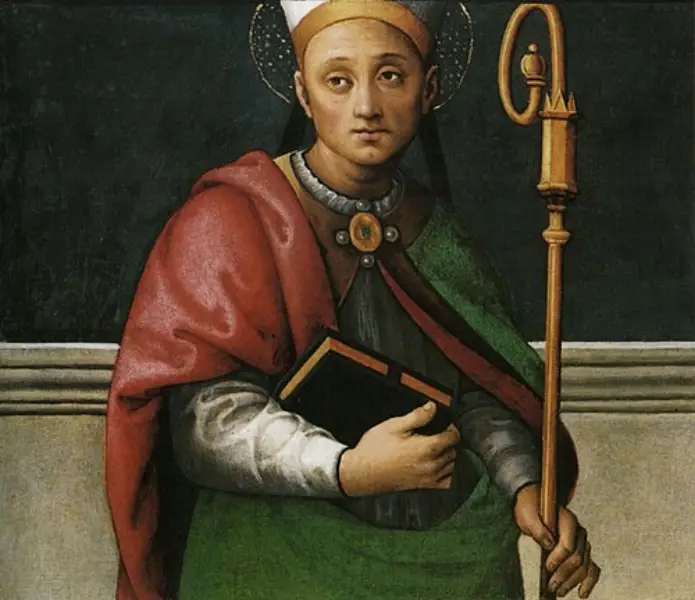
Few saints are so thoroughly identified with a city as Herculanus with Perugia. The church honored him as its patron, keeping his principal feast on 7 November and a second celebration on 1 March, so that his memory returned twice each year to the calendars of the faithful. His image entered the coinage: a Perugian coin of the fifteenth century bears the half-length figure of the saint, crozier in hand, a striking mark of civic devotion in which the shepherd-martyr stood for the city itself before the world. Artists gave him a place in the sacred painting of the Renaissance, and Pietro Perugino, the city's greatest painter, depicted Sant'Ercolano in a work now in the Galleria Nazionale dell'Umbria. Devotion of this depth, nourished by Gregory's Dialogues and by the annual feasts, made the martyred bishop a permanent presence in the civic identity of Perugia: a reminder that the city had been defended to the death by its own shepherd. For the wider church his story preserved, from the wreckage of the Gothic War, one of the classic narratives of episcopal martyrdom, in which the bond between a bishop and his people was sealed not by words but by blood.
§ Introduction
The Record
- Patron of
- Perugia
- Symbols
- Crozier
- Canonization
- Pre-congregation
Prayer
Bibliography
Show 5 sources
- "Gregory the Great, Dialogues (1911) Book 3. pp. 105-174". Archived from the original on 2009-09-17.
- "Bangkok When the Leaves Turn, Part VII".
- "Dominican Martyrology: March".
- "La Strada del Sagrantino". Archived from the original on 2006-05-06.
- Sauser, Ekkart (2003). "Herculanus von Perugia". In Bautz, Traugott (ed.). Biographisch-Bibliographisches Kirchenlexikon (BBKL). Vol. 22. Nordhausen: Bautz. col. 517. ISBN 3-88309-133-2.
Profile text adapted from the Wikipedia article, licensed CC BY-SA 4.0.
Pray with this saint every day
Save St. Herculanus of Perugia to your favorites, read the full profile, and get feast-day reminders in the Saints app.
Get the Saints AppFree on the App Store for iPhone and iPad