
c. 970 – 1021·Feast March 16 (August 30 in Cologne)
St. Heribert of Cologne
Archbishop of Cologne and chancellor to two emperors
Overview
Heribert of Cologne, one of the great prelates of the Ottonian church, served as Archbishop of Cologne from 999 until his death in 1021 and as chancellor to two emperors of the Saxon house. Born around 970 at Worms, the son of Count Hugo and Tietwista, he was educated at the Worms cathedral school and at Gorze Abbey, studying alongside the future Pope Gregory V. His gifts brought him early to the attention of the court: ordained a priest in 994, he was named chancellor of Italy by Otto III in the same year and chancellor of the German kingdom in 998. Chosen for the see of Cologne, he received the pallium from Pope Sylvester II in July 999 and was consecrated on Christmas Day. He stood at Otto III's deathbed in 1002, suffered imprisonment at the hands of Henry II while escorting the dead emperor's remains, and then gave his rival a loyalty that turned into genuine friendship, serving him as advisor and chancellor. He founded Deutz Abbey on the Rhine in 1003 and was remembered for his alms to the poor. Honored locally as a saint from the day of his death on 16 March 1021, he was canonized around 1075, and his miracles on behalf of those praying for rain made him a favored intercessor of the Rhineland.
The Complete Life
A Count's Son from Worms
Heribert was born around 970 at Worms, into the ranks of the lesser imperial nobility: his father was Graf Hugo, a count, and his mother Tietwista, whose son by an earlier connection, Heinrich, rose to be Bishop of Würzburg. The family thus stood already close to the episcopal church in which Heribert would make his career. His education followed the best path available to a gifted boy of his class: first the cathedral school of Worms, then Gorze Abbey, the celebrated Benedictine house on the Moselle in Lorraine that stood at the center of the monastic reform of the age. At Gorze his fellow student was Bruno of Carinthia, the young man the imperial court would raise to the papal throne as Gregory V, a companionship that shows the caliber of the circles in which Heribert moved from boyhood. His own inclination ran toward the cloister rather than the court: he wanted to become a Benedictine monk. His father, however, refused his consent, and Heribert, obedient, set the desire aside, a renunciation that quietly shaped his later life as a bishop who founded an abbey and was buried in one. The schooling of Worms and Gorze, the family's connections, and the discipline of a wish foregone equipped him for the extraordinary career that followed.
§ Early life
Provost, Chancellor, Archbishop
Heribert's rise through the church and the court ran on parallel tracks. Worms Cathedral saw him back again in the provost's role, and in 994 Bishop Holdebold ordained him to the priesthood. The bishop of Worms wanted him as his successor, but a greater patron had taken notice: Emperor Otto III marked him out for the court, and in the same year appointed him chancellor of Italy, adding the chancellorship of the German kingdom in 998. He went with Otto to Rome in 996 and made the journey a second time in 997, serving the final, visionary phase of the emperor's Italian design. While he was still on Italian soil the news reached him that he had been chosen Archbishop of Cologne. At Benevento the new pope, Sylvester II, bestowed on him investiture and the pallium on 9 July 999 — a pope who had been his fellow scholar's colleague in the reformed learning of the age, and on Christmas Day of that year he was consecrated in his cathedral at Cologne. The course of a single decade had carried him from the provostship of his native city to one of the principal sees of Germany, and he held that see, through all the convulsions of the imperial succession, for the remaining twenty-two years of his life.
§ Religious career
Between Two Emperors
The turning point of Heribert's public life came with the death of Otto III in 1002. He was present at the emperor's deathbed at Paterno Castle, and he took charge of the royal remains and the imperial regalia for the journey home toward Aachen. On the way he was seized, at the command of Henry II, who claimed the succession and wanted the regalia that legitimized it. Heribert first opposed Henry's accession, but once the duke had gained the crown of Germany he acknowledged him as king and continued in the office of chancellor, serving as his advisor. What began as enforced service became real: the new sovereign came to respect his abilities, and the rift between the two men turned into friendship. The reconciliation says much about Heribert's character, a churchman who resisted what he judged wrong, accepted what was lawfully settled, and gave his new king a loyalty that was never servile. His private charity matched his public service: he frequently sent alms to the poor, dispatching them through priests to be distributed among those in need, and in 1003 he founded Deutz Abbey on the Rhine, the Benedictine house opposite Cologne that would become the shrine of his own memory. Politics, foundation, and charity formed a single understanding of his office.
§ Religious career
Death and Burial at Deutz
Heribert died as a bishop ought, in the midst of his pastoral duties. While making a visitation he contracted a fever and hurried back toward his archdiocese of Cologne to recover, but the illness moved faster than he did, and he died there within the week, on 16 March 1021, at about fifty years of age. He was buried at Deutz, in the abbey he himself had founded on the Rhine, so that the house born of his generosity became the keeper of his remains. The veneration that began at his grave did not wait for formal recognition: the people of his archdiocese had revered him in his lifetime and honored him locally as a saint from the day of his death. Nearly a century later, on 30 August 1147, his remains were lifted into a golden reliquary at Deutz Abbey, an act of devotion that fixed the feast of the translation on 30 August alongside his death feast of 16 March. That reliquary, a masterpiece of Rhenish goldsmithwork, was moved in the nineteenth century to the parish church of Neu St. Heribert in Köln-Deutz, and it is preserved there still, so that the archbishop lies today within sight of the abbey site he chose a thousand years ago.
§ Death and legacy
Saint of the Rhineland
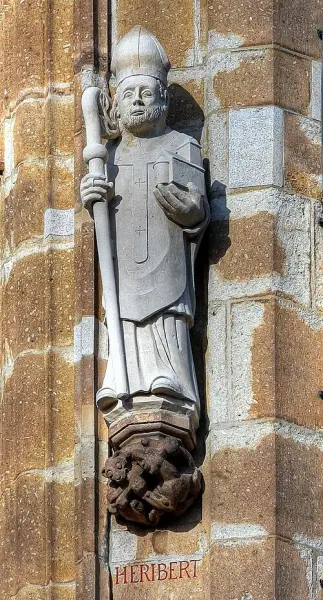
The church's formal judgment followed the devotion of the people. Heribert was revered during his lifetime, and the local cult that arose at his tomb persisted through the generations until, around 1075, his canonization was confirmed by Pope Gregory VII, the great reforming pope of the eleventh century. The miracles associated with his intercession had a distinctive character: he was credited with ending a drought, and on that account the faithful invoked him for beneficial rains, making him a patron in the agricultural anxieties of the Rhineland countryside. Devotion to him took institutional form as well as popular: Deutz Abbey kept his shrine and his memory, the city of Cologne added a second feast on 30 August in honor of the translation of his relics, and his patronage was claimed by the district of Deutz itself. His iconography remained that of his office, the bishop in full attire, holding the crozier of the good shepherd rather than the emblems of the chancellor. In the company of Ottonian saints he stands as the type of the prelate who wielded the highest political office of his day without surrendering the charity of a monk's intentions, a man the empire used and the church preserved.
§ Death and legacy
Timeline
- 970
Is born at Worms, son of Count Hugo and Tietwista
§ Early life
- 994
Is ordained to the priesthood at Worms by Bishop Holdebold
§ Religious career
- 994
Is appointed chancellor of Italy by Emperor Otto III
§ Religious career
- 996
Accompanies Otto III on his journey to Rome
§ Religious career
- 998
Is appointed chancellor of the German kingdom, an office he holds until Otto's death
§ Religious career
- 9 Jul 999
Receives investiture and the pallium from Pope Sylvester II at Benevento as archbishop-elect of Cologne
§ Religious career
- 25 Dec 999
Is consecrated archbishop in the cathedral of Cologne on Christmas Day
§ Religious career
- 1002
Attends Otto III's deathbed at Paterno Castle and is captured by order of Henry II while escorting the imperial remains and regalia
§ Religious career
- 1003
Founds Deutz Abbey on the Rhine opposite Cologne
§ Religious career
- 16 Mar 1021
Dies at Cologne of a fever contracted on pastoral visitation, and is buried at Deutz
§ Death and legacy
- 1075
His canonization is confirmed around this year by Pope Gregory VII
§ Death and legacy
- 30 Aug 1147
His remains are enshrined in a golden reliquary at Deutz Abbey
§ Death and legacy
The Record
- Major works
- Deutz Abbey (founded 1003)
- Patron of
- Rain·Deutz, Cologne
- Symbols
- Episcopal attire
- Canonization
- Canonized c. 1075 by Pope Gregory VII
Prayer
Bibliography
Show 4 sources
- Herbermann, Charles, ed. (1913). "St. Heribert". Catholic Encyclopedia. New York: Robert Appleton Company.
- "Saint Heribert of Cologne". Saints SQPN. 14 March 2017. Retrieved 17 October 2017.
- Stevens, Clifford J. (1989). "March Saints: St Heribert of Cologne". The One Year Book of Saints. Huntington, Indiana: Our Sunday Visitor, p. 83. ISBN 978-0-87973-417-6.
- Abend-David, Ilana (2004). "Architectural representations on the medallions of the Heribert shrine". In Blick, Sarah; Tekippe, Rita (eds.). Art and Architecture of Late Medieval Pilgrimage in Northern Europe and the British Isles. Vol. 1: Texts. Leiden; Boston: Brill, pp. 121-133. ISBN 978-90-47-43008-7.
Profile text adapted from the Wikipedia article, licensed CC BY-SA 4.0.
Pray with this saint every day
Save St. Heribert of Cologne to your favorites, read the full profile, and get feast-day reminders in the Saints app.
Get the Saints AppFree on the App Store for iPhone and iPad