
c. 1756 – 1837·Feast December 13 (repose); also August 9 (glorification) and November 15
St. Herman of Alaska
Monk, hermit, and missionary of Russian America
Overview
Herman of Alaska was a Russian Orthodox monk who became the first saint of North America canonized by the Orthodox Church. Born around 1756, he embraced monastic life at Valaam Monastery on Lake Ladoga, where he studied under Abbot Nazarius and longed for solitude. In 1794 he was among ten Valaam monks sent to Kodiak in Russian America, in a mission whose harsh reality contradicted the rosy reports of the fur traders who had requested it. The monks baptized more than seven thousand native people of the Kodiak region, and Herman won their love by defending them against the cruelty and greed of the Russian-American Company, enduring the mockery of Alexander Baranov for it. He led the mission from 1807, taught in its school, and then withdrew around 1811 to Spruce Island, which he named New Valaam. There he lived as a hermit, receiving visitors, teaching orphans, and caring for the sick during an epidemic that other Russians dared not approach. He died on the island on November 15, 1837, and was canonized at Kodiak on August 9, 1970. His relics rest in Kodiak's Holy Resurrection Cathedral, and his grave on Spruce Island draws pilgrims from around the world.
The Complete Life
From Russia to the Cloister of Valaam
The details of Herman's life before Alaska are debated, and his biographers tell competing stories. The account of his life that Valaam Monastery printed in 1867 declared that no one remembered what he had been called before his tonsure, and traced his birth to a merchant household of Serpukhov in Moscow Governorate; from there, it said, he went as a novice to the Trinity-St. Sergius Hermitage by St. Petersburg and finished his formation at Valaam. The modern biographer Sergei Korsun showed that this account rested on faulty information from Semyon Yanovsky, an early administrator of the Russian-American Company, who had mixed Herman's story with that of another monk. A different and better-supported tradition comes from Ferdinand von Wrangel, another former chief manager of the Company, who said Herman came from a prosperous peasant family in Voronezh Governorate, had served as a soldier, and afterward began the religious life among the novices of Sarov Monastery. The testimony of Archimandrite Theophan (Sokolov) pointed the same way, and so does a letter in Herman's own hand: his religious life opened at Sarov, and the full tonsure came to him at Valaam. The records there show a young military clerk named Egor Ivanovich Popov, of Voronezh, tonsured under the name Herman in 1782. At Valaam all accounts converge on one point: he studied under Abbot Nazarius, a disciple of the hesychastic tradition of Paisius Velichkovsky.
§ Early life
The Monk Who Longed for the Desert
At Valaam, He discharged his assigned tasks and won the affection of the brotherhood, yet his heart was set on a stricter solitude. With the blessing of Abbot Nazarius he withdrew to a hermitage about two kilometers from the monastery, a place that came to be known as Herman's field, or Germanovo. His gifts did not go unnoticed by the church's leadership. Metropolitan Gabriel of St. Petersburg proposed raising him to the priesthood, and twice proposed him as leader of the Russian Orthodox Mission in China; Herman refused every honor, choosing to remain a simple monk. Even after he sailed for North America he kept Valaam close, writing to Abbot Nazarius that in his mind he pictured his beloved monastery and gazed on it constantly across the great ocean. This temperament, formed in the school of Paisius Velichkovsky's hesychasm, shaped everything that followed: a man who sought hiddenness, yet whose hidden life became a lamp for an entire continent. When the call came for missionaries to Russian America, it was this restless solitary, and not an ambitious churchman, whom the mother monastery sent across the sea.
§ Early life
Missionary to Kodiak and Defender of the Aleuts
Russian colonization of Alaska began after Vitus Bering and Aleksei Chirikov discovered the land for the Russian Empire in 1741, and the sea otter trade that followed brought a rush of frontiersmen who fought with and married among the native peoples. Grigory Shelikhov, who subjugated Kodiak Island and founded a school for its people, appealed to the Most Holy Synod for a priest; Catherine the Great answered instead by sending an entire mission, which Metropolitan Gabriel recruited from Valaam. Herman and nine brother monks landed on Kodiak on September 24, 1794, into conditions far grimmer than Shelikhov had promised. Under the oversight of Alexander Baranov, native hunters were driven out to take sea otter in cruel weather, women and children were abused, alcoholism spread through the settler population, and the monks themselves went without the promised supplies, breaking the earth with implements of wood. Even so, they baptized more than seven thousand people of the Kodiak region and built a church and monastery. Herman ran the mission bakery as its steward and became foremost in defending the natives from the Company's demands; Baranov's pen branded him, in a surviving letter, nothing better than a chatterer and hack writer; one present-day historian has set him beside Bartolomé de las Casas. In 1807 he became head of the mission without priestly ordination, ran its school, and taught reading, writing, singing, catechism, and agriculture.
§ Mission in Alaska
New Valaam on Spruce Island
The longing for solitude that had marked Herman at Valaam never left him, and after years of administration he withdrew from active duty and crossed to Spruce Island, whose strait barely a mile wide divides it from Kodiak. He settled there between about 1811 and 1817 and named his hermitage New Valaam, after the monastery of his youth. His dress was plain and his bed a deerskin laid across a bench, and when asked how he endured the loneliness of the forest he answered that God was there, as God is everywhere. Solitude, however, did not mean idleness. Native Alutiiq families came to him on Sundays and great feasts; a chapel and a guesthouse appeared next to his hermitage, followed by an orphan school in which he taught in person. Disciples gathered around him, among them the Creole orphan Gerasim Ivanovich Zyrianov and a young Aleut woman named Sofia Vlasova, and entire families moved to the island to live near the elder who settled their disputes. His love for the Aleuts was practical and fearless: he stood up for them against the Russian-American Company, and when epidemic swept the region he was the only Russian who would come among the sick, tiring himself out to nurse them and console the dying. On this island he remained until his death on November 15, 1837.
§ Life on Spruce Island
Glorification of America's First Orthodox Saint
Veneration of Herman grew steadily through the nineteenth century, and in the twentieth it bore formal fruit. On March 11, 1969, the bishops of the Orthodox Church in America declared their intention to glorify him as an exalted pattern of holiness, for their spiritual benefit and comfort, for inspiration, and for the strengthening of the faith. The canonization was celebrated on August 9, 1970, at Holy Resurrection Cathedral on Kodiak Island, presided over by Metropolitan Ireney (Bekish), joined by Archbishop Paul (Olmari) of Finland and a company of other bishops and clergy; on the same day the bishops of the Russian Orthodox Church Outside of Russia canonized him at the Holy Virgin Cathedral in San Francisco. Preparing the way had been the St. Herman of Alaska Brotherhood, founded in 1963 with the blessing of Archbishop John Maximovitch, whose members Gleb Podmoshensky, Eugene (Seraphim) Rose, and Lawrence Campbell gathered materials for the Synod of Bishops and composed liturgical services in his honor. At the San Francisco vigil the canon to Herman was sung for the first time. His relics were transferred from beneath the Saints Sergius and Herman of Valaam Chapel on Spruce Island to the cathedral in Kodiak, where the greater portion of them remains. He is thus honored as the first saint of North America canonized by the Orthodox Church.
§ Canonization
Feast Days, Relics, and an Enduring Mission
Herman's memory is kept on several days: August 9, the anniversary of his glorification; November 15, the true date of his repose; and December 13, a feast that arose from an old record-keeping error and was kept for the sake of long tradition, more likely the day of his burial. Since 2022 the Episcopal Church has also commemorated him on November 15, and he is remembered on the Synaxis of the Saints of North America, the second Sunday after Pentecost, and venerated in the Anglican Communion as well as the Orthodox Church. Pilgrims travel to his burial site at the Saints Sergius and Herman of Valaam Chapel on Spruce Island, built in 1898 near the hermitage by Monk's Lagoon, and carry away earth from his grave and water drawn from the spring that bears his name. Portions of his relics are enshrined at St. Ignatius Chapel in the Antiochian Village in Pennsylvania, where he is counted a patron. The brotherhood that bore his name spread Orthodox literature in English; Saint Herman's Orthodox Theological Seminary in Kodiak honors him, as do parish churches across the world and the Finnish Orthodox church in Espoo dedicated to him. In 1993 Patriarch Alexis II of Moscow prayed at his relics and left a lampada whose flame still burns above them.
§ Relics and legacy
Timeline
- 1756
Born at Serpukhov or, by another account, into a prosperous peasant family in Voronezh Governorate.
§ Early life
- 1782
Egor Ivanovich Popov, a young military clerk from Voronezh Governorate, was tonsured with the name Herman at Valaam Monastery.
§ Early life
- 24 Sep 1794
Arrived on Kodiak with the ten monks sent by Metropolitan Gabriel of St. Petersburg as the first Orthodox mission to America.
§ Mission in Alaska
- 1807
Became head of the Alaska mission after more than a decade in the field, though he was never ordained to the priesthood.
§ Mission in Alaska
- 1811
Withdrew from active mission work to Spruce Island, naming his hermitage there New Valaam.
§ Life on Spruce Island
- 27 Nov 1837
Died on Spruce Island after roughly four decades of missionary and eremitical life in Alaska.
§ Life on Spruce Island
- 1867
Valaam Monastery published Herman's official biography, giving his origin as a merchant family of Serpukhov.
§ Early life
- 1898
The Saints Sergius and Herman of Valaam Chapel was built on Spruce Island over the site of his grave.
§ Sainthood and legacy
- 1963
The St. Herman of Alaska Brotherhood was formed, with Father Seraphim Rose among its founders, to publish Orthodox literature in English.
§ Relics and legacy
- 11 Mar 1969
The bishops of the Orthodox Church in America formally declared their intention to canonize Herman.
§ Canonization
- 4 Aug 1970
The 91st Congress acknowledged his glorification in a Senate speech, and his biography entered the Congressional Record.
§ Relics and legacy
- 9 Aug 1970
Canonized at Holy Resurrection Cathedral in Kodiak by the Orthodox Church in America; ROCOR glorified him the same day in San Francisco.
§ Canonization
- 1993
Patriarch Alexis II of Moscow visited Kodiak to venerate the relics and gave an ornate lampada that burns constantly over the reliquary.
§ Relics and legacy
- 2022
The Episcopal Church formally enrolled him in its calendar of saints, assigning his commemoration to November 15.
§ Feast days
In Their Own Words
in my mind I imagine my beloved Valaam, and constantly behold it across the great ocean.
I am not alone. God is here, as God is everywhere.
The Record
- Major works
- Mission school on Spruce Island, teaching catechism, singing, reading, writing, and agriculture·Chapel, guesthouse, and school for orphans built beside his hermitage on Spruce Island
- Patron of
- The Americas·Orthodox missions in North America
- Symbols
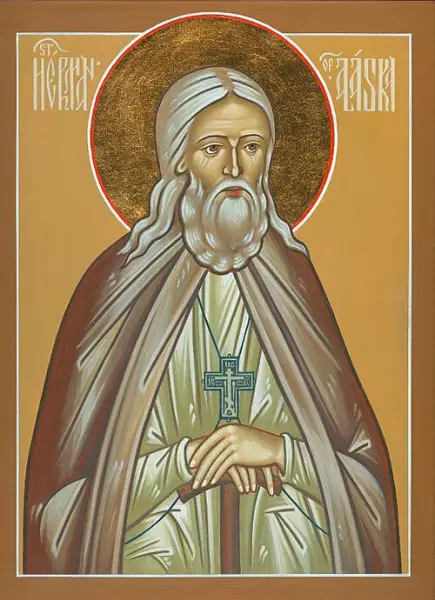
- Clothed as a monk with a flowing white beard·A wrought iron cross and chains worn about his chest
- Canonization
- Canonized August 9, 1970, at Kodiak by the Orthodox Church in America, and the same day in San Francisco by the Russian Orthodox Church Outside of Russia; the first Orthodox saint of North America
Prayer
Bibliography
Show 8 sources
- “Address of the Great Council of Bishops of the Orthodox Church in America 11–13 March 1969, Concerning The Canonization of the Spiritual Father Herman of Alaska”, Orthodox Church in America
- “Antiochian Village: St. Herman”, Antiochian Orthodox Christian Archdiocese of North America
- “Herman of Alaska: Missionary 1837”, The Episcopal Church
- Korsun, Sergei (2012). Herman: A Wilderness Saint. Jordanville, NY: Holy Trinity Publications. ISBN 978-0-88465-192-5
- Kovalskaya, E. Yu. “German Alyaskinsky”, Pravoslavnaya Entsiklopediya
- Little Russian Philokalia, vol. III: St. Herman. Platina, CA: St. Herman of Alaska Press. 1988. ISBN 0-938635-32-8
- Walsh, Michael J. (2007). A New Dictionary of Saints: East and West. Collegeville, MN: Liturgical Press. ISBN 978-0-8146-3186-7
- Venerable Herman of Alaska: Canon, Akathist, and Prayers (ed. John Mikitish). St. Tikhon's Monastery Press, 2025
Profile text adapted from the Wikipedia article, licensed CC BY-SA 4.0.
Pray with this saint every day
Save St. Herman of Alaska to your favorites, read the full profile, and get feast-day reminders in the Saints app.
Get the Saints AppFree on the App Store for iPhone and iPad