
died 1479·Feast August 12 (repose); also August 21 (translation of relics)
St. Herman of Solovki
Hermit and co-founder of the Solovetsky Monastery
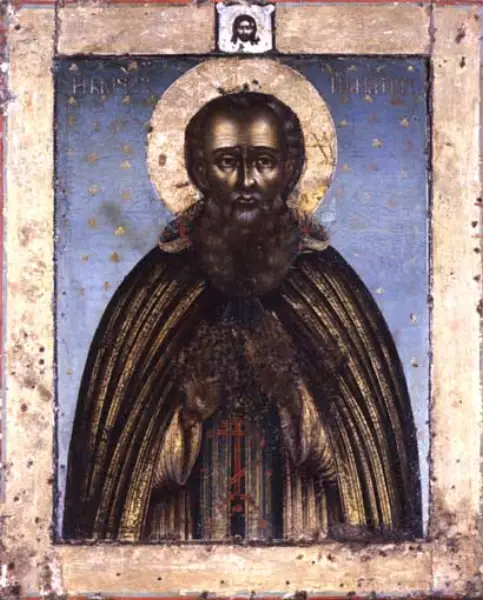
Overview
Herman of Solovki, who died in 1479, was a Russian hermit, probably of Karelian origin, and one of the founders of the Solovetsky Monastery on the far islands of the White Sea. Restless for a desolate place far from the crowds of the world, he attached himself in 1429 to the monk Sabbatius, who had settled near a chapel on the Vyg River, and the two sailed together to the Solovetsky Islands to live as hermits in the harshest solitude northern Russia could offer. Sabbatius died in 1435, and Herman came back to the mainland; there, in 1436, he made the acquaintance of Zosima and crossed once more to the islands with him; around the pair there gathered the brethren from whom the Solovetsky Monastery took its beginning, under the eparchy of Novgorod. For roughly fifty years in all Herman lived in the Solovetsky archipelago, then among the most remote places inhabited by man. The year 1479 brought the death of Zosima; his successor as hegumen, Arseniy, then dispatched the elderly Herman to Novgorod on the monastery's business; Herman died there that same year. His relics, prevented by the season from being carried home, were buried on the Svir River and transferred in triumph to the Solovetsky Monastery in 1484. The Russian Orthodox Church has numbered him among the saints since 1692.
The Complete Life
In Search of a Desolate Place
Herman's life was shaped from the first by a single longing: to find a place so desolate that nothing would stand between the soul and God. He was, so far as can be known, a man of Karelian origin from the northern marches of the Russian world. In 1429 his search brought him to the monk Sabbatius, who had already gone out from the common life and settled near a chapel on the Vyg River. The two were kindred spirits, both looking for solitude where the crowds of men could not follow, and under Sabbatius' influence Herman undertook the venture that gave his life its meaning: they sailed together to the Solovetsky Islands in the White Sea, at that time among the most remote locations imaginable, and lived there as hermits. The enterprise was renewed by death and Providence. When Sabbatius died in 1435, Herman returned to the continent, but solitude had not finished with him; in 1436 he met Zosima, a new companion of like mind, and with him he crossed the sea again to the islands where his name would be joined forever to the history of Russian monasticism.
§ Life
Founder of the Solovetsky Brotherhood
What Herman and his companions began as a hermits' refuge became, almost without design, one of the great monasteries of Russia. After his return to the islands with Zosima in 1436, other monks began to arrive, drawn by the fame of the holy men at the edge of the White Sea; when the brethren had gathered, the Solovetsky Monastery was founded, made subject to the Eparchy of Novgorod. Zosima became the monastery's hegumen, and Herman remained the living link with its eremitical beginnings, the man who had known both Sabbatius and Zosima and could hand on intact the spirit in which those far islands had first been taken possession of for God. In all, he spent about fifty years of his life in the Solovetsky archipelago, outlasting both of the companions with whom his memory is now inseparably joined. The monastery that grew from those beginnings became a spiritual powerhouse of the Russian North, and its later generations never forgot that the foundation of their whole edifice had been nothing grander than a hermit's patient prayer offered at the edge of the map.
§ Life
Death in Novgorod and the Journey of the Relics
Herman's death carried a gentle irony: the hermit who had crossed the sea to escape mankind died on business among men. In 1479, after the death of his old companion Zosima, the monastery's new hegumen, Arseniy, sent the aged Herman to Novgorod, the eparchial city to which the monastery was subject. There, in that same year, Herman ended his long life. The monks of Solovki wished to bring their founder's body back across the sea to the monastery he had founded, but the season defeated them — the northern waters do not forgive delays — and they were forced to bury him beside the Svir River instead. Five years later, in 1484, the transfer was finally accomplished, and the relics of Herman were translated in honor to the Solovetsky Monastery, joining him in death to the brotherhood he had helped to gather. The Church completed what the season had delayed: the Russian Orthodox Church has counted him among its saints since the year 1692, keeping his memory on July 30 Old Style, August 12 new style, the day of his repose, and again on August 8 and 21, in commemoration of the translation of his relics.
§ Life
Timeline
- 1429
Met the monk Sabbatius near a chapel on the Vyg River while searching for a desolate place in which to live.
§ Life
- 1435
Sabbatius died, and Herman left the Solovetsky Islands and returned to the continent.
§ Life
- 1436
Met Zosima on the mainland and returned with him to the Solovetsky Islands, where the monastery would later grow up around them.
§ Life
- 1479
Sent to Novgorod by the new hegumen Arseniy after Zosima's death, and died there in the same year.
§ Life
- 1484
His relics, first buried on the Svir River, were transferred to the Solovetsky Monastery.
§ Life
- 1692
From this year the Russian Orthodox Church has formally venerated Herman as a saint.
§ Life
The Record
- Major works
- Co-founding of the Solovetsky Monastery on the Solovetsky Islands
- Patron of
- The Solovetsky Monastery·Hermits and monastic pioneers of the Russian North
- Symbols
- Shown in monastic habit with the Solovetsky Monastery
- Canonization
- Venerated as a saint by the Russian Orthodox Church since 1692
Prayer
Bibliography
Show 3 sources
- Герман Соловецкий [Herman of Solovki], Solovki Encyclopaedia (in Russian)
- Православные святые и святыни в истории Архангельского Севера [Orthodox saints and shrines in the history of the Arkhangelsk North], Pomor State University named after M.V. Lomonosov, 2002 (in Russian)
- Преподобный Герман Соловецкий [Venerable Herman of Solovki]
Profile text adapted from the Wikipedia article, licensed CC BY-SA 4.0.
Pray with this saint every day
Save St. Herman of Solovki to your favorites, read the full profile, and get feast-day reminders in the Saints app.
Get the Saints AppFree on the App Store for iPhone and iPad