
1st century·Feast May 31
St. Hermas of Philippopolis
Apostle of the Seventy and Bishop of Philippopolis
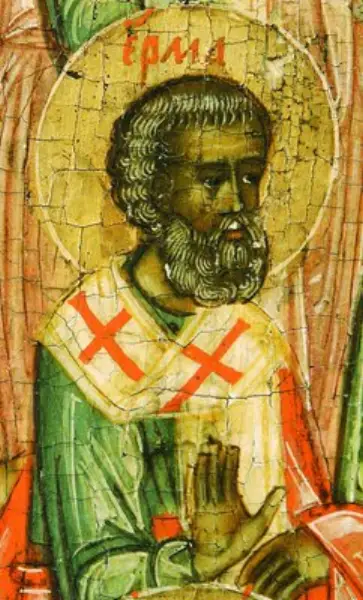
Overview
Hermas of Philippopolis belongs to the earliest generation of Christian leaders, counted by tradition among the Seventy Disciples whom the Lord sent out beyond the Twelve. He is commonly identified with the Hermas whom Saint Paul greets in the sixteenth chapter of the Letter to the Romans, and he served as bishop of Philippopolis, the chief city of Thrace, a see that corresponds to modern Plovdiv in Bulgaria. Later writers frequently confused him with the author of The Shepherd of Hermas, an early Christian work of penitential teaching, yet the sources distinguish the two: the author of the Shepherd belonged to the second Christian generation and lived somewhat later than the apostolic bishop. The biographical tradition preserved in the Prologue from Ohrid relates that Hermas possessed considerable wealth, lost it through his own transgressions and those of his sons, and then received the visits of an angel of repentance who remained with him to the end of his days. He sealed his witness with his blood, dying as a martyr. His commemoration falls on May 31, on November 5 together with several fellow apostles, and on January 4 with the choir of the Seventy.
The Complete Life
Wealth, Fall, and the Angel of Repentance
The tradition that has come down about Hermas paints a strikingly honest portrait of a holy man who knew failure from the inside. He is described as having been wealthy, a man of means in the community of the early church. Yet his riches did not endure. The account preserved in the Prologue from Ohrid says that he fell into poverty because of sin, both his own transgressions and the misdeeds of his sons, whose conduct brought him low. In that season of loss and contrition, the story continues, an angel of repentance came to visit him. This heavenly visitor did not depart after a single appearance; the tradition says the angel remained at Hermas side until the close of his earthly life, accompanying him through the years that followed his humiliation. It was during this long companionship, according to the same account, that the work known as The Shepherd of Hermas was set down, a book whose whole burden is the possibility of repentance after baptism. Whatever questions scholars may raise about the identity of the author, the picture of Hermas that this tradition preserves is of a leader who preached conversion because he had lived it, turning personal catastrophe into a testimony of mercy.
§ Life
Among the Seventy and Shepherd of Philippopolis
Hermas stands in the apostolic rank of the Seventy Disciples, the wider company of missionaries whom the Gospel tradition honors alongside the Twelve. In the lists of these apostolic men his name is joined to those whom Saint Paul himself mentions, for in the fourteenth verse of the sixteenth chapter of Romans the apostle sends greetings to a Hermas among the believers of Rome. On the strength of this greeting and of uninterrupted church tradition, Hermas has been venerated from antiquity as one of the Seventy. His particular charge was the church of Philippopolis, the principal city of the Roman province of Thrace, where he served as bishop. That city, which stands today as Plovdiv in Bulgaria, thus received the faith through one whose ministry reached back to the age of the apostles. A long-standing confusion has linked him with Hermas, the second-century Christian who wrote the Shepherd, one of the most beloved works of early Christian literature; but the ancient testimony is careful to separate the two men, noting that the author of the Shepherd was a Christian of the second generation and lived at a later time than the bishop of Philippopolis. The apostle and the writer therefore remain distinct figures in the church's memory.
§ Introduction
Martyrdom and Commemoration
The earthly course of Hermas ended in blood. The tradition states plainly that he finished his life as a martyr, bearing witness to Christ by his death as he had by his episcopal ministry, though the circumstances of his execution have not been preserved. The church of both East and West keeps his memory on more than one day, a sign of the antiquity and breadth of his cult. His principal feast falls on May 31. A second observance on November 5 unites him with a company of fellow apostolic men, Patrobas, Linus, Gaius, and Philologus, several of whom are likewise greeted in the closing chapter of the Letter to the Romans. Finally, on January 4 he is commemorated with the whole choir of the Seventy Disciples, whose feast gathers into a single celebration all the missionary companions of the Twelve. The chief source for his life is the Prologue from Ohrid of St. Nikolai Velimirovic, the great Serbian hagiographic compilation, which preserves the outline of his wealth, his fall, his angelic visitor, and his martyr's crown. Through this slender but ancient memory, the bishop of Philippopolis remains a living witness that repentance and apostolic courage belong together.
§ Introduction
The Record
- Major works
- The Shepherd of Hermas (attributed to him only by traditional identification)
- Canonization
- Pre-congregation; honored from apostolic times as one of the Seventy
Prayer
Bibliography
Show 1 sources
- St. Nikolai Velimirovic, The Prologue from Ohrid
Profile text adapted from the Wikipedia article, licensed CC BY-SA 4.0.
Pray with this saint every day
Save St. Hermas of Philippopolis to your favorites, read the full profile, and get feast-day reminders in the Saints app.
Get the Saints AppFree on the App Store for iPhone and iPad