
died 13 April 585·Feast April 13
St. Hermenegild
Visigothic Prince and Martyr of Catholic Faith
Overview
Hermenegild was the eldest son of Liuvigild, king of the Visigoths, and was raised in the Arian faith of his father's court. In 579 he married Ingund, a Catholic Frankish princess, and in the same year fell out with his father, openly rebelling the following year. During the uprising he abandoned Arianism and embraced Catholicism, coming under the influence of Leander of Seville. The revolt had political as much as religious causes, and it ended in failure: Hermenegild was defeated in 584 and exiled. Seeking sanctuary in a church, he accepted a false promise of peace, was imprisoned, and refused the Eucharist from an Arian bishop at Easter. His father ordered his death, and he was executed on 13 April 585. Contemporary Spanish chroniclers treated him as a rebel, but Pope Gregory the Great, in his Dialogues, hailed him as a Catholic martyr who died rather than betray the true faith, and credited his death with inspiring the conversion of the Visigothic kingdom under his brother Reccared. His cult flourished especially after the Reconquista and was formally authorized by Pope Sixtus V in 1585.
The Complete Life
A Prince of the Visigoths
Hermenegild entered the world as the firstborn son of Liuvigild, king of the Visigothic Kingdom that dominated the Iberian Peninsula and part of southern France. His father raised him in the Arian confession, the form of Christianity the Gothic rulers had long professed, and in time Liuvigild elevated his sons to the rank of co-regents, preparing them to share in the government of the realm. Among his brothers was the future King Reccared I, whose own religious path would one day vindicate Hermenegild's cause. The decisive turn in the young prince's life came in 579, when he married Ingund, daughter of the Frankish King Sigebert I of Austrasia. The bride was only twelve years old and a devout Catholic; her mother was Brunhilda of Austrasia, herself a Visigothic princess. At the Visigothic court the girl faced relentless pressure from Hermenegild's stepmother Goiswintha, who demanded that she abandon her beliefs, but Ingund stood unmoved in the faith she had received. The clash between the Catholic princess and the Arian household exposed the religious fault line running through the kingdom, and it was into this charged atmosphere that Hermenegild himself was soon drawn toward the Catholic faith.
§ Marriage to Ingund
Conversion in the South
Liuvigild dispatched his son to the southern portions of the kingdom to govern in the royal name, and there, in the neighborhood of Seville, providence arranged the encounter that would change his life. Hermenegild came under the guidance of Leander of Seville, the learned bishop and older brother of Isidore of Seville, whose teaching led the prince to embrace Catholicism. The conversion was no secret; his family demanded that he return to the Arian communion in which he had been raised, but he refused. Around the same period he placed himself at the head of an uprising against his father. Modern historians, reading the contemporary evidence, attribute the revolt to politics rather than to religious conviction alone, a struggle for power within a dynasty as much as a confession of faith. Hermenegild sought help from the Byzantine Empire, which held territory in the south, but the empire was too occupied with defending itself against the Sasanian Persians to lend him real support. For a time he enjoyed the backing of the Suebi, a people his father had crushed in 579, though Liuvigild compelled them to submit once again in 583. The rebellion thus stood on weakening foundations from its outset.
§ Marriage to Ingund
Revolt and Ruin
The rising against Liuvigild unfolded across the southern kingdoms and ended in unrelenting failure. Hermenegild withdrew to Seville, and when that city fell to a royal siege in 584 he fled on to Córdoba. His wife and infant son had found shelter with the Byzantine garrison; once Liuvigild offered the imperial command a ransom of 30,000 gold pieces, the eastern troops pulled out of the struggle and sailed off with Ingund and her little boy, and the princess never saw Spain again. Deserted by his allies, Hermenegild sought sanctuary in a church, trusting that the holiness of the place would shield him. His father, whatever else he was, declined to violate the sacred precinct. Instead he sent his other son Reccared inside to speak with the fugitive and to offer him peace. The offer was accepted, and a fragile reconciliation held for a time. It was not to last. Goiswintha, the king's wife, rekindled the alienation within the family, and the promised peace proved only a pause before the final catastrophe. The rebellion of the Catholic prince collapsed entirely in 584, leaving him at the mercy of a father whose patience had been exhausted by years of civil strife.
§ Marriage to Ingund
Imprisonment and Martyrdom
After the reconciliation broke down, Hermenegild was confined, first at Tarragona or Toledo according to the varying accounts, and during his captivity he was held in a tower at Seville. The crisis that decided his fate came at Easter. An Arian bishop was sent to the prisoner to celebrate the feast, but Hermenegild would not receive the Eucharist from a minister of the confession he had renounced. That refusal sealed his death sentence. King Liuvigild ordered his son's execution, and on 13 April 585 the prince was put to death, tradition preserving the detail that he was felled with an axe. The Roman Martyrology, in its English rendering, records that he was imprisoned for confessing the Catholic faith and that his father ordered him brought down with an axe when he refused communion from the Arian bishop at the Easter liturgy, and thus the prince passed from this world into the presence of God, wearing at once the crown of royalty and the crown of martyrdom. Thus died the heir of the Visigoths, at once a prince disowned by his own house and a confessor whom the Church would number among her saints, his royal birth transfigured into the nobility of faithful blood shed for the true belief.
§ Imprisonment and death
From Rebel to Martyr
The martyr's crown was not granted at once by the historians of his own generation. Contemporary Spanish writers, such as John of Biclaro in his continuation of Victor of Tunnuna and Isidore of Seville in his history of the Gothic kings, record only Hermenegild's revolt and say nothing of his conversion. Gregory of Tours, writing in Francia, does recount the conversion and even names it as the spur to the rebellion, yet he sits in judgment on the prince as a traitor. It was Pope Gregory the Great who first proclaimed Hermenegild a martyr. In his Dialogues the pope relates that the prince was slain after refusing communion from an Arian bishop, and he draws from the death a theology of sacrifice: he credits Hermenegild's blood with the conversion of his brother Reccared and, through Reccared, of the whole Visigothic kingdom, quoting the Gospel word about the grain of wheat that must die to bear fruit. Upon the pope's verdict the entire later reputation of Hermenegild rests. In 1585, at the urging of King Philip II of Spain, Pope Sixtus V authorized his cult in Spain, and Pope Urban VIII afterward extended the recognition to the universal Church.
§ Reputation and legacy
Cult, Art, and Memory in Spain
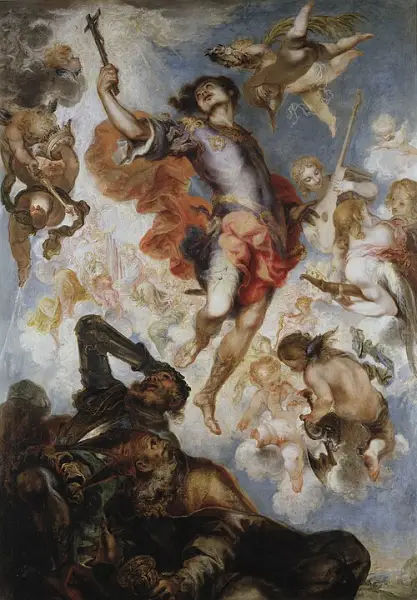
Once the Church had ranked him among her martyrs, Hermenegild rose to exceptional prominence in Spain during the centuries after the Reconquista, when renewed interest in the Visigothic golden age made the Catholic prince of the Arians a national figure. Poets, painters, and playwrights seized upon his story. The Mexican nun Juana Inés de la Cruz wrote El mártir del sacramento, San Hermenegildo, a Eucharistic drama of the 1680s; Cardinal Francesco Sforza Pallavicino produced in 1644 the tragedy Ermenegildo martire, judged a masterpiece of seventeenth-century hagiographic theater; and Francisco de Herrera the Younger painted in 1654 The Triumph of St. Hermenegild, made for the Discalced Carmelites of Madrid and now preserved in the Museo del Prado. In art he appears bearing an axe together with a crown, a sword, and a cross, the emblems of his rank and execution. His feast is kept on April 13. Spain's Royal Brotherhood uniting veterans of the armed forces and the Civil Guard claims him as patron, and the Royal and Military Order of Saint Hermenegild, founded by Ferdinand VII in 1814, bears his name in honor of the martyr king's son who chose faith over dynasty.
§ Reputation and legacy
Timeline
- 579
Marries Ingund, the twelve-year-old Catholic daughter of King Sigebert I of Austrasia, against the opposition of his stepmother Goiswintha
§ Marriage to Ingund
- 580
Openly revolts against his father Liuvigild, having converted from Arianism to Catholicism under the influence of Leander of Seville
§ Marriage to Ingund
- 583
Forces the Suebi, who had briefly supported his cause, to capitulate once more before his father's arms
§ Marriage to Ingund
- 584
Defeated and exiled; flees to Seville, and when the city falls to siege makes peace after taking sanctuary in a church
§ Marriage to Ingund
- 13 Apr 585
Executed by his father's order after refusing the Easter Eucharist from an Arian bishop while imprisoned
§ Imprisonment and death
- 1585
Pope Sixtus V, at the urging of Philip II of Spain, authorizes the cult of Hermenegild throughout Spain
§ Reputation and legacy
In Their Own Words
Poor prince, he did not realize that the judgment of God hangs over anyone who makes such plans against his own father, even if that father be a heretic.
Unless the grain of wheat falling into the earth doth die, itself remaineth alone; but if it die it bringeth forth much fruit.
The Record
- Patron of
- Seville, Spain·Royal Brotherhood of Veterans of the Armed Forces and the Civil Guard in Spain
- Symbols
- axe·crown·sword·cross
- Canonization
- Cult authorized in Spain by Pope Sixtus V in 1585; later extended to the whole Church by Pope Urban VIII
Prayer
Bibliography
Show 15 sources
- Stracke, Richard (2015-10-20). "Saint Hermenegild: The Iconography". Christian Iconography.
- Heather, Peter (1998). The Goths. Wiley. pp. 280–282. ISBN 978-0-631-20932-4.
- Markus, Robert Austin (1997). Gregory the Great and His World. Cambridge University Press. p. 165. ISBN 978-0-521-58608-5.
- Kirsch, Johann Peter. "Saint Hermengild." The Catholic Encyclopedia. Vol. 7. New York: Robert Appleton Company, 1910.
- Frassetto, Michael (2003). Encyclopedia of Barbarian Europe: Society in Transformation. ABC-CLIO. ISBN 978-1-57607-263-9.
- Gregory of Tours, translated by Lewis Thorpe, History of the Franks. Harmondsworth: Penguin, 1974.
- Butler, Alban. The Lives or the Fathers, Martyrs and Other Principal Saints, Volume 4. D & J Sadlier and Company, 1864.
- "Lives of the Saints: For Every Day of the Year", edited by Rev. Hugo Hoever, S.O.Cist, Ph.D. New York: Catholic Book Publishing Co., 1955.
- Saxer, V., and S. Heid. "HERMENEGILD, martyr (d. 585)." Encyclopedia of Ancient Christianity, Angelo Di Berardino, InterVarsity Press, 1st edition, 2014.
- Pope Gregory I, Dialogues, trans. Edmund Garratt Gardner. London: Warner, 1911. Book III, Chapter 31.
- Fuller, Amy. "Rebel with a cause? From traitor prince to exemplary martyr: Sor Juana Inés de la Cruz's representation of San Hermenegildo", European Review of History Vol. 16, Issue 6 (2009), pp. 893-910.
- Goffart, W. "Saint Hermenegild." New Catholic Encyclopedia, Gale, 2003.
- Sforza Pallavicino, Martyr Hermenegild. Ed. and trans. by Stefano Muneroni. Centre for Reformation and Renaissance Studies, 2019.
- "The Triumph of Saint Hermenegild". museodelprado.es. Retrieved 7 May 2023.
- "San Hermenegildo". defensa.gob.es. Retrieved 7 May 2023.
Profile text adapted from the Wikipedia article, licensed CC BY-SA 4.0.
Pray with this saint every day
Save St. Hermenegild to your favorites, read the full profile, and get feast-day reminders in the Saints app.
Get the Saints AppFree on the App Store for iPhone and iPad