
died c. 160·Feast May 31
St. Hermias
Soldier martyr of Comana under Antoninus Pius
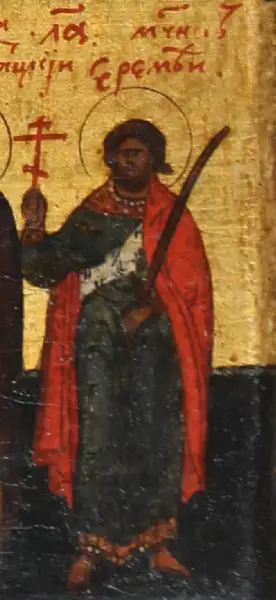
Overview
St. Hermias was a soldier of the Roman army who won the crown of martyrdom at Comana in Pontus around the year 160. He had served in the ranks for long years, finishing his time of service in the reign of Emperor Antoninus Pius, and when that time was complete he refused the pay due to him and openly confessed his faith in Christ. Arrested and brought before the proconsul Sebastian at Comana, he withstood every demand that he renounce his confession to prove his loyalty to the emperor. What followed is one of the most vivid passion narratives preserved from the early Church: tortures of escalating cruelty, a sorcerer's poison rendered harmless by the sign of the cross, and finally the executioner's sword. Even his persecutor's hired sorcerer was converted by what he saw and died a martyr himself. Hermias is commemorated on 31 May by Catholics and Orthodox alike, and his relics were buried secretly by the Christians of the city, who treasured them as a source of healing.
The Complete Life
A Soldier Who Laid Down His Pay
Hermias spent the prime of his life in the Roman army, stationed at Comana in Pontus, a garrison town of Asia Minor. His military service stretched across many years, and he completed it under the emperor Antoninus Pius, whose reign from 138 to 161 marked the calm before later storms. At the end of that service Hermias did something quietly startling: he declined the pay owed to him and declared himself a Christian. For a veteran to renounce what the state owed him and confess the forbidden faith at the same time was a double defiance, a witness both of detachment from the world and of loyalty to a higher king. The response of the authorities was swift. He was arrested and brought before Sebastian, the proconsul at Comana, who summoned him to renounce his confession as proof of fidelity to the Roman emperor. Hermias refused with vigor, and the proconsul, finding persuasion useless, ordered him handed over to the torturers. Thus the career that had trained his body for hardship now prepared his soul for the arena, and the discipline of the barracks passed over into the discipline of confession.
§ Life
Torments Conquered by the Cross
The tortures inflicted on Hermias were meant to break him in body before he could be broken in will. His tormentors shattered his jaws and then tore the skin from his face. He was next thrown into a burning furnace, yet after three days he emerged from the flames without injury. Sebastian then turned to a sorcerer named Marus, who brewed a powerful poison to kill the saint by subtler means. Hermias traced the cross over the draught and swallowed it unharmed; when he emptied a second, stronger poison with the same immunity, Marus professed faith in the power of Christ, and the sword took him at once — a martyr baptized in his own blood. The saint's trials resumed: he was dipped in seething oil, deprived of his eyes, and hung head downward for three days, giving thanks to Christ all the while. At last the frenzied Sebastian cut him down with his own sword. The Christians of Comana buried the martyr in secret, honoring him as their city's greatest treasure, and his remains became known far and wide as a fountain of numerous healings.
§ Life
Memory of the Martyr of Pontus
The memory of Hermias has endured in both the East and the West for eighteen centuries. His feast is kept on 31 May, and he is commemorated by the Orthodox Church and the Catholic Church alike, standing among the soldier martyrs whose witness joined military discipline with the confession of Christ. The Eastern tradition preserves his life in the great hagiographic collections, and the tale of his endurance has been retold wherever Christians have needed an example of patience under suffering. His story carries two lessons that later generations have drawn from it. The first is the power of blessing over harm: the sign of the cross rendering poison harmless became one of the classic images of the martyr's triumph. The second is the surprising harvest of persecution, for the sorcerer Marus, sent to destroy the saint, was himself converted by the spectacle of faith and won the same crown. Above all, the secret burial of Hermias by the Christians of Comana, and the healings reported at his relics, show how quickly the Church recognized in his death not a defeat but a victory.
§ Life
The Record
- Canonization
- Pre-congregation martyr, honored by the Orthodox and Catholic Churches since antiquity
Prayer
Bibliography
Show 2 sources
- Dimitry of Rostov, The Lives of the Saints, Article: May 31
- Nikolai Velimirovic, The Prologue from Ohrid, Article: May 31
Profile text adapted from the Wikipedia article, licensed CC BY-SA 4.0.
Pray with this saint every day
Save St. Hermias to your favorites, read the full profile, and get feast-day reminders in the Saints app.
Get the Saints AppFree on the App Store for iPhone and iPad