
died A.D. 117·Feast September 4
St. Hermione of Ephesus
Unmercenary Healer and Virgin Martyr of Ephesus
Overview
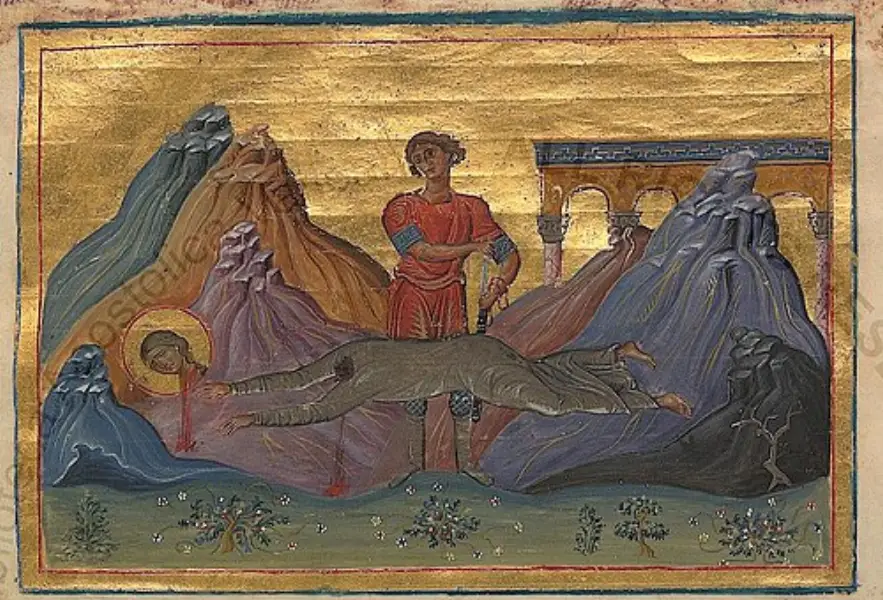
Hermione of Ephesus, who died around A.D. 117, was a second-century virgin martyr numbered among the most beloved healer saints of the early Church. She was born at Caesarea, one of the four daughters of Philip the Evangelist, the deacon whose ministry the Acts of the Apostles describes; Scripture does not record her name, but it tells that the daughters of Philip were virgins gifted with prophecy. Trained in medicine, Hermione set out in the early second century with her sister Eukhilda for Ephesus, hoping to aid John the Theologian in his evangelization; finding that he had already died, the sisters attached themselves instead to Petronius, a disciple of Paul. In Ephesus Hermione won renown as a great healer and founded the first Christian hospital in the city. Her fame as physician and believer reached the emperor Trajan, who halted at Ephesus in 114 during his march against the Persians and tried in vain to make her renounce Christ. Under Trajan, and still more under Hadrian, she endured torments with unconquerable patience: scourging, burning tar, and the executioner's blade. She was beheaded after her executioners were converted at her feet, and she may lie buried on the slopes of Pion Hill in Ephesus.
The Complete Life
A Daughter of Philip the Evangelist
Hermione's story begins in the household of one of the most striking figures of the apostolic age. She was born at Caesarea, and her father was Philip the Evangelist, one of the seven deacons chosen by the earliest Christian community of Jerusalem to serve the believers, as the sixth chapter of the Acts of the Apostles relates. Scripture itself does not mention Hermione by name, but the Acts of the Apostles record that Philip had four daughters, and the sacred text describes them as virgins who possessed the gift of prophecy. Christian tradition identified Hermione as one of these prophetic daughters, a girl raised in a home where the Holy Spirit was honored and the ministry of the word was a family affair. In later centuries her memory was sometimes entangled with legend, and she has frequently been mistaken for a daughter of Philip the Apostle rather than of Philip the Evangelist; the tradition of the Church, however, places her firmly in the evangelist's family. The Eastern Orthodox Church remembers her in the Menaion, its liturgical book for the singing of the saints, where her descent and her virginity are confessed alongside her gifts of healing and prophecy.
§ Biography
Physician and Founder in Ephesus
Hermione prepared for her life's work by the disciplined study of medicine, and she united that learning to the charism her family knew so well, the prophetic gift. Around the beginning of the second century she set out from her native Caesarea with her sister Eukhilda, traveling through Anatolia to Ephesus. The goal of the journey was the great apostle John the Theologian: the sisters hoped to place their talents at the service of his evangelization. When they reached the city they learned that John had already died, but the providence of God had another guide waiting for them. They met Petronius, a disciple of the Apostle Paul, and under his direction they continued their Christian work. In Ephesus Hermione's medical skill soon made her famous. She was celebrated as a great healer, and her practice of medicine took institutional form: she built a hospital in the city, remembered by tradition as the first Christian hospital in Ephesus. Here the ideals of the unmercenary physician took flesh, as she treated the suffering of the pagan metropolis in the name of Christ. Her double reputation, as a skilled doctor and as a devout and conspicuous Christian, could not long remain hidden from the authorities of the empire.
§ Biography
Before the Emperor Trajan
The report of the Christian physician reached the throne of the Caesars. In 114 the emperor Trajan, advancing to war against the Persians, stopped at Ephesus and summoned Hermione, intending to persuade her to renounce Christ. Her refusal was absolute, and the emperor commanded that her face be beaten for hours on end. She bore the ordeal without breaking, sustained, as the tradition tells, by a vision of Christ himself, who appeared wearing Petronius's own form upon the seat of judgment. Trajan watched a woman he could neither frighten nor compel, and he released her when two things became plain: she would never give up her belief, and she endured the torment with unshaken patience and a brave heart. A word of prophecy completed her triumph. Hermione foretold that the emperor would defeat the Persians and that after him his son-in-law Hadrian would wear the purple. Whether out of superstition or grudging respect, Trajan let her go free. The episode set the pattern of her martyrdom: before judges and executioners she combined invincible constancy with a prophet's calm, treating the wrath of emperors as a small thing beside the faith she had learned in the house of Philip the Evangelist.
§ Biography
Trial by Fire under Hadrian
Hadrian proved a fiercer persecutor than his predecessor, and under him Hermione's sufferings reached their fullness. He too demanded that she renounce Christ, and when she refused he had her flogged and wires driven through her feet; she carried these agonies without a murmur. Next the emperor commanded that she be plunged into a cauldron filled with burning tar. The virgin blessed herself with the cross as she stepped into the vessel, and emerged without a wound; the flames died down around her, and those watching said she appeared to stand in dew. Hadrian, rash enough to touch the vessel himself, lost his nails and suffered severe burns, and in fury ordered his soldiers to torture her without mercy. They beat her and tore her feet with nails; they tried to roast her alive in an enormous pan, but the fire beneath it exploded and burned the onlookers. Hermione then feigned willingness to sacrifice to the idols and was led into a pagan temple, where her prayer brought the jeweled images crashing down in ruin. For this the emperor condemned her to be beheaded. At the place of execution her two executioners, Theotimus and Theodulos, were suddenly paralyzed; they knelt at her feet, confessed Christ, received her healing and her promise of heaven, and died soon after. Then the sword fell.
§ Biography
Burial and Veneration
The memory of Hermione remained green in the churches of East and West. Tradition holds that she was laid to rest on the eastern slopes of Pion Hill at Ephesus, in ground that legend claims for an extraordinary company of the saints: Mary Magdalene, Timothy, her own father Philip, Paul of Thebes, Aristobulus, Adauctus, and Adauctus's daughter Callisthena. Modern investigators, however, have found no archaeological evidence to confirm even one of these revered burials, so the hill keeps its secret. Her liturgical commemoration is kept on September 4 in the Eastern Orthodox Church and the Roman Catholic Church, while the Episcopal Church honors her on April 14 together with her fellow unmercenary healers Zenaida and Philonella. In the judgment of the writer Khoury, whose study of the saints of the Holy Land preserved her story, Hermione holds a special place among the Palestinian saints, the place set aside for courageous women whose faith in Jesus Christ could not be broken. Healer, founder, prophet, and martyr, she stands at the head of the long line of Christian physicians, a virgin whose hospital outlived her and whose patience under torture instructed generations of believers in the cost and the triumph of discipleship.
§ Veneration
Timeline
- 100
Around the early 100s, after studying medicine, travels with her sister Eukhilda to Ephesus to assist John the Theologian, and instead follows Petronius
§ Biography
- 114
Summoned before Emperor Trajan at Ephesus, refuses to renounce Christ, withstands hours of facial torture, and is freed after prophesying his victory
§ Biography
- 117
Under Hadrian survives scourging, burning tar, and the frying pan, topples the idols of a pagan temple by prayer, and is beheaded
§ Biography
In Their Own Words
owns a special place among the Palestine saints — the place reserved for valiant women of unbreakable faith in Jesus Christ.
The Record
- Major works
- Founding of the first Christian hospital in Ephesus
- Canonization
- Pre-congregation; venerated since antiquity by the Eastern Orthodox, Catholic, and Anglican churches
Prayer
Bibliography
Show 9 sources
- Khoury, Demetri (2008-06-06). A Cloud of Witnesses: Saints and Martyrs from the Holy Land. Bloomington, Indiana: AuthorHouse. pp. 16–17. ISBN 978-1-4343-9440-8.
- Acts 6:1–6
- Lillie, W. J. (2020-09-04). "Saint Hermione, the Daughter of Saint Philip the Deacon". Pemptousia. Archived from the original on 2022-03-08.
- Acts 21:8–9
- Miszczak, Izabela (2020-01-17). The Secrets of Ephesus. TAN Travel Guide. Oxford: Aslan Publishing House. pp. 45, 243. ISBN 978-8-3956-5401-5.
- Baring-Gould, Sabine (1898) [1872]. The Lives of the Saints. Vol. 10 (New and revised ed.). London: John C. Nimmo. pp. 43–44.
- Dunbar, Agnes Baillie Cunninghame (1904). A Dictionary of Saintly Women. Vol. 1. London: George Bell & Sons. p. 380.
- "Martyr Hermione, Daughter of Saint Philip the Deacon". Orthodox Church in America. Syosset, New York. 2010-09-04.
- Lesser Feasts and Fasts 2018. Church Publishing, Inc. 2019-12-01. ISBN 978-1-64065-234-7.
Profile text adapted from the Wikipedia article, licensed CC BY-SA 4.0.
Pray with this saint every day
Save St. Hermione of Ephesus to your favorites, read the full profile, and get feast-day reminders in the Saints app.
Get the Saints AppFree on the App Store for iPhone and iPad