
1858 – 1918·Feast Not stated in the source article
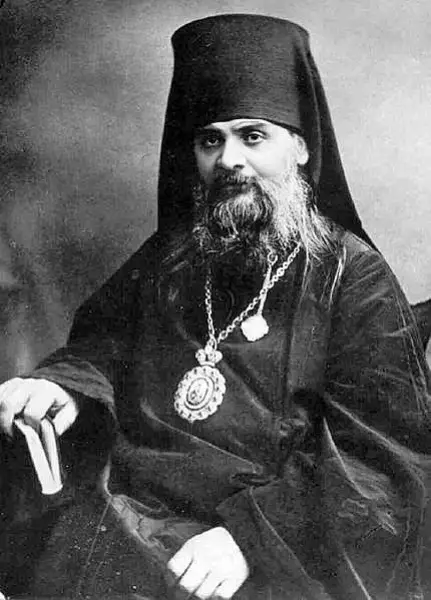
St. Hermogenes Dolganyov
Bishop of Tobolsk and Martyr of the Bolshevik Terror
Overview
Hermogenes Dolganyov, born Georgiy Yefremovich Dolganyov on 25 April 1858 in Kherson Governorate, rose from the son of a village priest to become one of the most conspicuous Russian Orthodox bishops of his era. Educated at Novorossiysk University and the Saint Petersburg Theological Seminary, he took the monastic name Hermogenes in 1892 and served the Church in Tiflis, Saratov, and finally Tobolsk. As inspector and then dean of the Tiflis seminary he expelled the young Joseph Stalin for lecturing on Marxism. A gifted and forceful churchman, he promoted congregational singing, founded monasteries and schools, and in 1903 became Bishop of Saratov and Tsaritsyn with a seat in the Holy Synod. His fearless, often incendiary rhetoric made him both widely respected and widely feared. He numbered among the first and fiercest opponents of Rasputin, whom he publicly denounced and once struck, an act that cost him his position and exile to distant monasteries. Appointed to Tobolsk in 1917, he established contact with the imprisoned Imperial Family. Arrested by the Bolsheviks in April 1918, he was drowned in the Tura River that June on the order of a Bolshevik sailor. The Russian Orthodox Church canonized him as a martyred saint on 31 March 1999.
The Complete Life
A Priest's Son from Kherson
The future bishop was born Georgiy Yefremovich Dolganyov on 25 April 1858 in the Kherson Governorate of the Russian Empire, into the household of a priest. His schooling took place at Ananiv, a town near Odessa in which half the population was Jewish, an environment that exposed the boy early to the religious diversity of the imperial south. He proved a capable student and went on to higher study at Novorossiysk University, where he pursued law, mathematics, and philology, an unusually broad formation for a future churchman. His path to the altar was settled under the influence of Nicanor, Bishop of Kherson, whose example drew him toward the Orthodox ministry. Before that ministry began, his university years and seminary training shaped a mind that was combative, learned, and impatient with mediocrity. A strange and darker footnote belongs to this period: because of his unusually high-pitched voice, rumor later claimed that Hermogenes had castrated himself in 1890 under the influence of the Skoptsy sect, a story repeated by some writers though not established. Whatever the gossip, his gifts were unmistakable, and in 1892, on completing his course at the Saint Petersburg Theological Seminary, he accepted the monastic name Hermogenes and gave himself wholly to the Church.
§ Life
Churchman and Builder
Hermogenes rose quickly through the ranks of the Russian Church. In 1893 he became inspector of the Tiflis Theological Seminary in Tbilisi, and five years later, in 1898, its dean. His discipline was severe enough to touch the future of world history: in 1899 he was responsible for expelling one of the seminary's most famous students, Joseph Dzhugashvili, the man the world would know as Stalin, who had been reading Victor Hugo's account of the French Revolution and lecturing his fellow students on Marxism. In 1903 came the summit of his administrative career, consecration as Bishop of Saratov and Tsaritsyn and a seat in the Holy Synod itself. As a diocesan bishop he proved a reformer of parish life. He introduced singing by the whole congregation in his churches, promoted public processions of the faith, founded schools, and organized mission work for the unchurched. His building program left lasting monuments: the Annunciation Convent and the Saint Trinity Monastery at Khvalynsk, and in Volsk the Town Church of the Annunciation. Contemporaries ranked him among the most widely respected figures of the entire Russian Orthodox Church, a prelate whose energy matched his convictions and whose rhetoric made him impossible to ignore.
§ Life
The War Against Rasputin
In 1905, as revolution shook the empire, Hermogenes formed a friendship that would come to dominate the last decade of his life. Grigori Rasputin, newly arrived in the capital, stayed at the Alexander Nevsky Lavra, where Hermogenes and Theophanes of Poltava met him and were astonished by his psychological insight. For a season the bishop and the peasant mystic were allies in a common struggle against freethinking and modernism within the church. The alliance curdled slowly. Rasputin's rhetoric and scandalous reputation grew; local officials even suppressed the newspaper of Hermogenes's own diocese because of the bishop's outrageous public statements. Rasputin visited Hermogenes at Saratov and the monk Iliodor at Tsaritsyn in 1909, but within two years the three men had become bitter enemies. In December 1911 Hermogenes began spreading word that Rasputin belonged to the Khlysty, an obscure sect with Siberian roots, and he confronted his former friend physically, beating him in a monastery on Vasilyevsky Island. Rasputin carried his complaint to the imperial couple, and the consequences were swift: without any trial, Hermogenes and his assistant, the holy fool Mitya Kozelsky, were expelled to the Zhyrovichy Monastery, removed from the capital and from influence.
§ Life
Tobolsk, Arrest, and Drowning
The years of banishment stretched from Zhyrovichy, where he was sent at the end of 1911, to Ugresha Monastery, where he lived from August 1915. The revolutions of 1917 transformed his fortunes in an unexpected way: in that year he was appointed Archbishop of Tobolsk and Siberia, the diocese of the exiled Imperial Family. He established contact with Nicholas and Alexandra at Ekaterinburg, a loyalty that the new Bolshevik authorities did not forget. In the fourth month of 1918 a Bolshevik party placed Hermogenes under arrest. Come June, the bishop together with a band of fellow captives, among them the priest Pyotr Karelin and several laymen, were taken toward Tyumen. Most of the prisoners were shot on the riverbank near the village of Pokrovskoye, but the bishop and the priest were spared for a crueler end. Forced first to labor on fortification works near Pokrovskoe, the two clergy were transferred to the steamer Oka, bound for Tobolsk. On the way, on orders given by the Baltic sailor and Bolshevik leader Pavel Khokhryakov, the priests were drowned in the Tura River, not far from the native village of the bishop's old enemy Rasputin. Fishermen found his body on 3 July; he was buried in a nearby village and later reinterred in the Sophia cathedral of Tobolsk.
§ Life
Canonization and Memory
The Church did not forget the bishop who had died at the hands of the revolutionary state. On 31 March 1999 the Russian Orthodox Church formally canonized Hermogenes Dolganyov, ranking him among the host of new martyrs and confessors whose blood was shed during the communist persecution. His glorification came eight decades after his drowning, in the years when post-Soviet Russia was recovering the memory of its silenced church, and it recognized in him a hieromartyr: a bishop who laid down his life for Christ and his flock. The assessment of his career has never been simple. He was a monarchist and an anti-communist, a supporter of the Union of the Russian People and the Black Hundreds, a man whose rhetoric was inflammatory enough to draw official suppression, yet whose personal courage was beyond dispute. The same fearlessness that drove Rasputin from his presence carried him into conflict with the Bolsheviks, and it is that fearless confession, not his politics, that the Church honors. Modern historians continue to study him through the memoirs of the Rasputin affair and works such as Joseph Fuhrmann's study of the holy man's life, but for the faithful of Tobolsk and Siberia he remains, simply, their martyred bishop.
§ Introduction
Timeline
- 25 Apr 1858
Born Georgiy Yefremovich Dolganyov in Kherson Governorate, the son of a priest
§ Introduction
- 1892
Completes studies at the Saint Petersburg Theological Seminary and receives the monastic name Hermogenes
§ Life
- 1893
Appointed inspector of the Tiflis Theological Seminary in Tbilisi
§ Life
- 1898
Made dean of the Tiflis Theological Seminary
§ Life
- 1899
Expels Joseph Dzhugashvili, the future Stalin, from the seminary after the student reads forbidden revolutionary literature and preaches Marxism
§ Life
- 1903
Consecrated Bishop of Saratov and Tsaritsyn and given a seat in the Holy Synod
§ Life
- Dec 1911
Breaks openly with Rasputin, denounces him to the court, and beats him in a monastery on Vasilyevsky Island, leading to his own exile to Zhyrovichy Monastery
§ Life
- Aug 1915
Takes up residence at Ugresha Monastery during his long banishment from active ministry
§ Life
- 1917
Appointed Bishop of Tobolsk and Siberia and establishes contact with the Imperial Family held at Ekaterinburg
§ Life
- Apr 1918
Arrested by a group of Bolsheviks after the revolution sweeps away the old order
§ Life
- Jun 1918
Forced to labor near Pokrovskoye, then drowned in the Tura River on the order of Bolshevik leader Pavel Khokhryakov
§ Life
- 31 Mar 1999
Canonized by the Russian Orthodox Church as a martyred saint
§ Introduction
The Record
- Major works
- Annunciation Convent, Khvalynsk·Saint Trinity Monastery, Khvalynsk·Town Church of the Annunciation, Volsk
- Canonization
- Canonized on 31 March 1999 by the Russian Orthodox Church as a hieromartyr
Prayer
Bibliography
Show 10 sources
- "Гермоген (Долганов)". Archived from the original on 2014-03-01.
- Dixon, Simon (2010). The 'Mad Monk' Iliodor in Tsaritsyn. p. 388.
- Fuhrmann, Joseph T. (2013). "The Untold Story". p. 69.
- Deutscher, Isaac (1949). Stalin: A Political Biography.
- Radzinsky, E. (2010). The Rasputin File.
- Nelipa, M. (2010). The Murder of Grigorii Rasputin: A Conspiracy That Brought Down the Russian Empire. pp. 37–38, 551.
- Ruud, Charles A., and Sergei Stepanov (1999). Fontanka 16: The Tsars' Secret Police. pp. 295–296.
- Mramornov, A. I. (2006). Church and Social and Political Activities of Bishop Hermogenes (Dolganov, 1858-1918). Saratov: Scientific Book. 366 p.
- Yusupov, Felix (1952). Lost Splendor.
- "О канонизации Священномученика Гермогена Долганева (1858-1918) Епископа Тобольского и Сибирского" (in Russian).
Profile text adapted from the Wikipedia article, licensed CC BY-SA 4.0.
Pray with this saint every day
Save St. Hermogenes Dolganyov to your favorites, read the full profile, and get feast-day reminders in the Saints app.
Get the Saints AppFree on the App Store for iPhone and iPad