
c. 730 – 815·Feast December 13
St. Herulph
Benedictine founder and first abbot of Ellwangen
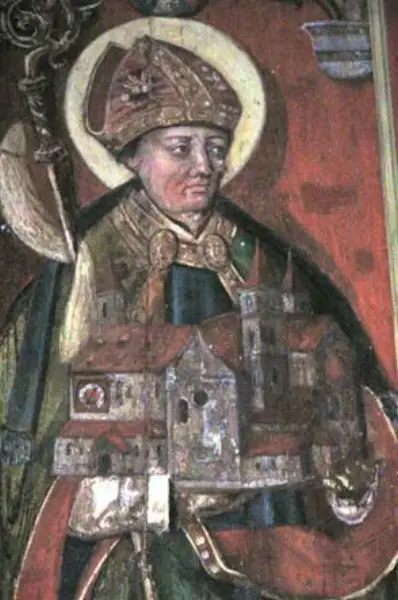
Overview
Herulph, also called Hariolf or Hariolfus, was a Benedictine monk of the Abbey of St. Gall who founded Ellwangen Abbey and became its first abbot. Born around 730 into the family of the Count of Ellwangen, he entered monastic life together with his brother Erlolf, and around the year 750 the two brothers established the monastery that would become the religious centre of their home region. His ecclesiastical horizons soon widened beyond the Swabian forest: in 769 he assisted at the Lateran Council in Rome, and in 772 he took up office as chorbishop of Langres, where his brother had been raised to the episcopate in 759. Through Erlolf's position the young abbey received precious relics, first of the brother martyrs Speusippus, Eleusippus and Meleosippus, and then, in 773, of Sulpicius and Servilian, obtained from Pope Adrian I, who became the chief patrons of its first church. Herulph resigned his bishopric around 778 and withdrew to Ellwangen, where he died in 815 and was buried beside his brother in the church of St. Vitus. His memory was preserved in a Vita Hariolfi composed by the monk Ermanrich of Passau, and his feast is kept on December 13.
The Complete Life
A Count's Son in Ellwangen
Herulph came into the world around the year 730 at Ellwangen, a settlement near Stuttgart in what is now the German southwest. His father was the Count of Ellwangen, so the boy grew up in a household of rank and local authority rather than in poverty, and his later career always bore the marks of a man at home among the aristocracy of the Carolingian world. The family's connections reached to the very summit of the East Frankish court: Herulph was related to Gozbald, who served as archchaplain and chancellor to King Louis the German. Kinship of that kind mattered enormously in the eighth century, when monasteries were founded by noble families and bishoprics were often filled from the same circles. Yet the sources give no hint that Herulph pursued a courtly or military career. Together with his brother Erlolf he turned instead toward the religious life, and the choice of the Abbey of St. Gall in Switzerland placed both young men inside one of the most vigorous monastic communities of the age, a house whose learning and discipline would shape everything they afterwards attempted in their own homeland.
§ Life
Monk of Saint Gall, Father of Ellwangen
At St. Gall, Herulph and Erlolf took the Benedictine habit and were formed in the round of prayer, study and manual labour that governed Alemannian monasticism. Around the year 750 the brothers left the great abbey on the Steinach to plant a monastery of their own at Ellwangen, in the country of their birth, and there Herulph was set over the new foundation as its first abbot. To found a monastery on family land was in that era an act of both piety and strategy: it sanctified the patrimony, gave the kindred a spiritual centre, and extended the network of reformed religious houses across the Carolingian realm. Under Herulph the community acquired patrons worthy of its ambitions. In 759 Erlolf, now Bishop of Langres in France, sent to Ellwangen the relics of the soldier-brothers Speusippus, Eleusippus and Meleosippus, and in 773 he sent on to Ellwangen the relics of Sulpicius and Servilian, secured from Pope Adrian I for that very purpose. These last became the principal patron saints of the first monastic church, tying the young Swabian house directly to the Apostolic See and giving its monks martyrs whose feasts anchored the liturgical year.
§ Life
Service in Council and Chapter
Herulph's responsibilities were never confined within the walls of his abbey. In 769 he assisted at the Lateran Council, the great assembly summoned in Rome amid the crises that followed the Frankish coronation politics of the age, and his presence there shows a man trusted to represent Frankish monastic and episcopal interests before the Pope. Three years later, in 772, he became chorbishop of Langres, sharing in the government of the diocese his brother Erlolf had governed since 759. The office of chorbishop placed him at the heart of the diocesan administration in Burgundy while his own foundation at Ellwangen continued to grow under the protection of its new patrons, Sulpicius and Servilian, whose relics had arrived from Rome in 773. The pattern is striking: an abbot who was simultaneously a diocesan dignitary in a foreign province, bound by blood to his metropolitan brother and by loyalty to the papacy. It was a thoroughly Carolingian combination of roles, and it made Herulph a bridge between the monasticism of St. Gall, the episcopate of Langres and the Roman church during the very decades in which the Frankish kingdom was being refashioned into an empire.
§ Life
Retirement and Burial at St. Vitus
Around 778, after roughly a decade of service as chorbishop, Herulph laid down his office and withdrew to Ellwangen, the house he had founded as a young monk nearly thirty years before. Retirement to one's own foundation was the natural closing act for a founder-abbot, and there is no sign that he sought any further charge. He lived to see his brother Erlolf die in 785; the bishop found his grave within the abbey's church of St Vitus, and it was decided that he would be commemorated there on August 13. Herulph survived him by thirty years, a long old age in which the abbey must have grown from an ambitious foundation into an established pillar of the regional church. When he died in 815, the community laid him beside Erlolf in the church of St Vitus, so that the two brothers who had left St. Gall together to serve God in their homeland were reunited in death at the altar they had endowed with the relics of the martyrs. Their shared grave made the abbey church a place of family memory and local pilgrimage from the very generation of its founding.
§ Life
A Vita and a December Feast
Herulph's memory did not depend on grave and stone alone. The Benedictine monk Ermanrich of Passau composed a Vita Hariolfi, a narrative of his life that carried the founder's story into the later middle ages and secured his reputation as a holy man; Ermanrich's work is the reason any detailed account of the founder survives at all. The church kept his memory liturgically: he is honoured as blessed in the Roman Catholic Church, and his feast day is kept on December 13. Modern scholarship has continued to find him significant, for his career illustrates how the great noble families of the Carolingian east Frankish lands planted monasteries, staffed bishoprics and linked their local foundations to Rome; the historian Eric Joseph Goldberg's study of kingship under Louis the German counts the family among the fabric of that world, and the old hagiographical dictionaries such as Holweck's Biographical Dictionary of the Saints preserve the outline of his life. Ellwangen Abbey itself, which he founded around 750 with Erlolf, remained the visible monument of the brothers' vocation long after their deaths, and the pilgrim who seeks Herulph today seeks him above all in the church of St Vitus where he lies.
§ Life
Timeline
- 730
Born at Ellwangen near Stuttgart, son of the Count of Ellwangen
§ Life
- 750
Founded the monastery of Ellwangen with his brother Erlolf and became its first abbot
§ Life
- 759
His brother Erlolf became Bishop of Langres and sent relics of Speusippus, Eleusippus and Meleosippus to Ellwangen
§ Life
- 769
Assisted at the Lateran Council held in Rome
§ Life
- 772
Became chorbishop of Langres
§ Life
- 773
Received from Pope Adrian I, through Erlolf, relics of Sulpicius and Servilian, chief patrons of the first monastic church
§ Life
- 778
Resigned his episcopal office and retired to Ellwangen
§ Life
- 785
Erlolf, his brother, passed away and found burial within the abbey's own church of St Vitus
§ Life
- 815
Died at Ellwangen and was buried at St. Vitus like his brother
§ Life
The Record
- Major works
- Ellwangen Abbey, founded around 750
- Canonization
- Pre-congregation; venerated as blessed in the Roman Catholic Church
Prayer
Bibliography
Show 3 sources
- Odden, Per Einar. "Den salige Herulf av Ellwangen (~730-~815)", Den katolske kirke, December 28, 2015
- Goldberg, Eric Joseph (2006). Struggle for Empire: Kingship and Conflict Under Louis the German, 817–876. Ithaca, New York: Cornell University Press, p. 171
- Holweck, Frederick George. A Biographical Dictionary of the Saints, B. Herder Book Company, 1924, p. 479
Profile text adapted from the Wikipedia article, licensed CC BY-SA 4.0.
Pray with this saint every day
Save St. Herulph to your favorites, read the full profile, and get feast-day reminders in the Saints app.
Get the Saints AppFree on the App Store for iPhone and iPad