
c. 521 – 575·Feast June 17
St. Hervé
Blind Breton abbot and bard with the wolf
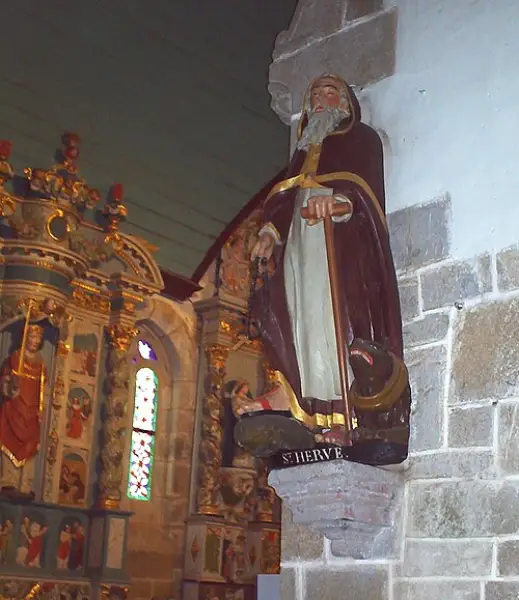
Overview
St. Hervé — remembered under the names Harvey, Herveus, and Houarniaule — stands with St. Ives among the best loved figures of sixth-century Brittany. Born around 521 at Guimiliau, he came into the world blind and never saw with his eyes, yet he became a teacher, minstrel, and holy man whose reputation spread across the whole peninsula. His father, the Welsh bard Hyvarnion, had studied under St. Cadoc and sang as a minstrel at the court of King Childebert I; his mother, Rivanone, was a woman of great beauty versed in the properties of plants and herbs. Left fatherless while still a small boy, Hervé was entrusted to the care of his uncles and educated at the monastic school of Plouvien, where one of them served as abbot. He lived as a hermit and bard near Plouvien with his disciple Guiharan, gathered other followers, and refused every ordination and earthly honor except that of exorcist. He died around 575 and was buried at Lanhouarneau. He is the patron of the blind, of bards, and of musicians.
The Complete Life
Born Blind to a Bard's House
The story of Hervé begins in song. His father, Hyvarnion, was a Welsh bard trained in the school of St. Cadoc who had wandered to the Frankish court of Childebert I to make his living as a minstrel. There he married Rivanone, remembered as a woman of exceptional beauty versed in the virtues of plants and herbs. Their son, born at Guimiliau around the year 521, was blind from birth — a fact that would shape every account of his life. Hyvarnion died while Hervé was still quite young, and the boy inherited his father's harp, an emblem of the music that ran in his blood. His mother withdrew to the solitary life of an anchoress and placed her seven-year-old son with his uncles, who in turn put him under the care of a learned hermit living in the forest. At about fourteen he entered the monastic school of Plouvien, over which his uncle Gourvoyed, his mother's brother, presided as abbot. There the blind boy grew into a man who taught others and sang to them, becoming both teacher and minstrel in the Breton manner.
§ Legend
Hermit, Bard, and Tamer of Wolves
Hervé chose the eremitical life, settling near Plouvien with his disciple Guiharan, where the two lived as hermits and he exercised his gifts as bard. He was credited with the power to cure animals, and tradition tells that a domesticated wolf accompanied him. One day, so the story goes, the wolf devoured the ox or donkey that Hervé used in plowing his field. Instead of driving the beast away, the blind saint preached a sermon so eloquent that the wolf lay down in penitence and begged to serve in the ox's stead — and from that day forward the wolf pulled the plow himself. The image of the sightless abbot guided by a wolf became his emblem in Breton art. Disciples gathered around him, drawn by his teaching and his music, yet he refused every offer of ordination and every earthly honor, consenting only to be ordained an exorcist, the lowest of the minor orders. In that humility he completed his life, dying around 575 and being buried at Lanhouarneau, where his tomb remained for centuries a center of devotion and prayer.
§ Legend
The Well-Beloved of Brittany
Few saints of Brittany have been loved as Hervé has been loved. Together with St. Ives he stands among the most popular of the Breton saints, venerated across the whole region, and his feast is kept on 17 June. In art he is represented as a blind abbot accompanied by a tame wolf, sometimes led by a child guide. At Lanrivoaré, the hermitage of Saint-Hervé, built on the model of Irish hermitages, still keeps its ruined chapel, its fountain, and a stone cell — the last pointed out by tradition as the saint's dwelling. His relics had a troubled history: for fear of the Norman raiders they were carried to the Château de Brest, where a silver shrine in its chapel received them; later they passed into the keeping of the Bishop of Nantes and vanished amid the upheavals of the French Revolution. The devotion outlived the loss. To this day the blind, bards, and musicians claim him as patron, the sick invoke him against eye problems and diseases of the eye, and farmers pray through him for the cure of their horses.
§ Veneration
Timeline
- 521
Born blind at Guimiliau to the bard Hyvarnion and his wife Rivanone
§ Legend
- 575
Died after a life as hermit, teacher, and bard; buried at Lanhouarneau
§ Legend
The Record
- Patron of
- the blind·bards·musicians·against eye problems and eye disease·against sickness of horses
- Symbols
- blind abbot being led by a wolf·child guide
- Canonization
- Pre-congregation, venerated throughout Brittany since the Middle Ages
Prayer
Bibliography
Show 6 sources
- Monks of Ramsgate. "Herveus". Book of Saints 1921. CatholicSaints.Info. 2 September 2013
- Brown, Abbie Farwell. The Book of Saints and Friendly Beasts, illustrations by Fanny Y. Cory, 1900
- "St Hervé", Herald Malaysia, June 10, 2022
- "St. Hervé", FaithND
- "Saint-Hervé Hermitage", Patrimoine D'Iroise
- "Hermitage Saint Hervé", Iroise Bretagne
Profile text adapted from the Wikipedia article, licensed CC BY-SA 4.0.
Pray with this saint every day
Save St. Hervé to your favorites, read the full profile, and get feast-day reminders in the Saints app.
Get the Saints AppFree on the App Store for iPhone and iPad