
1st-2nd century (tradition)·Feast May 15
St. Hesychius of Cazorla
Apostolic missionary and martyr of Visigothic Spain
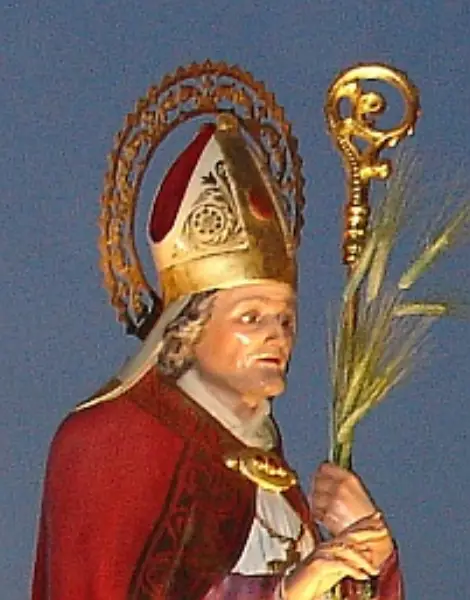
Overview
Saint Hesychius, honored in Spanish as San Isicio, San Hesiquio or San Exiquio and in French as Saint Hisque, is venerated as the patron saint of Cazorla in Andalusia. He belongs to the group known as the Seven Apostolic Men, seven Christian clerics whom tradition says were ordained in Rome by the Apostles Peter and Paul and sent out to evangelize Spain; his companions in that band were Torquatus, Caecilius, Ctesiphon, Euphrasius, Indaletius and Secundius. The legend in this form probably took shape in the seventh century, and sober historians assume the seven men, if they lived at all, belonged rather to the second century. Tradition makes Hesychius a missionary of the apostolic age who preached in the town called Carcere, Carteia or Carcesi, generally identified with Cazorla, became its first bishop, and was put to death by stoning at La Pedriza. An alternative tradition, recorded by Migne, sets his last days at Gibraltar, where he reportedly ended his life quietly, not under an executioner's hand. In Spain he is commemorated at Cazorla on May 15 and elsewhere on March 1, and he is honoured as patron of both Cazorla and Jaen.
The Complete Life
One of the Seven Apostolic Men
Hesychius stands in Spanish hagiography as one of the siete varones apostólicos, the Seven Apostolic Men, a company of Christian clerics whom tradition declares were ordained in the city of Rome by the Apostles Peter and Paul themselves and dispatched to preach the Gospel in the Iberian peninsula. His six fellows in the mission are named as Torquatus, Caecilius, Ctesiphon, Euphrasius, Indaletius and Secundius, each of whom was afterwards honoured as the apostle of a different district of Spain, so that the seven together form the legendary backbone of Spanish Christianity's origins. The story in this developed form probably dates from the seventh century, an age when the Spanish church, recently converted from Arianism under its Visigothic kings, eagerly sought connections to the apostolic generation. Critical historians draw a different conclusion about chronology: scholars have grounds to conclude that the seven, if they walked the earth at all, belonged rather to the second century rather than the first. Between the bare possibility of a missionary named Hesychius and the baroque certainty of the legend lies the whole problem of early Spanish hagiography, and the Church has always honoured these patrons while leaving their history in reverent obscurity.
§ Introduction
Missionary, Bishop and Martyr of Carcere
Tradition presents Hesychius as a Christian missionary of the first century, labouring during the apostolic age in the far south of the peninsula. The town of his ministry is given under several names in the sources: Carcere, Carteia or Carcesi, an imprecision typical of the legend, and the place is commonly identified with Cazorla, the hill town of the upper Guadalquivir that keeps his feast to this day. There he is said to have planted the faith, to have served as the community's first bishop, and finally to have sealed his preaching with martyrdom, stoned to death at a place called La Pedriza, whose very name recalls the shower of stones. Not every ancient witness agrees with this bloody ending. The scholar Migne records a different tradition that sets the saint's death at Gibraltar and describes it as a death in peace, meaning that in that version Hesychius ended his days not under the executioner's stones but as a bishop dying quietly in his see. The identification of the mission field is itself disputed, for some sources state that Carcere or Carcesi should be located not at Cazorla but at Cieza, in the neighbouring region of Murcia, so that even the geography of his apostolate remains a matter of learned debate.
§ Introduction
Patron of Cazorla and of Jaen
Whatever the historians conclude, the devotion of the people has been constant. Hesychius is venerated as a saint by both the Roman Catholic Church and the Eastern Orthodox Church, a shared cult appropriate to a figure of the undivided early Church. In Spain his memory divides between two days: the town of Cazorla commemorates him on May 15, with a romería and the festivals of its patron, while the rest of Spain keeps March 1. His patronage extends beyond Cazorla itself to the whole province of Jaen, whose ancient Christian origins the legend claims for him. A statue of the saint stands in the cathedral of Guadix, testifying to the reach of his cult across Andalusia, where the names San Isicio, San Hesiquio and San Exiquio all circulate in the vernacular records alongside the Latin Isichius, Isicius, Iscius, Hesicius, Hisicius, Esicius and Esitius. No act of formal canonization was ever needed or possible for a martyr of such remote antiquity; his crown rests on the tradition of the Seven Apostolic Men and on centuries of pilgrimage, procession and popular festival at Cazorla, which has never ceased to call him its own and to date its Christian beginnings from his coming.
§ Introduction
The Virgin of the Sierra at Cabra
One curious thread of the tradition binds Hesychius to one of the oldest Marian devotions of Andalusia. The legend says that the saint, or Isicio as the people call him, presented the townspeople of Cabra with an image of the Mother of God that tradition traces to the chisel of Saint Luke the Evangelist, the same painterly apostle to whom so many ancient images of Our Lady are attributed. The image venerated under the title of Nuestra Señora de la Sierra is in fact a work of the end of the thirteenth century, as scholarship recognizes, but the attribution to Luke and the gift of Hesychius express the community's desire to root its devotion in the apostolic age itself. Her image is venerated in the sanctuary of Nuestra Señora de la Sierra on the outskirts of Cabra, and the devotion is counted among the oldest and most beloved in the province of Córdoba. Whatever one makes of the legend, the connection shows how the memory of the Seven Apostolic Men continued to shape religious life across southern Spain, linking the martyr of Cazorla not only to the towns where he is patron but to the shrines where Andalusian Catholics have prayed for seven hundred years and more.
§ Introduction
Timeline
- 100
The period to which scholars assign the Seven Apostolic Men, though tradition places Hesychius a century earlier in the apostolic age
§ Introduction
- 600
The era in which the legend of the Seven Apostolic Men ordained by Peter and Paul probably took its final shape
§ Introduction
The Record
- Major works
- Evangelization of Carcere (identified with Cazorla), of which tradition makes him the first bishop
- Patron of
- Patron saint of Cazorla, Spain·Patron saint of Jaen, Spain
- Symbols
- Stones, for his martyrdom by stoning·Bishop's vestments
- Canonization
- Pre-congregation; ancient martyr venerated by the Catholic and Eastern Orthodox churches
Prayer
Bibliography
Show 5 sources
- "Romería de San Isicio en Cazorla". Junta de Andalucía, Agenda Cultural de Andalucía
- "Fiestas de San Isicio – Patrón de Cazorla". cazorla.es
- Odden, Per Einar. "Den hellige Hesychius av Carcere", Den katolske kirke
- Ward, Mary Augusta. "Hesychius (1)", A Dictionary of Christian Biography, (William Smith, Henry Wace, eds.), J. Murray, 1882
- "Los orígenes históricos del cristianismo. Lección XVII: La difusión del cristianismo fuera de Palestina". Lecciones de la cátedra de Teología (archimadrid.es), citing García Villoslada, Historia Eclesiástica de España, pg. 168
Profile text adapted from the Wikipedia article, licensed CC BY-SA 4.0.
Pray with this saint every day
Save St. Hesychius of Cazorla to your favorites, read the full profile, and get feast-day reminders in the Saints app.
Get the Saints AppFree on the App Store for iPhone and iPad