
1st century AD·Feast October 4
St. Hierotheos the Thesmothete
First Bishop of the Athenians
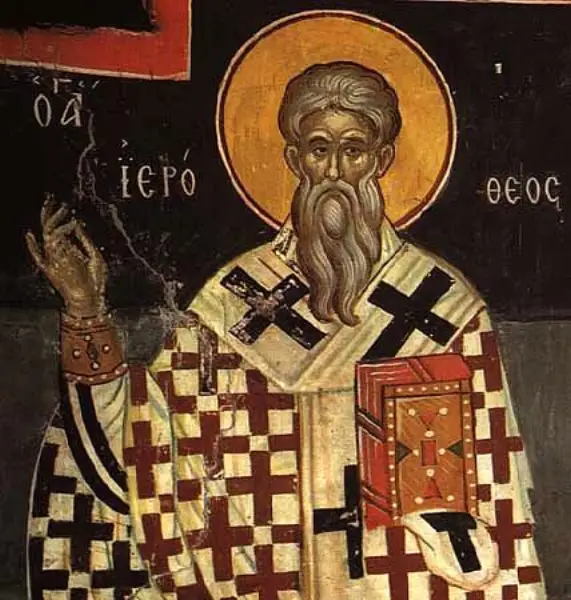
Overview
Hierotheos, whose Greek name means 'sanctified by God', is honoured by tradition as the earliest pastor and bishop of the Athenian Christians. His title, Thesmothete, was borrowed from the civic order of the city, where a Thesmothete was a ruler or junior archon — literally a rule-setter — and tradition explains it by his office over the young Athenian church. The sources know almost nothing of his life beyond this: he belonged to the learned men of Athens, was taught the faith by the Apostle Paul, and around the year 52 received baptism and ordination at the apostle's hands. He frequently visited and instructed Dionysius the Areopagite, the convert of the Areopagus whom some traditions honour as the city's first bishop in Hierotheos' place, a divergence that has left doubt whether Hierotheos himself was priest or bishop. Pseudo-Dionysius, in On the Divine Names, preserves a portrait of him as an inspired hymnographer, so carried out of himself in singing the sacred mysteries that hearers judged him touched by God. The same tradition places him among the apostles at the Dormition of the Theotokos, consoling them with spiritual songs played on instruments. His name survives nowhere in Greek literature except a single Athenian inscription, a silence that modern scholars have debated.
The Complete Life
Vocation
The calling of Hierotheos ran through the lecture halls and courts of Athens to the apostolic preaching. Church tradition holds that he was numbered among the learned men of the city — a background that his civic title of Thesmothete, junior archon or rule-setter, confirms — when the teaching of the Apostle Paul reached him. Paul himself instructed him in Christianity, and around the year 52 the apostle baptized and ordained him, making him one of the direct fruits of the Athenian mission reported in Acts. On him, or by his side, the young community of the city was founded: Hierotheos is the reputed first head of the Athenian Christians, and in the episcopal lists of the church of Greece his name opens the line of bishops of Athens that runs from him through Dionysius the Areopagite down to the archbishops of our own day. He did not keep his instruction to himself; he frequently sought out Dionysius the Areopagite, the other great Athenian convert, and taught him. Whether his own order was priesthood or episcopacy was already debated in antiquity, for some traditions give Dionysius the first place in the Athenian succession, but East and West alike have kept Hierotheos among the first bishops of Greece.
§ Biography
The Divine Hymnographer
The most vivid witness to Hierotheos is not a chronicle but a description of him at prayer. Pseudo-Dionysius, writing under his friend's name in On the Divine Names, records that Hierotheos was carried wholly outside himself as he sang, so taken up into communion with the mysteries he praised in song that all who heard and saw him, and yet did not know him, took him for a man inspired of God — a divine hymnographer. The passage shows a form of sanctity rooted in liturgy: his theology passed into song, and his song became vision. The same tradition attaches him to the most tender scene in the lives of the apostles, the Dormition of the Theotokos, where he took his place among the assembled apostles and cheered them with sacred odes and chants, sounding them upon instruments of music. Behind the title Thesmothete, the rule-setter, stands this other vocation: one who ordered the praise of the church before he ordered its discipline. Later centuries honoured this gift by grouping him with the great hymnographers of the East, and the frescoes of Theophanes the Greek at Meteora keep the image of the singing bishop before pilgrims still.
§ Biography
Cult, Doubts and Memory
Hierotheos belongs to the saints of the apostolic age whose veneration predates every canonical process. He is honoured by the Eastern Orthodox Church, the Eastern Catholic churches and the Armenian Apostolic Church, with his feast on 4 October, the day the Greek Orthodox Archdiocese of America also keeps his memory. Yet his cult carries an unusual scholarly shadow. Recent researchers have observed that the name Hierotheos is unique in Greek literature and does not appear in the vast body of proper names recovered from the papyri; its only ancient attestation is a Greek inscription from Athens itself. Carlo Maria Mazzucchi has argued from this that the Thesmothete was a figure of the Corpus Dionysiacum rather than of history, suggesting that an unknown author borrowed the name of a soldier who died in 409 BC and was buried near the Academy, and Giovanni Reale's edition of Dionysius' works welcomed the hypothesis. The churches have not followed the skeptics: whatever the resolution of the Corpus' authorship, Hierotheos continues to be venerated as the first bishop of Athens and the master of Dionysius, standing in the episcopal succession of a see that has never forgotten him.
§ References
Legacy
Hierotheos' legacy is threefold. To the church of Athens he is the founding bishop, the head of the episcopal catalogue in which every later metropolitan, from Narcissus and Publius to Michael Choniates and the archbishops of independent Greece, succeeds him; the see's very continuity is measured from his name. To the tradition of sacred music he is the prototype of the hymnographer, the bishop whose singing transported him beyond himself, cited wherever the mystical writers discuss the ascent of the soul in liturgy, since Pseudo-Dionysius made his ecstasy the very illustration of how divine praise deifies the singer. And to iconography he belongs as a figure of the apostolic age: Theophanes the Greek painted him for the Saint Nicholas Anapafas Monastery at Meteora, an image that carries the Athenian bishop into the visual tradition of Orthodoxy. His feast on 4 October is kept across the Orthodox and Eastern Catholic world and in the Armenian Apostolic Church. Even the debate over his historicity is part of his afterlife, for few saints of the first century have drawn such sustained attention from scholars of the Areopagite corpus; through it all the church of Greece keeps him first in the line of its pastors.
§ Biography
In Their Own Words
He was wholly transported, wholly outside himself and was so deeply absorbed in communion with the sacred things he celebrated in hymnology, that to all who heard him and saw him and knew him, and yet knew him not, he seemed to be inspired of God, a divine hymnographer.
The Record
- Major works
- Hymnology in honour of the sacred mysteries, attested by Pseudo-Dionysius
- Patron of
- Hymnographers·The Church of Athens
- Symbols
- Bishop's vestments·Musical instruments of his Dormition hymns·Portrait by Theophanes the Greek at Meteora
- Canonization
- Pre-congregation; venerated in the Eastern Orthodox, Eastern Catholic and Armenian Apostolic churches, feast on 4 October
Prayer
Bibliography
Show 5 sources
- Herbermann, Charles, ed. (1913). "Christian Athens". Catholic Encyclopedia. New York: Robert Appleton Company.
- Herbermann, Charles, ed. (1913). "Hierotheus". Catholic Encyclopedia. New York: Robert Appleton Company.
- Daily Reading, October 4, 2005, The Greek Orthodox Archdiocese of America.
- Mazzucchi, Carlo Maria (2006). "Damascio, autore del Corpus Areopagiticum, e il dialogo ΠΕΡΙ ΠΟΛΙΤΙΚΗΣ ΕΠΙΣΤΗΜΗΣ". Aevum (in Italian). 80 (2): 299–334.
- Reale, Giovanni (2009). "Introduzione. Il Corpus Dionysiacum e i grandi problemi che suscita per la sua interpretazione". In Scazzoso, Piero; Bellini, Enzo (eds.). Dionigi Areopagita. Tutte le opere (in Italian). Milano: Bompiani. pp. 11–29. ISBN 978-88-452-6288-3.
Profile text adapted from the Wikipedia article, licensed CC BY-SA 4.0.
Pray with this saint every day
Save St. Hierotheos the Thesmothete to your favorites, read the full profile, and get feast-day reminders in the Saints app.
Get the Saints AppFree on the App Store for iPhone and iPad