
c. 291 – 371·Feast October 21
St. Hilarion the Great
Founder of Palestinian Monasticism
Overview
Hilarion, honoured in the Orthodox Church as Hilarion the Great, was born around 291 to pagan parents at Thabatha near Gaza and became the founder of Palestinian monasticism. Educated by a grammarian at Alexandria, he sought out Anthony the Great in the Egyptian desert and spent two months learning the ascetic life from him, then left for solitude in Palestine when the crowds that pressed on Anthony proved more than he could bear. Returning to find his parents dead, he distributed his goods and settled about seven miles from the port of Maiuma, where around 308 he built the hut in which he lived alone for twenty-two years, weaving baskets as he had learned in Egypt and subduing temptation by fasting, thirst and labour. When a healed woman drew the crowds to him, disciples gathered; under Constantius he established a monastery that numbered many brothers by his sixty-third year. After Anthony's death he fled the fame that followed him — to Egypt, Sicily, Dalmatia, where he was said to still the tsunami of 365, and finally Cyprus, welcomed by his disciple Epiphanius, bishop of Salamis. He died there at eighty. His biographer Jerome made his life the model of the desert saint, and his relics were honoured at Maiuma into the Byzantine age.
The Complete Life
Early Life
Hilarion's first sixteen years belonged to the pagan world of the Gaza coast. He was born about 291 at Thabatha, a village five miles south of Gaza, to parents who sacrificed to the old gods, and he grew up speaking both the Greek of the cities and the Aramaic common in the countryside around Gaza. His schooling was a mark of family ambition: his parents sent him in his youth to a grammarian at Alexandria, the intellectual capital of the East, where Jerome reports he gave striking proof of talent and character and became an accomplished speaker. The visit changed him in another way, for it was in Egypt that he first heard of Anthony, the celebrated father of monasticism, and went out to the desert to sit at his feet. Two months with Anthony taught him the practice of the ascetic life, but they also taught him its cost: the sick and the demoniacs who thronged the great hermit for healing made solitude impossible there. Hilarion, still young, concluded that his own path lay elsewhere, and left Egypt for the wilderness of his homeland, choosing a loneliness even stricter than his master's.
§ Origin and life as a hermit
Vocation
Hilarion's calling was fixed in the years between his return to Gaza and his settlement in the wilderness. He came home to find his parents dead, gave his inheritance to his brothers and the poor, and walked out to the desert inland from the coastal road, about seven miles from Maiuma, Gaza's port. There around 308 he raised the low hut that pilgrims would still show Jerome generations later, and gave twenty-two unbroken years to solitary asceticism. He earned his bread as Anthony's monks did in Egypt, weaving baskets, and fought the war against his own flesh that Jerome describes as the substance of his sanctity: assailed by what the biographer calls the flames of lust, he answered with hunger, thirst and hard labour until the body was mastered. One journey alone broke the solitude — a visit to Jerusalem to venerate the holy places — and even then he declined to settle in the Judaean Desert, reasoning that God must not be shut up within prescribed bounds but could be found close at hand anywhere. That conviction, unusual among the desert fathers, made the sand dunes of Gaza his Sinai.
§ Origin and life as a hermit
Mission
The mission Hilarion never sought arrived through a sick woman. After his twenty-two years of silence, a woman of the region came to his hut seeking a cure for her sterility; he resisted, then prayed, and she conceived. The healing transformed the desert, for from that day the hermit's cell became a place of pilgrimage, and Hilarion spent the rest of his Gaza years encircled by disciples and by crowds demanding healing and exorcism. Jerome catalogues his wonders — cures, deliverances, prophecies and divinely given words — including the three children of Helpidius, the future praetorian prefect, restored to health, and the healing of Alaphion at Bethelea, through which the whole family of the historian Sozomen came to the faith. Because neither Palestine nor Syria yet possessed a single monastery, the men who came seeking spiritual training found in him their only master, and he became for the coastal Gaza the teacher Anthony had been for Egypt. Sozomen names Epiphanius and Hesychius as the brightest of his circle; Epiphanius, after Egyptian training, would carry monasticism to Cyprus and reign as bishop of Salamis. Under Constantius, Hilarion at last gathered the throng of seekers into a monastery which by his sixty-third year had grown into a great community with a constant stream of visitors.
§ Life in Gaza and attributed miracles
Final Years
Fame drove the old monk from his desert. He stayed in Gaza until three years after Anthony's death around 356, then went first to the Egyptian place where Anthony had died, seeking the shadow of his master and escape from his own admirers. The paganism of the new reign caught up with him: once Julian held the East from the winter of 361/362, Gaza's magistrates moved to lay hands on him, and he escaped. Jerome and Sozomen differ slightly on the route — Jerome has him evade arrest in Egypt and remain there until Julian's death before sailing for Sicily, Sozomen takes him straight to the island. From Sicily he moved to Epidaurus in Dalmatia, where tradition credits him with stilling the great tsunami of 21 July 365 by tracing three crosses in the sand before the wave. Almost at once he crossed to Cyprus, where his old disciple Epiphanius welcomed him and urged him to stay. He settled first near Paphos, then withdrew to a remoter spot twelve miles away, and there his life closed in his eightieth year, and he was laid to rest. Hesychius, ten months on, carried the body off secretly — incorrupt and fragrant, Jerome says — and buried it in his own monastery at Maiuma, returning the saint to the desert he had fled.
§ Final years and death
Veneration
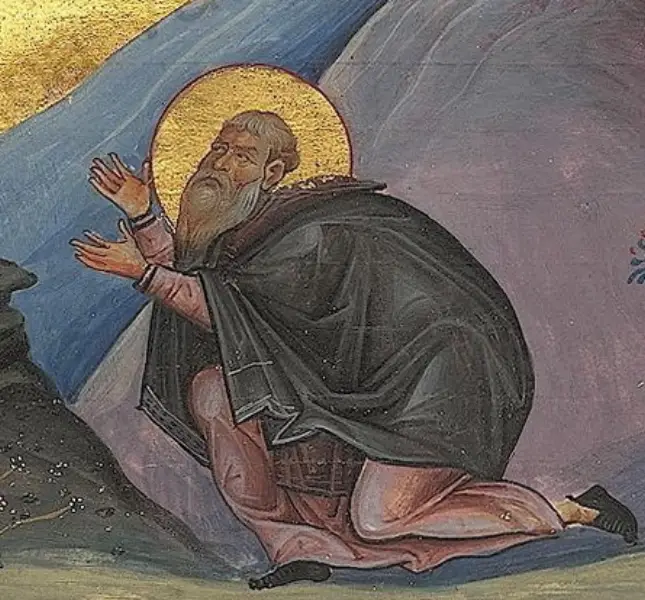
Hilarion was never canonized by any process, for he belongs to the age in which sanctity was recognized by the consent of the churches. He was venerated from early times in East and West as an exemplar of the monastic virtues: the Orthodox, Oriental Orthodox and Catholic churches all keep his feast, on 21 October. Bede entered him in his martyrology, and his name appears constantly in the monastic calendars of Anglo-Saxon England before the Conquest, until the feasts of Ursula and of Dunstan's ordination displaced it. His cult attached itself to his relics: at Maiuma, Sozomen reports, the population kept an annual festival at the tomb after Hesychius' translation, and the anonymous Piacenza Pilgrim still found the relic venerated there around 570. In the West, Charlemagne is said to have brought relics to Moissac Abbey, from which they passed in 1065 to the church of Duravel. In Calabria he is patron of Caulonia under the name Sant'Ilario. On icons he is painted as an aged father, his brown beard rush-like and parted into three points, a scroll in his hand bearing his counsel on the monk's arms — steadfastness, humility and love according to God.
§ Veneration and relics
Legacy
Hilarion's bequest to Christianity was a landscape transformed. Before him, Palestine and Syria had no monasteries; after him, Gaza stood at the head of a monastic movement that dotted the coastal plain and the Judaean wilderness with communities, so that historians can say without exaggeration that Gaza became in his lifetime a centre of monasticism. His literary afterlife was even wider. Epiphanius' letter of lament for his master supplied the basis for the two great early accounts, Jerome's Latin Life, written around 390 at Bethlehem and soon translated into Greek by Sophronius, and Sozomen's Ecclesiastical History of the 440s, which added material from the author's own family memory of the Bethelea healing. Jerome's book, modelled on the Life of Anthony and built around the twin themes of solitary prayer and filial succession, became one of the most influential hagiographies of antiquity and fixed the image of the desert saint for the Middle Ages. Literature kept returning to him: Herder wrote his poem on Anthony and Hilarion in 1797, Flaubert reversed the relationship to make Hilarion the tempter in The Temptation of Saint Anthony, and Hermann Hesse turned a life of Hilarion into one of the three Lives of Joseph Knecht in The Glass Bead Game. The Sayings of the Desert Fathers remember him twice, and his monastery's tradition survives in the Saint Hilarion Monastery near Gaza.
§ Sources
Timeline
- 291
Is born at Thabatha, five miles south of Gaza, to pagan parents
§ Origin and life as a hermit
- 308
Builds the hut near Maiuma where he will live in solitude for twenty-two years
§ Origin and life as a hermit
- 337
Founds his monastery during the reign of Constantius, which grows into a large community by his sixty-third year
§ Life in Gaza and attributed miracles
- 356
Departs for Egypt about three years after Anthony's death, seeking to escape the crowds
§ Final years and death
- 361
Flees arrest when the pagan Julian becomes emperor and the authorities of Gaza move against him
§ Final years and death
- 21 Jul 365
Is said to still the sea at Epidauros in Dalmatia during the tsunami of 21 July by drawing three crosses in the sand
§ Final years and death
- 371
Dies in Cyprus at the age of eighty and is buried in the remote place twelve miles from Paphos
§ Final years and death
- 372
His disciple Hesychius secretly removes the incorrupt body and buries it in his own monastery at Maiuma
§ Final years and death
- 390
Jerome composes the Latin Life of Hilarion at Bethlehem, drawing on Epiphanius' laudatory letter
§ Sources
In Their Own Words
The tools of a monk are steadfastness, humility, and love according to God.
Go forth, my soul, why do you hesitate? You have served Christ nearly eighty years; do you still fear death?
Peace be with you, pillar of light supporting the world
The Record
- Major works
- Monastery near Gaza, founded under Constantius·Introduction of monasticism to Cyprus
- Patron of
- Caulonia, Calabria, as Sant'Ilario
- Symbols
- Scroll reading: "The weapons of the monk are steadfastness, humility, and love according to God"·Monastic habit·Beard divided into three points
- Canonization
- Pre-congregation; venerated from earliest times in East and West as an exemplar of monastic holiness
Prayer
Bibliography
Show 9 sources
- Bar, Doron (January 2005). "Rural Monasticism as a Key Element in the Christianization of Byzantine Palestine". Harvard Theological Review. 98 (01): 49–65. doi:10.1017/S0017816005000854.
- "Daily Liturgy: October 21: St. Hilarion of Gaza, abbot". Heralds of the Gospel. Retrieved 17 February 2025.
- "Venerable Hilarion the Great". www.oca.org. Orthodox Church in America. Retrieved 13 October 2024.
- Butler, Edward Cuthbert (1911). "Hilarion, St". In Chisholm, Hugh (ed.). Encyclopædia Britannica. Vol. 13 (11th ed.). Cambridge University Press. p. 458.
- Farmer, David (14 April 2011). "Hilarion". The Oxford Dictionary of Saints (5th revised ed.). Oxford: OUP. p. 210. ISBN 978-0-19-959660-7.
- Shaw, Teresa M. The Burden of the Flesh: Fasting and Sexuality in Early Christianity. Fortress Press. pp. 108–110. ISBN 978-1-4514-1888-0.
- Binns, John (1994). Ascetics and Ambassadors of Christ: The Monasteries of Palestine, 314-631. Clarendon Press. ISBN 978-0-19-826465-1.
- Bitton-Ashkelony, Brouria; Kofsky, Aryeh (February 2006). The Monastic School of Gaza. Brill. pp. 36–43. ISBN 9789047408444.
- Barnes, Timothy David (2010). Early Christian Hagiography and Roman History. Mohr Siebeck. ISBN 978-3-16-150226-2.
Profile text adapted from the Wikipedia article, licensed CC BY-SA 4.0.
Pray with this saint every day
Save St. Hilarion the Great to your favorites, read the full profile, and get feast-day reminders in the Saints app.
Get the Saints AppFree on the App Store for iPhone and iPad