
476 – 558·Feast May 15
St. Hilary of Galeata
Venerable hermit and founder of the monastery of Galeata
Overview
Hilary of Galeata, remembered in Italian as Sant'Ilaro or Sant'Ellero, was a hermit and monastic founder of the sixth century, born in Tuscia in 476. According to the tradition preserved in his Life, he resolved at the age of twelve to give himself to the solitary life, forsook his home for the eremitical life, making his way over the Apennines into Emilia until an angel directed him to a mountain above the Bidente valley, close by the Ronco. As a young man he delivered the nobleman Olibrius of the district from demonic possession; in thanksgiving the nobleman had his entire household baptized at Hilary's hands and bestowed on him lands and money. Olibrius's gift ripened, around the year 496, into the monastery of Galeata — Sant'Ellero di Galeata as it came to be called — a house governed by a form of Pachomius's rule and constantly enlarged by new recruits. Miracles were attributed to him in abundance, and he is said to have won the respect of Theodoric, who had first harassed the monks and then endowed them. Hilary died on 15 May 558, and his cult spread across Tuscany and Romagna; Lugo honors him as its principal patron.
The Complete Life
A Child of Tuscia
Hilary was born in Tuscia in the year 476, the very year in which the last western emperor was deposed, into an Italy that had recently passed under Ostrogothic rule. The traditional account of his life tells that he resolved on the hermit's calling while still only twelve years old. Such a resolution meant leaving everything: he left his home and set out across the Apennines, traveling toward Emilia in search of a place where solitude and prayer would be possible. The hagiographer says that an angel indicated to him a mountainside site above the Bidente, hard by the Ronco, and there the young ascetic took up his dwelling. The narrative belongs to a world in which the collapse of Roman administration in the Italian countryside opened spaces for the eremitical life, and in which boys and adolescents were sometimes drawn to the desert ideal with the same intensity that earlier generations had given to secular ambition. From this mountain solitude would grow one of the notable monasteries of the Tuscan-Romagnol frontier. The date of his birth placed his childhood in the first generation of Italy under Ostrogothic rule, and the road across the Apennines that the boy traveled ran between provinces still adjusting to new masters — a landscape in which the mountain solitude he sought was both a refuge from the world and, in time, a center from which that world would be evangelized.
§ Life
The Hermit of the Bidente
Hilary's vocation took shape not in an established monastery but in the solitude to which the angel had guided him. The choice of a mountain above the valley of the Bidente placed him within reach of the populated lowlands of Emilia while preserving the isolation that the eremitical life required. There he prayed in a small cell, the memory of which endured among his devotees: later generations preserved in that cell a chair the saint was said to have used in prayer, which became an object of pilgrimage. His reputation for holiness drew the attention of the surrounding district, and it was in this period that the nobleman Olibrius, afflicted by a demon, was brought to him or came to his door. Hilary's liberation of the possessed man proved the turning point of his life, for the gratitude of Olibrius transformed a hermitage into an estate and a solitary into the head of a growing spiritual family. The gift of lands and money, freely given for baptism bestowed, became around the year 496 the nucleus of the monastery of Galeata.
§ Life
Founder of Galeata
Olibrius's donation grew, about the year 496, into the monastery of Galeata — Sant'Ellero di Galeata, as it came to be styled — the house that would keep Hilary's name alive for fourteen centuries. The foundation attracted new recruits, and the community adopted a version of the rule of Saint Pachomius, the Egyptian legislator whose congregational discipline had shaped Eastern coenobitism. The Life credits Hilary with numerous miracles. Among them is the startling prodigy of a grape changed into a serpent, a rebuke aimed at the sluggish monk Glicerio, an emblem of the abbot's authority to confront laxity with startling imagery. His standing reached even to the Ostrogothic court: Theodoric, who had initially harassed the monks and was building a palace near Galeata, was so impressed by the saint that he instead donated land and goods to the monastery. The episode places Hilary among the ascetics whose personal authority could tame the power of the new rulers of Italy, and it secured for his foundation the material endowment on which its later history rested. Under his government the house stood at the meeting point of two worlds, Eastern in its rule and Italian in its setting, and its survival depended on exactly the combination of sanctity, miracle, and worldly tact that the stories of Glicerio and Theodoric were told to illustrate.
§ Life
Discipline and Wonder
The spirituality reflected in Hilary's tradition joins the solitary's silence to the abbot's governance of souls. He began as a hermit who prayed alone in a mountain cell, guided by an angelic vision, and he ended as the father of a coenobitic family living under a version of the Pachomian rule, the ancient Eastern discipline that organized monastic life into obedience, work, and common prayer. The miracles recorded of him serve as illustrations of the abbot's spiritual power over the natural world: the grape that became a serpent in his hands rebuked the laziness of the monk Glicerio more effectively than any verbal admonition. Yet the same tradition that celebrates these signs also preserves a sober awareness of their literary character, for the medieval hagiographical genre required marvels, the visible action of angels and demons, and long devout discourses. Modern scholarship, following Giovanni Lucchesi, reads the story of Olibrius's possession as a trope found in the Lives of many other saints of the period. The devotion of his admirers, which treasured the chair from his cell as a remedy against backache, shows how his blend of austerity and wonder continued to speak to ordinary sufferers.
§ Veneration
Death and Burial
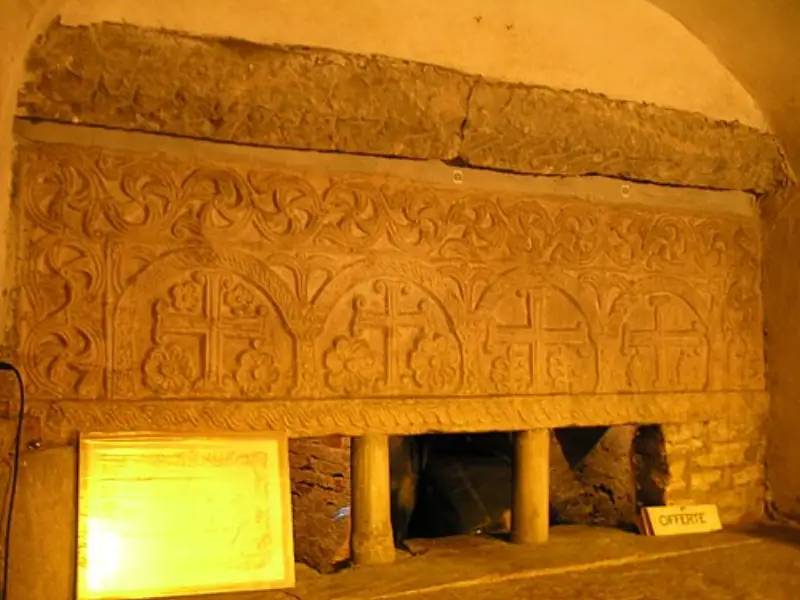
Hilary governed the monastery he had founded for more than sixty years, from its beginnings around 496 until his death in 558. He died on the fifteenth of May of that year, aged eighty-one or eighty-two, and the sources associate his passing with Lugo, in the Romagnol plain that lay within the sphere of his monastery's influence. His tomb became the center of his cult: it is venerated to this day, and the memory of the saint attached itself to the places he had sanctified, above all the monastery of Sant'Ellero at Galeata and the church at Lugo that claimed his protection. The date of his death, 15 May, became his feast day in both the Eastern Orthodox and Roman Catholic churches, keeping alive each spring the memory of the hermit who had crossed the Apennines as a boy of twelve. By the time of his death he had lived to see his foundation endowed, staffed, and secured under the patronage of the Ostrogothic king, a stability that allowed his monastery to flourish long after him. Between the settlement of his community and the death of its founder lay more years of unbroken service than many monasteries enjoy in their whole early history, and the age at which he died was itself a testimony, in a hard century, to the endurance his way of life was thought to confer.
§ Veneration
An Ancient and Doubly Honored Cult
No formal act of canonization stands behind the veneration of Hilary of Galeata; he belongs to the saints whose cult arose from the devotion of the people among whom he had lived and was ratified by ecclesiastical usage on both sides of the later division between East and West. Both the Orthodox East and the Catholic West number him among their saints, keeping 15 May in common on their calendars. The authority of his cult rests in large part on his Life, a document whose author claims to be a disciple and eyewitness of the events he narrates, and which scholars have judged to have been written contemporaneously with the saint's life, a rare antiquity for a Gallic-Italian hagiography. Giovanni Lucchesi, however, has cautioned that the hagiographer followed the normal medieval standards for such writing, incorporating miracles, angelic and demonic activity, and long devout speeches into the narrative. The cult's diffusion and persistence, whatever the qualifications of scholarship, are beyond dispute: the saint's memory remained fixed in the dioceses and abbeys of two regions for a millennium and a half.
§ Veneration
Patron of Lugo and the Camaldolese Succession
His cult flourished through Tuscany and Romagna, strongest in the sees of Arezzo, Sarsina, and Forlì, of Bertinoro, Faenza, and Imola, of Modigliana, Fiesole, and Florence, and at the abbey of Farfa, a geographic spread that maps the reach of his monastery's influence across the Apennine frontier. His cult found a civic focus at Lugo, in the Diocese of Imola, of which he is the principal patron saint, and at Galeata itself, where the monastery of Sant'Ellero kept his name and his tomb. He is invoked especially against backache, and the chair preserved in the cell where he was said to pray was used by devotees of his cult as an instrument of cure. The monastery he founded endured through the whole medieval period and beyond: in 1488 Sant'Ellero di Galeata became a Camaldolese house, entering the reformed Benedictine congregation that had itself been born in the Tuscan eremitical tradition. Through that succession his foundation survived into modern times, and his feast on 15 May continues to be kept in the churches of the region that first honored him. The breadth of that distribution, reaching from the Apennine passes to the Arno and across to the Po, shows how far the fame of a mountain hermitage could travel in an age of slow communications, and how a single holy man's reputation could bind two regions together in devotion.
§ Veneration
Timeline
- 476
Born in Tuscia, according to the traditional account of his life.
§ Life
- 496
Olibrius's gift became, around 496, the seed of the monastery of Galeata, afterwards known as Sant'Ellero di Galeata.
§ Life
- 15 May 558
Died on 15 May 558 at the age of eighty-one or eighty-two.
§ Life
- 1488
The monastery of Sant'Ellero di Galeata, which he had founded, became a Camaldolese house.
§ Veneration
The Record
- Major works
- Monastery of Sant'Ellero di Galeata
- Patron of
- Lugo·Galeata·against backache
- Canonization
- Pre-congregation; venerated as a saint in the Eastern Orthodox and Roman Catholic churches from early times.
Prayer
Bibliography
Show 4 sources
- Lucchesi, Giovanni (15 May 1961). "Sant' Ellero (Ilaro) di Galeata". Enciclopedia dei santi [Encyclopedia of Saints]. Instituto Giovanni XXIII nela Pontifica Università lateranense. ISBN 9788831193474
- "www.synaxaristis - ΜΕΓΑΣ ΣΥΝΑΞΑΡΙΣΤΗΣ", www.synaxarion.gr, retrieved 15 August 2024
- "Patron Saints Index: Saint Hilary", archived from the original on 23 May 2008
- Holweck, Frederick George. A Biographical Dictionary of the Saints, B. Herder, 1924, p. 484
Profile text adapted from the Wikipedia article, licensed CC BY-SA 4.0.
Pray with this saint every day
Save St. Hilary of Galeata to your favorites, read the full profile, and get feast-day reminders in the Saints app.
Get the Saints AppFree on the App Store for iPhone and iPad