
c. 310 – c. 367·Feast January 13
St. Hilary of Poitiers
Bishop, confessor, and Hammer of the Arians
Overview
Hilary of Poitiers, called in Latin Hilarius Pictaviensis, was bishop of Poitiers and one of the towering figures of fourth-century Latin Christianity. Born around 310 to pagan parents of distinction, he received an excellent education with a strong Greek component, studied the Scriptures, and abandoned Neoplatonism for the Nicene faith, being baptized together with his wife and his daughter, the future saint Abra of Poitiers. Elected a bishop amid the Arian crisis of the 350s, he secured the local excommunication of the Arian bishop Saturninus and his allies Ursacius and Valens, and addressed a remonstrance to Emperor Constantius II. Banished to Phrygia in 356, he governed his diocese from exile and produced his masterpieces, including De synodis and the twelve books De Trinitate, the first successful Latin expression of the Nicene theology elaborated in Greek. Known as the Hammer of the Arians and the Athanasius of the West, he returned to Gaul around 361 and continued the fight, encouraging Martin of Tours to found the monastery of Ligugé and later challenging the Arian bishop Auxentius of Milan. Jerome records his death at Poitiers in 367. Pius IX declared him a Doctor of the Church in 1851.
The Complete Life
From Neoplatonism to the Nicene Faith
Poitiers claims the birth of Hilary at the turning of the third century into the fourth; his parents were pagans of standing in the city. They gave him a good education, one that included a high level of Greek, an accomplishment that would later let him carry the subtleties of Eastern theology into the Latin world. As a young man he inclined to Neoplatonism, but his reading of the Old and New Testaments overturned that philosophy, and he left it behind for the Nicene faith, and he, his wife, and their daughter — the child known to tradition as Saint Abra of Poitiers, afterwards famed as a nun of great charity — were baptized together and received into the Church. The controversy that would define his life was already gathering: Arianism was gaining ground among Christians of the era, and the bishops at Nicaea, assembling under Constantine the Great's sponsorship, had already overturned that teaching, after rigorous and even violent disputes between Trinitarians and Arians. Into that conflict the converted Neoplatonist would bring the full weight of his classical and scriptural formation.
§ Early life
Bishop in a Divided Church
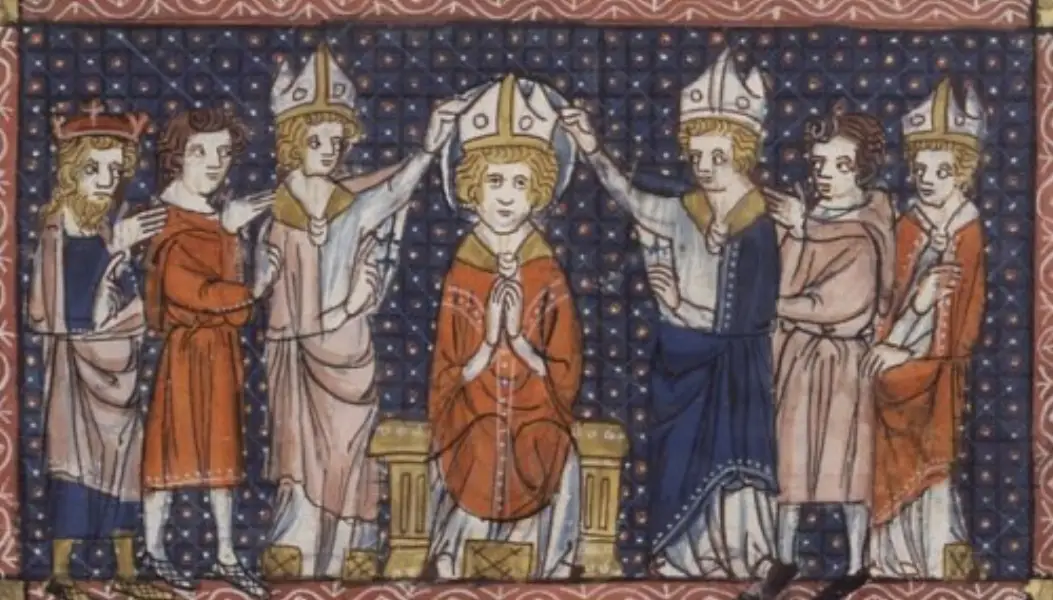
Hilary's elevation to the episcopate came in the year 353, at a moment when the Arian party appeared to hold the upper hand in the West: the existing bishop, Saturninus of Arles, was an Arian, and the Trinitarian Christians turned to Hilary. In the proceedings that followed the Council of Arles, where the legates of Pope Liberius declined to condemn Arianism and even considered formally opposing Athanasius of Alexandria, Hilary nevertheless prevailed upon the Gallican hierarchy allied with him to excommunicate locally Bishop Saturninus and two of that prelate's chief allies, Ursacius of Singidunum and Valens of Mursa. About the same time he laid before Emperor Constantius II a written protest at the persecutions the Arians were using to break their adversaries, the work best dated to 355, known to other historians as the Book Against Valens, of which only fragments survive. The courage of these interventions did not immediately prosper. At the synod of Biterrae, which the emperor convoked in 356 with the declared aim of ending the long quarrel, an imperial rescript sent the newly made bishop into exile in Phrygia, deep in Arian country, in the company of Rhodanus of Toulouse.
§ Early life
Exile as a Pulpit
Hilary spent nearly four years in banishment, though the reasons for it remain obscure; tradition ascribes the banishment to his refusal to sign the condemnation of Athanasius and of the Nicene faith, while a number of recent scholars suspect political hostility to Constantius and sympathy with the usurper Claudius Silvanus. Exile proved no silence. From Phrygia he went on directing his diocese from afar and produced the two works at the center of his theology. In 358 appeared De synodis, an epistle sent to the Semi-Arian bishops of Gaul, Germania, and Britain, analyzing the creeds of the Eastern councils and counseling the Western bishops to more reserve in condemnation, since sometimes the difference lay in words rather than ideas. In 359 and 360 came the twelve books of De Trinitate, the first successful Latin rendering of the Nicene theology first elaborated in Greek, a work that drew criticism from his own party for its forbearance and called forth his Apologetica in reply. He attended the council of Seleucia in 359, sought an audience with the emperor and a hearing before the council of Constantinople in 360, and when both were denied answered with the bitter In Constantium, which attacked Constantius as Antichrist and persecutor. His repeated demands for public debate with Ursacius and Valens at last proved so inconvenient that he was sent home, reaching his diocese about 361, within a short time of Julian's accession.
§ In exile
Theology Become Prayer and Song
Hilary's spirituality was intellectual, exegetical, and hymnic at once. In exegesis he followed Origen and in Christology Athanasius, the two great Alexandrians, yet his work everywhere shows traces of vigorous independent thought, and among his earliest writings, completed before his exile, stands the Commentarius in Evangelium Matthaei, the first complete Latin commentary on Matthew to survive. The Tractatus super Psalmos, his expositions of the Psalter, are heavily indebted to Origen and belong to the years after his homecoming. Jerome's witness that Hilary issued a liber hymnorum has moved some to call him the earliest hymn writer of the Latin church; the three hymns bearing his name cannot, however, be securely his. But the deepest note of his spiritual teaching sounds in his protest, preserved in Watson's summary, against a Church that craves the favor of the world: the apostles needed no secular support to convert the greater part of mankind, and the endurance of exile and prison, not the world's love, is the evidence that a church belongs to Christ. Watson's introduction records his indictment of bishops who bear themselves as priests of Antichrist, assuming the cloak of piety to induce others to deny Christ. The confession of the Trinity was for Hilary not a formula to defend but a life to endure persecution for.
§ Reputation and veneration
Return, Last Controversies, and Death
Back in his diocese from about 361, Hilary gave his first two or three years to convincing the clergy of his province that behind the homoion formula lay nothing other than the old Arian subordinationism; Gallic synods in consequence rejected the creed issued at Ariminum. In these same years, with his encouragement, the future bishop of Tours, Martin, founded a monastery at Ligugé within his diocese, a seed of monasticism in the Latin West. In 364 he extended his efforts beyond Gaul once more, impeaching Auxentius, bishop of Milan and a favorite of the court, as heterodox. Emperor Valentinian I summoned him to Milan to maintain the charges, but Auxentius gave answers deemed satisfactory, and Hilary, denouncing his opponent as a hypocrite, was ignominiously sent away. He responded in 365 by publishing the Contra Arianos vel Auxentium Mediolanensem liber, recounting the failed campaign, and by issuing, perhaps somewhat earlier, the Contra Constantium Augustum liber, branding the dead emperor Antichrist, a rebel against God, a tyrant who had tried to hand over to the devil that world for which Christ had suffered. According to Jerome, he died at Poitiers in 367.
§ Later life
Doctor of the Church
Hilary's sanctity was acknowledged from antiquity without any formal process, and he is venerated today across the whole Christian spectrum: in the Catholic Church, the Eastern Orthodox Church, the Anglican Communion, the Lutheran Church, and Oriental Orthodoxy. The ancient church's estimate of him is registered in Augustine of Hippo's tribute, which styled him the churches' illustrious doctor, and by the trustworthy early notices in Jerome's De viris illustribus and Sulpicius Severus's Chronicle; the vita composed by Venantius Fortunatus by 550 is now little regarded as a source. The Roman calendar keeps his feast on 13 January, the Byzantine rite and some local calendars and the pre-1970 General Roman Calendar keeping 14 January, and the Anglican Communion remembers him with a lesser festival on the same day. The formal recognition of his teaching came late: in 1851 Pope Pius IX declared Hilary a Doctor of the Church, confirming in an official act the title that Augustine's phrase had long bestowed. In England and Ireland, the spring terms of the law courts and of the universities of Oxford and Dublin are called the Hilary term because they begin around his feast, a living calendar echo of his commemoration.
§ Reputation and veneration
The Hammer of the Arians Remembered
Hilary stands as the pre-eminent Latin writer of the fourth century before Ambrose, and his works remained highly influential in later centuries. His literary monument embraces the twelve books of De Trinitate, the De synodis, composed at the beginning of 359 as preparation for the twin councils of Ariminum and Seleucia, the exegetical Commentarius in Evangelium Matthaei, the Tractatus super Psalmos with its extant commentaries on individual psalms, the Tractatus mysteriorum, which waited in a lone manuscript until its first edition of 1887, and the controversial writings against Constantius and Auxentius gathered with the Fragmenta historica. His cult spread early and wide: Sulpicius Severus's Vita Sancti Martini carried devotion to both Hilary and Martin into western Britain, where the villages of St Hilary in Cornwall and Glamorgan, Llanilar in Ceredigion, and the Welsh village of St Hilary preserve his name. In France most dedications styled Saint-Hilaire lie west and north of the Massif Central, and the cult in time reached Canada; in northwest Italy, the church of Sant'Ilario, at Casale Monferrato in the Piedmont, could already claim his patronage by 380, and the Andalusian village of Comares keeps the feast of San Hilario with Mass, a procession, and local Verdiales dances. Some traditions also honor him as patron saint of lawyers, and iconography assigns him three books and a quill pen.
§ Dedications
Timeline
- 310
Born at Poitiers, at the end of the third or beginning of the fourth century.
§ Early life
- 353
Elected bishop amid the Arian controversy and secured the local excommunication of Saturninus, Ursacius, and Valens.
§ Early life
- 355
Wrote his first book to Emperor Constantius II against the Arian persecutions, the Ad Constantium Augustum liber primus.
§ Early life
- 356
Banished by imperial rescript from the synod of Biterrae to Phrygia, a stronghold of Arianism.
§ Early life
- 358
Addressed De synodis to the Semi-Arian bishops of Gaul, Germania, and Britain from exile.
§ In exile
- 359
Attended the council of Seleucia, where the homoion party triumphed and debate on the divine substance was forbidden.
§ In exile
- 360
Failed to obtain an audience with Constantius and responded to the Council of Constantinople with the In Constantium.
§ In exile
- 361
Returned to his diocese around 361, shortly after the accession of Emperor Julian.
§ Later life
- 361
Encouraged Martin, the future bishop of Tours, to found a monastery at Ligugé in his diocese.
§ Later life
- 364
Impeached Auxentius, the Arian-leaning bishop of Milan, before Emperor Valentinian I, without success.
§ Later life
- 365
Published the Contra Arianos vel Auxentium Mediolanensem liber on his failed campaign against Auxentius.
§ Later life
- 367
Died at Poitiers, according to Jerome.
§ Later life
- 550
Venantius Fortunatus had written a vita of Hilary by this date, now judged largely unreliable.
§ Reputation and veneration
- 1851
Pope Pius IX formally recognized Hilary as a Doctor of the Church.
§ Reputation and veneration
In Their Own Words
The Church seeks for secular support, and in so doing insults Christ by the implication that His support is insufficient. She in her turn holds out the threat of exile and prison.
Bishops in exile spread the Faith; now it is she that exiles bishops.
Unhappily, a love of walls has seized you; unhappily, the Church of God which you venerate exists in houses and buildings; unhappily, under these you find the name of peace. Is it doubtful that in these Antichrist will have his seat? Safer to me are mountains, and woods, and lakes, and dungeons, and whirlpools; since in these prophets, dwelling or immersed, did prophesy.
The Son of God is nailed to the cross; but on the cross God conquers human death. Christ, the Son of God, dies; but all flesh is made alive in Christ. The Son of God is in hell; but man is carried back to heaven.
Many are kept within the pale of the church by the fear of God; yet they are tempted all the while to worldly faults by the allurements of the world. They pray, because they are afraid; they sin, because it is their will. The fair hope of future life makes them call themselves Christians; the allurements of present pleasure make them act like heathen. They do not abide in ungodliness, because they hold the name of God in honour; they are not godly because they follow after things contrary to godliness. ... These, then, are they whom the judgment awaits which unbelievers have already had passed upon them and believers do not need... and their judgment arises from the fact that, though they loved Christ, they yet loved darkness more. (John 3:18-19)
The divine Nature feels no pain. ... although He underwent the sufferings in all the fullness of their force, which necessarily causes pain to the sufferers, yet He never so abandoned the powers of His Nature as to feel pain.
The Record
- Major works
- De Trinitate (twelve books)·De synodis (De fide Orientalium)·Commentarius in Evangelium Matthaei·Tractatus super Psalmos·Tractatus mysteriorum·In Constantium·Contra Arianos vel Auxentium Mediolanensem liber·Contra Constantium Augustum liber·Apologetica ad reprehensores libri de synodis responsa·Liber hymnorum (attributed by Jerome; three hymns attributed, none indisputable)
- Patron of
- lawyers (by some traditions)
- Symbols
- episcopal vestments·mitre and crozier·white and often long beard·three books and a quill pen
- Canonization
- Pre-congregation; formally recognized as a Doctor of the Church by Pope Pius IX in 1851.
Prayer
Bibliography
Show 12 sources
- Stracke, Richard (20 October 2015). "Saint Hilary: The Iconography". Christian Iconography
- General Audience, Libreria Editrice Vaticana
- Chisholm, Hugh, ed. (1911). "Hilarius, St". Encyclopædia Britannica. Vol. 13 (11th ed.). Cambridge University Press. pp. 458–459
- Hunter, David G. (2010). "Fourth-century Latin writers". In Young, Frances; Ayres, Lewis; Young, Andrew (eds.). The Cambridge History of Early Christian Literature
- Bettenson, Henry. The Later Christian Fathers, OUP (1970), p. 4
- Watson, E. W. "Introduction to the Life and writings of St Hilary of Poitiers" in Library of Nicene and Post Nicene Fathers, Series II N° IX, Eerdmans reprint 1983
- Clugnet, Léon. "St. Hilary of Poitiers." The Catholic Encyclopedia. Vol. 7. New York: Robert Appleton Company, 1910
- Cross, F. L.; Livingstone, E. A., eds. (1974). "Hilary of Poitiers, St.". The Oxford Dictionary of the Christian Church. OUP
- Farmer, David Hugh (1997). The Oxford Dictionary of Saints (4th ed.). Oxford: Oxford University Press. ISBN 0-19-280058-2
- Carl Beckwith, Hilary of Poitiers on the Trinity: From De Fide to De Trinitate (New York and Oxford, 2009)
- J. Doignon, Hilaire de Poitiers avant l'exil, EAA, Paris 1971
- Rondeau, Marie Josèphe (1962). "Remarques sur l'anthropologie de saint Hilaire". Studia Patristica. 6. Berlin: Akademie-Verlag: 197–210
Profile text adapted from the Wikipedia article, licensed CC BY-SA 4.0.
Pray with this saint every day
Save St. Hilary of Poitiers to your favorites, read the full profile, and get feast-day reminders in the Saints app.
Get the Saints AppFree on the App Store for iPhone and iPad