
c. 614 – 680·Feast November 17
St. Hilda of Whitby
Abbess of Whitby and adviser of kings
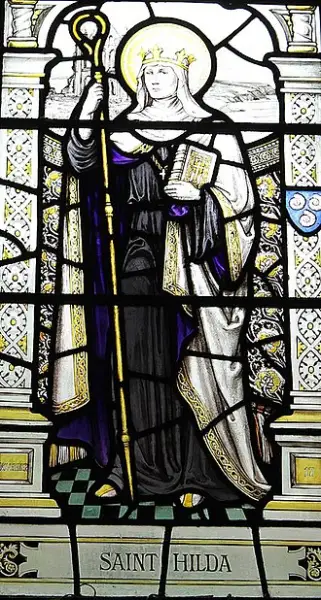
Overview
Hilda of Whitby, also called Hild, was a saint of the early Church in Britain who founded and first governed the monastery at Whitby — in its own day called Streoneshalh — the house selected to host the Synod of Whitby of 664. Her family belonged to the royal kindred of Deira: she was the second daughter of Hereric, a nephew of King Edwin, and at thirteen she shared in the baptism of Edwin's court in 627. After the fall of Edwin in 633 she accompanied Queen Æthelburh to Kent, and at the age of thirty-three she accepted Bishop Aidan of Lindisfarne's summons and went back to Northumbria to take up the religious life. After training on the River Wear and serving as the second abbess of Hartlepool, she became founding abbess of Whitby in 657 and led it until her death. Bede portrays her as a woman of great energy, a skilled administrator and teacher whose wisdom drew kings and princes to her counsel, and who recognized and nurtured the poetic gift of the cowherd Cædmon. Five men from her monastery became bishops. Afflicted by fever for her last seven years, she died on 17 November 680 at the age of sixty-six.
The Complete Life
A Princess of Deira
Bede places Hilda's birth in 614 within the royal kindred of Deira: Hereric, a nephew of Edwin, King of Deira, had married Breguswīþ; of that union Hilda was the second daughter. Her first years were shadowed by violence and banishment, for while she was still a baby her father died of poison at the court of the Brittonic ruler of Elmet, in the region that is now West Yorkshire. In 616 Edwin, fighting beside Rædwald of East Anglia, overcame Æthelfrith, the son of Æthelric of Bernicia, in battle, joined the two realms as the Kingdom of Northumbria, and claimed its throne; the orphaned Hilda grew up in his household. Twelve years on, the widowed king took as his bride Æthelburh, the Christian princess of Kent, and the marriage treaty let her keep her Roman Christian worship, so that she came north with her chaplain Paulinus of York, a monk of the Gregorian mission dispatched to England in 601. On Easter Day of 627, 12 April, Edwin received baptism together with his whole court — the thirteen-year-old Hilda among them — inside a small wooden church thrown up for the occasion beside what is now York Minster. When pagan Mercia crushed Northumbria in 633 and Edwin was slain in battle, Paulinus escorted Hilda and the queen to Kent, where Æthelburh founded a convent at Lyminge; Hilda is presumed to have stayed on there with the queen-abbess.
§ Early life
The Call of Bishop Aidan
Hilda's family circle inclined steadily toward the religious life: her elder sister Hereswith married Ethelric, brother of King Anna of East Anglia, and later became a nun at Chelles Abbey in Gaul. Bede picks up Hilda's story at the moment she was preparing to join her widowed sister at Chelles. At the age of thirty-three she made a different decision, choosing instead to answer the call of Bishop Aidan of Lindisfarne and returning to Northumbria to live as a nun. Her first convent can be placed only on the north bank of the River Wear; there, in the company of a small band of fellow religious, she absorbed the Celtic monastic tradition which Aidan had carried over from Iona. After a year of formation, Aidan appointed her the second abbess of Hartlepool Abbey, an office of real responsibility in the rising church of Northumbria. No trace of that abbey survives above ground, though its monastic cemetery has been discovered near the present St Hilda's Church at Hartlepool. The path from princess in exile to abbess of a Celtic-style house had prepared her for the larger work of foundation that awaited her on the Yorkshire coast.
§ Abbess
Founding and Governing Whitby
The year 657 saw her establish the monastery of Streoneshalh — Whitby Abbey as it later became — and she presided over it as first abbess until she died. Archaeological evidence shows that her monastery followed the Celtic style, its members living in small houses of two or three people each; as was customary in double monasteries like Hartlepool and Whitby, the sexes dwelt apart yet shared their worship in a single church. Bede records that the original ideals of monasticism were strictly maintained in her abbey: possessions were shared in common, the Christian virtues — peace and charity above all — were deliberately cultivated, and the study of Scripture together with good works was required of every member. The monastery proved a nursery of bishops, five of its men rising to the episcopate, among them John of Beverley, Bishop of Hexham, and Wilfrid, Bishop of York, both later canonized. Hilda herself governed as a woman of great energy, a skilled administrator and teacher who as a landowner employed many to care for sheep, cattle, farms, and woodland. Her reputation for wisdom grew so great that kings and princes sought her counsel, and Oswiu of Northumbria picked her own house for his kingdom's first church council, the synod of 664, where most of those present, Hilda included, accepted the Roman method of calculating Easter; the monks of Lindisfarne who refused withdrew to Iona and later to Ireland.
§ Synod of Whitby
Mother of Her People
The spirituality of Hilda's abbey joined strict communal discipline to an attentive charity toward individuals. The rule of common property and the obligation of Bible study and good works shaped the community's daily life, while peace and charity were singled out by Bede as the virtues especially exercised there. Her concern extended to the humblest members of the household: Cædmon, a herdsman of the community, received in a dream the power of versifying God's praise, and Hilda perceived the gift and set about fostering it, an act of patronage that has made her forever a patron of sacred poetry. Bede describes her as a woman of great energy whose devotion matched her administrative skill, and he preserves the judgment of her contemporaries: her contemporaries, Bede tells us, gave her the title of mother on account of her surpassing devotion and grace. The description gathers up the whole character of her rule, maternal rather than merely disciplinary, learned rather than merely pious, open to kings at the gate and to herdsmen in the fields alike. In her the Celtic tradition learned from Aidan and the Roman order accepted at the synod were held together in one wise and generous government.
§ Character
Fever, Hackness, and Death
The last seven years of Hilda's life were spent in the endurance of fever, but illness did not suspend her work, and she continued to govern until her death. In her final year she undertook one last foundation, setting up another monastery at Hackness, fourteen miles from Whitby. Her death came on 17 November 680, in her sixty-seventh year, an age then reckoned very great, and only after she had received the viaticum, the final communion of the dying. Her legend keeps the report that the Hackness community's bells sounded of their own accord at the instant of her passing, and that one of the sisters there, Begu, reported a vision of Hilda's soul carried up to heaven by angels. The story belongs to the oldest stratum of her cult and shows how quickly the abbess of Whitby was regarded as a saint whose passing heaven and earth had alike acknowledged. She was succeeded at Whitby by Eanflæd, the widow of King Oswiu, and by Eanflæd's daughter Ælfflæd, who carried on the double monastery she had founded and governed for more than two decades.
§ Illness and death
From Bede's History to the Calendars
Hilda's canonization belongs to the age before formal processes; her sanctity was ratified by the devotion of the church that mourned her. That Hilda was honored very early is shown by her entry in Saint Willibrord's calendar, a document penned early in the eighth century, while memory of her was still living. The primary source of all knowledge about her is the Ecclesiastical History of the English People, completed by Bede in 731, its author having been born approximately eight years before she died. One tradition traces a removal of her remains to Glastonbury under King Edmund, and a second attributes their transfer to Gloucester to the same sainted ruler; either way, the translations witness to how far the northern abbess's fame had reached. Her feast is kept on 17 November in the Roman Catholic Church and the Eastern Orthodox Church, on 18 November in some parts of the Anglican Communion as a Lesser Festival, on 19 November in the Church of England, and on 23 June in the Anglican Use and in the calendar approved for formerly Anglican Personal Ordinariate and Pastoral Provision parishes, where she shares the day with Saint Etheldreda and Saint Mildred. She is venerated in the Anglican Communion, the Roman Catholic Church, and the Eastern Orthodox Church.
§ Veneration
Snakestones, Schools, and Sacred Song
Hilda's afterlife in English memory is unusually rich. Local legend says that seabirds flying over the abbey dip their wings in her honor, and another tale tells of a plague of snakes she turned to stone, explaining the ammonite fossils of the Whitby shore; artisans carved snakes' heads onto the fossils and sold them as relics, and the ammonite genus Hildoceras bears her name. Her coiled-snake emblem appears on the arms of the town of Whitby, of St Hilda's College, Oxford, and of Durham's College of St Hild and St Bede, and she counts among the patrons of learning and culture — poetry included — thanks to her encouragement of Cædmon. Whitby Abbey itself was destroyed by Danish invaders in 867, re-founded after the Norman conquest by monks from Evesham as a Benedictine house, and dissolved by Henry VIII in 1539; its wraith is said to haunt the ruins, its bells to ring beneath the sea. Churches from Whitby to South Shields, Leeds, Manchester, Newcastle, Crofton Park, and Bilsborrow are dedicated to her, and an Orthodox church was due to open in Halifax in 2025. The Order of the Holy Paraclete was founded at Whitby in 1915, the Community of St Aidan and St Hilda on Lindisfarne, and St Hilda's House in New Haven carries her name in America. Schools and colleges across the world, from Oxford, Durham, and Melbourne to Toronto, Dunedin, Jamaica, Buenos Aires, and Australia, claim her as patron, and she figures as a main character in novels by Peter Tremayne, Melvyn Bragg, Nicola Griffith, and Vibeke Vasbo.
§ Legacy
Timeline
- 614
Born of the Deiran royal line, the second daughter of Hereric and Breguswīþ.
§ Early life
- 616
Edwin, fighting alongside Rædwald of East Anglia, defeated Æthelfrith and created the Kingdom of Northumbria; Hilda was brought up at his court.
§ Early life
- 12 Apr 627
Baptized on Easter Day with King Edwin and his entire court, in a wooden church near the site of the present York Minster.
§ Early life
- 633
After Edwin fell in battle against the pagan King of Mercia, accompanied Queen Æthelburh to Kent, where the queen founded a convent at Lyminge.
§ Early life
- 657
Established the monastery of Streoneshalh (later Whitby Abbey) as its first abbess, and served there until her death.
§ Abbess
- 664
King Oswiu chose her monastery as the venue for the Synod of Whitby, which adopted the Roman method of calculating Easter.
§ Synod of Whitby
- 680
In her last year she founded another monastery at Hackness, fourteen miles from Whitby.
§ Illness and death
- 17 Nov 680
Died at Whitby Abbey on 17 November at the age of sixty-six, after receiving viaticum.
§ Illness and death
- 867
Whitby Abbey, where she had been abbess, was destroyed by Danish invaders.
§ Legacy
- 1066
After the Norman conquest, monks from Evesham re-founded Whitby Abbey as a Benedictine house for men.
§ Legacy
- 1539
Whitby Abbey was dissolved by Henry VIII in the Dissolution of the Monasteries.
§ Legacy
- 1915
The Order of the Holy Paraclete, a community of Anglican sisters, was founded at St Hilda's Priory on the western edge of Whitby.
§ Religious communities
In Their Own Words
All who knew her called her mother because of her outstanding devotion and grace
The Record
- Major works
- Monastery of Streoneshalh (Whitby Abbey)·Monastery of Hackness
- Patron of
- learning and culture·poetry·National Cathedral School for Girls, Washington, D.C.
- Symbols
- coiled snake (ammonite)·crozier of an abbess·model of Whitby Abbey
- Canonization
- Pre-congregation; her veneration from an early period is attested by her inclusion in the calendar of Saint Willibrord, written at the beginning of the 8th century.
Prayer
Bibliography
Show 11 sources
- Kiefer, James E. (1999). "Hilda of Whitby, Abbess and Peacemaker | 18 November 680". Biographical sketches of memorable Christians of the past. The Society of Archbishop Justus
- "St. Hilda". Saint Wilfrid Church, Bognor Regis, archived from the original on 16 July 2011
- Lindemann, Kate (12 December 2014). "Hilda of Whitby / Hild of Streonshalh | 614-680 | Educator of Women". Society for the Study of Women Philosophers, Inc., retrieved 11 July 2026
- Thurston, Herbert (1910). "St. Hilda". In Herbermann, Charles (ed.). Catholic Encyclopedia. Vol. 7. New York: Robert Appleton Company
- "St Hilda". The Order of the Holy Paraclete, archived from the original on 23 June 2014
- Colgrave, Bertram (1985). Earliest Life of Gregory the Great. Cambridge University Press. p. 9. ISBN 978-0521309240
- Lovett, Edward (19 April 1905). "The Whitby Snake-Ammonite Myth". Folk-Lore. 16 (3). The Folk-Lore Society: 333–334. doi:10.1080/0015587X.1905.9719966 – via Wikisource
- "The Calendar". The Church of England, retrieved 11 July 2026
- Barker, Rosalin (2001). Smith, Anita C. (ed.). The Whitby Sisters: A Chronicle of the Order of the Holy Paraclete 1915-2000. Order of the Holy Paraclete. ISBN 978-0954061708
- Bragg, Melvyn (1996). Credo: Epic Tale of the Dark Ages. Sceptre. ISBN 978-0340667057
- Vasbo, Vibeke (2018). The Song of Hild. Translated by Kynoch, Gaye. Sacristy Press. ISBN 978-1910519097
Profile text adapted from the Wikipedia article, licensed CC BY-SA 4.0.
Pray with this saint every day
Save St. Hilda of Whitby to your favorites, read the full profile, and get feast-day reminders in the Saints app.
Get the Saints AppFree on the App Store for iPhone and iPad