
1098-1179·Feast September 17
St. Hildegard of Bingen
Abbess, Doctor of the Church
Overview
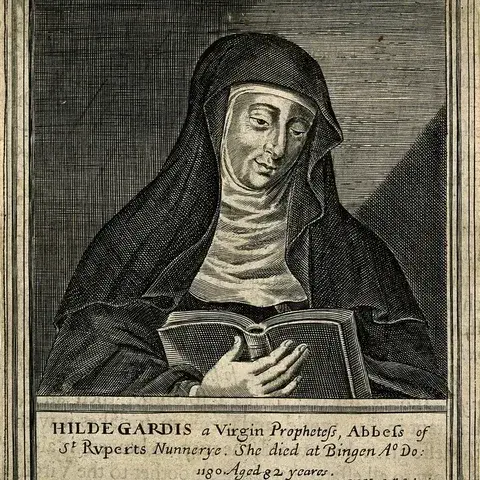
Hildegard was born around 1098 at Bermersheim into the free lower nobility, and while still a small child was given as an oblate to the Benedictine house at Disibodenberg, where she was enclosed together with the young noblewoman Jutta, who taught her to read and write. Visions had visited her since early childhood, what she called the Shade of the Living Light, and in 1141, aged about forty-two, she received an inner command to write down what she saw and heard; her hesitation brought illness until she obeyed, and at the synod of Trier in 1147-48 Pope Eugenius sanctioned her writing as revelation. Elected magistra after Jutta's death in 1136, she fought for and won independence for her nuns, moving some twenty of them to the new monastery of Rupertsberg near Bingen in 1150 and founding a second house at Eibingen in 1165. From there she corresponded with popes, emperors, abbots and abbesses — nearly four hundred letters survive — preached on journeys, composed seventy-plus liturgical songs and the morality play Ordo Virtutum, wrote on natural history and medicine in Physica and Causae et Curae, even devised a constructed language, the lingua ignota. She died on 17 September 1179, and Benedict XVI, calling her an authentic teacher of theology and scholar of nature and music, named her a Doctor of the Church.
The Complete Life
Early Life
Hildegard was born around 1098 at Bermersheim in the Rhineland, the tenth child of a family of the free lower nobility, and offered as a child oblate to the Benedictine monastery of Disibodenberg — a common arrangement for daughters the family could not or did not wish to dower, and in her case the entry into everything she became. With her was enclosed Jutta of Sponheim, a young noblewoman who became her teacher and, for thirty years, the head of the small women's community attached to the monks' house; from Jutta, in Hildegard's spare account, she learned to read and write Latin and to sing the psalmody. From early childhood — from her third year, by her own account — she had experienced what she called the Shade of the Living Light: perceptions she did not lose consciousness to receive, and which she had never described to anyone. She was about fifteen when the door of the enclosure closed, and thirty-eight when it mattered.
§ Visions
Conversion and Vocation
The turn of Hildegard's life came in 1141, when she was about forty-two: a voice she identified as the Living Light commanded her to say and write what she saw and heard. She hesitated — and fell ill, a pattern that repeated throughout her life when she delayed obedience — until she began the work that became Scivias, 'Know the Ways,' the first of her three great visionary books. Her hesitation, the illness, the obedience, and then the astonishing productivity became the template of her authority. In 1147-48 Pope Eugenius III, at the synod of Trier — on the recommendation, tradition says, of Bernard of Clairvaux — sanctioned her writing as revelation, an endorsement that transformed a prioress of a obscure double monastery into a prophet addressed by prelates and princes. Meanwhile she had been elected magistra of the community on Jutta's death in 1136, and had begun the fight that would define her as an administrator: to take her nuns out of the monks' shadow.
§ Visions
Mission and Ministry
Hildegard won her nuns' independence, and moved some twenty of them in 1150 to Rupertsberg, a new monastery on the Rhine near Bingen, against the opposition of the Disibodenberg monks — she reportedly lay in illness until the move was agreed. Fifteen years later she founded a second house across the river at Eibingen, which she visited by boat twice a week and which survives as the community of St. Hildegard today. From Rupertsberg she ran an administration, a building program, and a correspondence of vast range: nearly four hundred letters survive, to popes (Eugenius, Anastasius, Adrian, Alexander), to Emperor Frederick Barbarossa (whom she rebuked), to bishops, abbots, abbesses, and ordinary petitioners seeking counsel. She made four preaching journeys through the Rhineland — a woman preaching publicly in the 1160s, in monasteries and cities, with clerical license — denouncing corruption and calling for reform a generation before it broke out as revolution.
§ External links
Spirituality and Teaching
Hildegard's teaching is a complete cosmology. Her three visionary books — Scivias, the Book of Life's Merits, and the Book of Divine Works — set out a theology of viriditas, the greenness of God's vitality running through creation, expressed in images of fire, wings, and living light that she also caused to be painted, and that make her manuscripts among the strangest and most beautiful of the century. Alongside them she wrote works of natural science and medicine, Physica and Causae et Curae, cataloging the properties of plants, animals, stones, and the human body with the authority of experience; she composed more than seventy liturgical songs and the morality play Ordo Virtutum, the earliest morality play by far, whose singing virtues and howling devil give her theology a stage; and she even devised a constructed language, the lingua ignota, with its own alphabet. Modern medicine, musicology, and feminism have each claimed her, and each claim rests on real work.
§ References
Final Years
Hildegard's last great battle was characteristic: she had allowed a young man who had been excommunicated — and who had reconciled to the Church before his death — to be buried in her cemetery, and when the interdict was imposed in consequence, she defied it, appealing over the local clergy until it was lifted months before her death. She died at Rupertsberg on 17 September 1179, in her eighty-second year, having been abbess, author, composer, physician, correspondent of emperors, and, by the testimony of her community, faithful to the end in the visions she had never once described for her own glory. Her feast is kept on 17 September, the day of her death, and the liturgy of that day in the German church reads her own account of the Living Light.
§ References
Canonization
Hildegard's canonization is one of the longest-running processes in Church history. It was begun under several popes within decades of her death and never formally concluded in the Middle Ages; her cult was confirmed by Pope John XXII in 1326, an equivalent canonization for her own houses, and extended to the universal Church by Benedict XIV. In 1940 Pius XII proclaimed her a Doctor of the Church in outline and ordered her works re-edited; on 10 May 2012 Benedict XVI extended her liturgical cult to the universal Church — the equivalent of canonization — and on 7 October 2012 declared her a Doctor of the Church, the fourth woman so named, calling her an authentic teacher of theology and a scholar of nature and music.
§ Introduction
Legacy
Hildegard's modern reception has been extraordinary: her music is recorded and performed worldwide, her medicine studied, her paintings reproduced, and her personality — imperious, scientific, visionary, administrative — the subject of a literature no twelfth-century woman received before the late twentieth century. Her own houses' successor at Eibingen keeps her cult alive on the Rhine, and her relics are venerated there. For the Church she stands as the proof that the visionary and the practical are not opposites: the woman who saw the living light also moved twenty nuns up a river, founded a second abbey, and dictated four hundred letters, and saw no contradiction anywhere in the list.
§ Introduction
Timeline
- 1098
Born at Bermersheim vor der Höhe; from early childhood she experienced visions.
§ Introduction
- 1 Nov 1112
Her vows were received by Bishop Otto of Bamberg on All Saints' Day as she joined the enclosed community under Jutta von Sponheim at Disibodenberg.
§ Monastic life
- 1136
After Jutta's death, her fellow nuns chose her by acclamation as magistra of the community.
§ Monastic life
- 1141
At age forty-two she received a vision she took as God's command to write down what she saw and heard.
§ Visions
- 1142
Began composing Scivias, her first major visionary work, which she would finish ten years later.
§ Visionary theology
- Nov 1147
Pope Eugenius III heard of her writings at the Synod of Trier, which sat between November 1147 and February 1148.
§ Visions
- 1148
A papal commission judged her visions authentic, portions of Scivias were read to Pope Eugenius III, and he sent her a letter of blessing.
§ Scivias
- 1150
Moved with about twenty nuns from Disibodenberg to found the monastery of Rupertsberg near Bingen, with Volmar as provost.
§ Monastic life
- 1151
Completed Scivias; when Richardis von Stade was elected abbess elsewhere, she wrote prelates pleading to keep her friend.
§ Friendship with Richardis von Stade
- 1151
Scholars date the morality play Ordo Virtutum, the earliest surviving musical drama independent of the liturgy, as early as this year.
§ Hildegard's music
- 1158
Began her second volume of visionary theology, Liber Vitae Meritorum, a drama of virtues confronting vices, finishing it in 1163.
§ Liber Vitae Meritorum
- 1160
Preached publicly in Germany and conducted four preaching tours, mainly denouncing clerical corruption and urging reform.
§ Hildegard's preaching tours
- 1163
Received an extraordinary mystical vision and began Liber Divinorum Operum, her last great work, completed around 1172 or 1174.
§ Liber Divinorum Operum
- 1165
Established a second convent at Eibingen for nuns drawn from her Disibodenberg community.
§ Monastic life
- 1173
Her secretary Volmar died; her devoted correspondent Guibert of Gembloux succeeded him.
§ Hildegard's preaching tours
- 17 Sep 1179
Died; her sisters said two streams of light crossed the skies above the room where she lay dying.
§ Visions
- 26 Aug 1326
Pope John XXII formally confirmed her cult, leaving her at the level of beatification after four unfinished canonization attempts.
§ Veneration
- 10 May 2012
Pope Benedict XVI extended her liturgical cult to the whole Catholic Church through equivalent canonization.
§ Veneration
- 7 Oct 2012
Named a Doctor of the Church by Pope Benedict XVI on the feast of the Holy Rosary.
§ Veneration
In Their Own Words
The light which I see thus is not spatial, but it is far, far brighter than a cloud which carries the sun... and I call it "the reflection of the living Light."
Cry out, therefore, and write thus!
Father, I am greatly disturbed by a vision which has appeared to me through divine revelation, a vision seen not with my fleshly eyes but only in my spirit.
Angels, living light most glorious! Beneath the Godhead in burning desire in the darkness and mystery of creation you look on the eye of your God never taking your fill: What glorious pleasures take shape within you!
The Record
- Major works
- Scivias (Know the Ways)·Liber Vitae Meritorum (Book of Life's Merits)·Liber Divinorum Operum (Book of Divine Works)·Ordo Virtutum (Play of the Virtues)·Symphonia armoniae celestium revelationum (collected songs)·Physica·Causae et Curae·Lingua Ignota (constructed language)
- Patron of
- Natural scientists and natural history (honored as a founder of the discipline in Germany)·Musicians and composers
- Symbols
- Receiving a vision and dictating to the monk Volmar·Flame or light descending (the Living Light)
- Canonization
- Cult confirmed by Pope John XXII in 1326; extended to the universal Church by Pope Benedict XVI on 10 May 2012 (equivalent canonization); declared Doctor of the Church on 7 October 2012
Prayer
Bibliography
Show 3 sources
- ↑ In this medieval name, the personal name is Hildegard and Bingen is an appellation or descriptor. There is no family name.
- ↑ Some writers have speculated a distant origin for opera in this piece, though without any evidence. See: ; alt Opera, [ clarification needed ] see Florentine Camerata in the province of Milan, Italy. [ 8 ] [ 9 ]
- ↑ Though John the Evangelist is traditionally considered the author of the Gospel of John , modern scholarship considers that the gospel is anonymously authored.
Profile text adapted from the Wikipedia article, licensed CC BY-SA 4.0.
Pray with this saint every day
Save St. Hildegard of Bingen to your favorites, read the full profile, and get feast-day reminders in the Saints app.
Get the Saints AppFree on the App Store for iPhone and iPad